The app development of an App like Fansly or something similar is not solely dependent on technology, but it is more about creating a digital world where the connection between people is the main factor. The artist’s platform’s success is based on the extent of their ability to provide the realest interactions that both the artist and the audience feel really involved in. To attract your audience means to go from just letting them consume the content in a passive way to actually making them take part in the activity. Every swipe, tap, and comment is a way through which not only community is formed but also trust is created.
In the upcoming years, the platforms that will win in the artist-owned space will be those that catch that every profile masks someone who longs for a connection, acknowledgment, and worth. If you combine a friendly user interface, an individualized user experience powered by AI, and cutting-edge interactive content, you are not merely creating an application but a whole neighborhood in the digital world that is full of life and where creators and fans are sharing the same joys and concerns.
This technology-centered approach, humanizing the technology such that it feels personal, unlocks the door to each user and responds to their need, and will be the cornerstone of each and every App like Fansly that survives and thrives in the modern world. It is what separates a app that users access from time to time from a daily-use platform.
What is Fansly and How Does It Work?
Fansly is a subscription service that offers a way for creators to monetize their fans by posting photos, videos, and live streams for their fans and having private chats. The platform also includes features such as membership levels, pay-per-view content, tips, and ways to monetize live streaming. By giving the creators the power to set their own prices and the control of who can access their content, Fansly promotes the direct engagement of the users and the safe transactions, which consequently leads to its being a favored platform among various creators who are looking for online income that is sustainable in the long run.
- Multiple subscription tiers offering flexible pricing
- Pay-per-view content unlocking
- Direct messaging with optional paid chats
- Tipping and donation functionalities
- Live streaming with monetization
- Media locking and customizable content previews
- Competitive 20% platform commission, letting creators keep ~80% of earnings
- Strong privacy, content control, and discoverability tools
Read Also: Benefits of White Label Apps for Startups and Entrepreneurs
Step-by-Step Process to Build an App Like Fansly
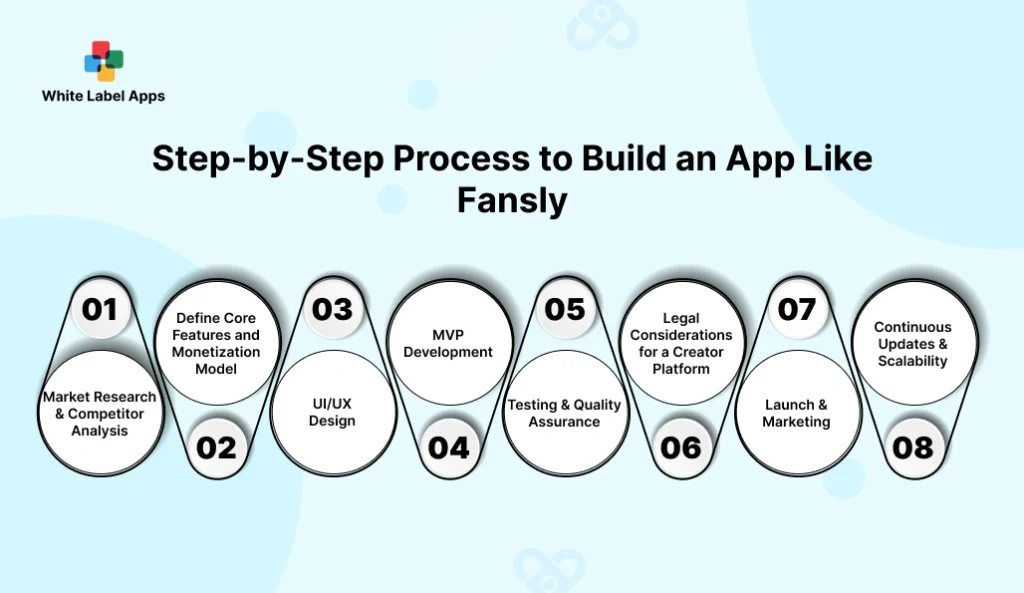
It’s crucial to have a proper plan for every step of the project if you are working to develop a Fansly-like app that will be viable throughout the entirety of developing the app. The detailed plans for every step are below:
Step 1: Market Research & Competitor Analysis
Getting a grasp of your market context opens the door to creating a competitive platform. In this stage, there will be a thorough examination of customers’ requirements, the aspects in the market that are not covered, and the positioning of existing competitors.
Key Activities:
- Identify your audience: Define writer demographics (fitness teachers, artists, instructors, adult content creators) and customer personas
- Analyze competing structures: Study present structures to apprehend their strengths, weaknesses, pricing fashions and person lawsuits
- Conduct person research: Interview capacity creators and customers to find troubles with existing platforms
- Research marketplace traits: Stay knowledgeable approximately developments in the manufacturer financial system, regulatory changes and new revenue generation models
- Study Regional Regulations: Understand the legal necessities for content material structures in your target markets
- Define your particular cost proposition: Decide how your app will be one of a kind (lower prices, better visibility, unique recognition)
- Assess monetization viability: Verify that your commercial enterprise version can maintain operations and growth
Step 2: Define Core Features and Monetization Model
Sustainably reward creators and subscribers alike with features developed for their benefit.
Creator Features:
- User registration with email/social login and verification
- Customizable creator profiles with bio, media and branding options
- Possibilities for uploading content (images, videos, audio, text entries)
- Multi-layer subscription management with flexible pricing
- Content planning and calendar planning tools
- Analytics dashboard showing earnings, customer growth, engagement metrics
- Payment management and earnings history
Subscriber Features:
- Easy registration and profile setup
- Content discovery through search, categories, and recommendations
- Subscription management and renewal controls
- Interactive features (likes, comments, shares)
- Notification system for new content and creator updates
- Favorites and bookmarking functionality
Monetization Options:
- Platform commission: Typically 15-25% of creator earnings
- Subscription levels: Free, Standard and Premium access levels
- Pay-Per-View Content: Unlock individual posts or media
- Tipping System: Direct donations from fans to creators
- Paid Direct Messages: Premium messaging fees
- Live Streaming Revenue: Virtual gifts and tips during streams
- Referral Programs: Incentives for bringing new users
Step 3: UI/UX Design
Design determines whether users stay engaged or abandon your platform. Focus on creating intuitive, attractive, and accessible interfaces.
Design Priorities:
- Mobile-first strategy: Making smartphone the primary point of entry and optimizing involved interactions
- Responsive design: Ensure a consistent experience across all devices and screen sizes
- Intuitive navigation: menus that the audience can understand, search feature and content distribution
- Visual hierarchy: direct users’ attention to the most important action (subscribe, tip, message)
- Accessibility standards: Compliance with WCAG including support for accessibility for a screen reader, color contrast and navigation via keyboard
- User experiences: Different experience for creators with a dashboard oriented to the subscribers that focuses on content
- Brand consistency: Uniform color scheme, typography, and visuals throughout
- Prototype testing: Develop wireframes and clickable prototypes for user feedback prior to development.
Step 4: MVP Development
Build a Minimum Viable Product with core features to validate your concept and gather real user feedback quickly.
Technology Stack Recommendations:
| Component | Recommended Technologies | Purpose |
| Frontend | React, Next.js, Vue.js | User interface and client-side logic |
| Backend | Node.js, Python (Django/Flask) | Server-side processing and API |
| Database | MongoDB, PostgreSQL | Data storage and management |
| Payment Gateway | Stripe, PayPal, Square | Subscription and transaction processing |
| Cloud Hosting | AWS, Google Cloud, Azure | Scalable infrastructure |
| CDN | Cloudflare, Amazon CloudFront | Fast content delivery globally |
| Security | SSL/TLS, OAuth 2.0, JWT | Authentication and data protection |
| Video Streaming | AWS Media Services, Mux | Live and on-demand video delivery |
MVP Feature Checklist:
- User registration and authentication
- Basic creator and subscriber profiles
- Content upload and display (images, videos)
- Single subscription tier functionality
- Payment processing integration
- Basic messaging system
- Simple content feed
- Essential security measures
Step 5: Testing & Quality Assurance
Rigorous testing ensures your platform is reliable, secure, and ready for users.
Testing Types:
- Functional Testing: The examination should confirm that the end users can carry out all major functions and operations encompassing payments, uploads, subscriptions, messaging, etc.
- Security Testing: Perform penetration testing, execute vulnerability scans, and check data is encrypted.
- Performance Testing: Simulate load through multiple users and stress test for heavy traffic scenarios as required.
- Compatibility testing: Test your web app in various browsers (Chrome, Safari, Firefox and Edge) and on different types of devices.
- User Acceptance Testing (UAT): Evaluating real-world applications of both the user and the customer;
- Payment Testing: confirming subscriptions and refund requests and payments process properly;
- Testing for content delivery: ensuring the video renders and that images load in a reasonable time;
- Testing for the mobile app: test the functionality of your app against App Store guidelines on both the iOS and Android devices.
Step 6: Legal Considerations for a Creator Platform
Compliance protects your business and users from legal risks.
Essential Legal Requirements:
- Corporate registration: Identify the appropriate entity type (LLC or Corporation) and submit the documentation to the appropriate governing body
- Terms of use: Detailed description to stop normal user actions, and protect content and IP
- Privacy notice: Indicating compliance with GDPR, CCPA and relevant local law
- Age verification: Have strict measures to block children from viewing adult content
- Content moderation: Filters with machine learning tools and human moderation
- Copyright protection: Ability to comply with the DMCA and receive requests for copyright removal from the account
- Payment compliance: Compliance with PCI DSS requirements to process payment information
- Tax issues: Correctly issue 1099s for the individual artists, international tax issues
- Liability protection: Have clear disclaimers about the platform’s liability in disputes
- Anti-money laundering: employ KYC checks for artists
Step 7: Launch & Marketing
Strategic launch and marketing drive initial adoption and long-term growth.
Pre-Launch Activities:
- Build anticipation with landing page and email collection
- Create social media presence across relevant platforms
- Create outreach initiatives aimed at creators to bring in the first users.
- Draft press releases and kits for the media.
- Finish your App Store listing by adding optimized visuals along with descriptions that are informative and engaging.
Launch Strategy:
- Soft launch: final testing during limited audience release
- Creator incentives: Lower commissions and spotlight for first users
- Referral Program: Creator and customer bonuses for inviting friends
- Influential Partnerships: Work with recognized creators of trust
- Content Marketing: Development and writing of guides and stories
- Promoted Ads: Specific campaigns utilizing social media and search engine promotion
- Community Building: Creator Support Group, discord, forums
- Public Relations outreach: Technical blog, trade magazine, podcasts
Step 8: Continuous Updates & Scalability
Post-launch success is continuous improvement and scaling the infrastructure.
Ongoing Operations:
- Analytics Monitoring: There is a constant evaluation of metrics, which include user acquisition, retention, revenue, and engagement.
- Feature Updates: There is a constant delivery of new features that are in line with client feedback and industry standards.
- Infrastructure: Server infrastructure has been built, which can handle big increases in traffic through auto-scaling, CDN and database improvements.
- Security: There are constant updates of security features, tests for vulnerabilities, and audits for compliance.
- Customer Support: Highly responsive help desk, detailed FAQ, and live chat available to high-tier users.
- Community: Creator-led webinars, user survey panels, and feedback panels
- Market: Multilingual application or support for multiple languages and regional payment options
- Performance: Improvement in load speed and stream quality
- A/B Testing: Experiment for UI updates, pricing models, and even moving features around
Scalability Checklist:
- Implement cloud infrastructure that possesses auto-scaling capabilities
- Enhance query performance and indexing in the databases
- Adopt a caching approach (Redis, Memcached)
- Set up load balancing for even distribution of traffic
- Keep track of server health and uptime
- Establish a data backup plan and disaster recovery
- Prepare for user growth in scenarios of 10x increase
Also Read: Affordable White Label App Development for Startups
Key Features of an App Like Fansly
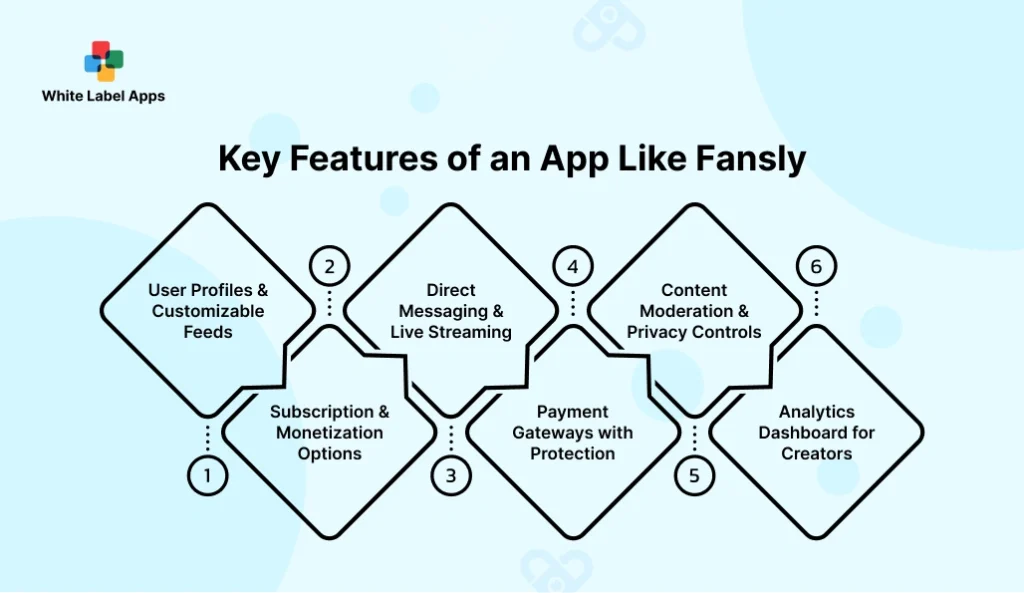
Fansly-like apps bring together main components that give power to creators to earn money through their content and connect with their audience in a hassle-free manner while providing a safe and easy-to-use platform.
1. User Profiles & Customizable Feeds
Creators need personalized profiles to showcase their brand and content effectively.
- Detailed bios and profile customization options
- Organize content into categories and collections
- Personalized feeds that enable users to tailor their view.
- Total flexibility in the modes of communication, such as photo, video, live stream, and text post, along with the total freedom of the content type.
Advantages: Better recognition of the creator’s brand, more enjoyment for the subscribers, and increased interaction.
2. Subscription & Monetization Options
Flexible and varied monetization channels are critical for revenue growth.
- Multi-tier subscription plans with different price points and access levels
- Pay-per-view content unlocking for exclusive posts
- Tipping and donations for additional income
- Paid direct messaging and live streaming features
Benefits: Creators get the chance to gain the highest profits and to attract different audiences with different spending habits at the same time.
3. Direct Messaging & Live Streaming
By allowing direct conversations, fans become more engaged with the brand.
- Direct messaging with the possibility of paid unlocks
- Live streaming in real-time along with chat and tipping interaction
- Alerts for new messages and streams to maintain users’ interest
Advantages: It establishes a community of creators and their fans; thereby, loyalty is enhanced and subscriber churn is decreased.
4. Payment Gateways with Protection
The platform’s reputation and user trust will be boosted by the increased payment processing securely and safely.
- Connection with reliable payment processors such as Stripe and PayPal
- Recurring billing and multi-currency transactions are supported
- Timely payouts for creators with transparent transaction histories
- Strong fraud detection and compliance with PCI DSS standards
Benefits: Ensures smooth, secure financial operations, enhancing both creator and subscriber trust.
5. Content Moderation & Privacy Controls
Maintaining a safe, compliant platform is essential for longevity.
- Automated content filtering combined with human review teams
- User reporting and flagging systems for inappropriate content
- Age verification systems, especially for adult content creators
- Privacy settings that let creators decide who can see their content
Advantages: The user’s security is maintained, the adherence to the regulations is assured, and the congenial ambiance of the platform is furthered.
6. Analytics Dashboard for Creators
Insights generated from data equip users with the power to sharpen their plan.
- Comprehensive analysis of the number of subscribers gained and lost.
- Earnings tracking with breakdown by revenue streams
- Content performance metrics (views, likes, comments)
- Audience demographics to tailor content
Benefits: It provides creators with the necessary input for their decisions; thus, their content effectiveness and income are increased.
Read Also: How to Launch a White Label Mobile App
Cost to Build an App Like Fansly
Knowing what an app like Fancyly will cost to develop is valuable for resource allocation, so you can proceed accordingly. The cost of similar apps heavily depends on functionality, member structure, as well as the technology, which must be ideal. If we look at cost estimates generally, an app similar to Fancy would range from $60,000 to $280,000, depending on the factors mentioned above. A minimum viable product (MVP) built with basic rudimentary features will be priced at less than $110,000. In contrast, a complete product with a live streaming function, subscription tiers, and complex analytics and backend capabilities could range somewhere between $156,000 and $280,000 or higher. It is also a best practice to budget at least 20-25% of the original cost of development for app maintenance each following year.
MVP Development Cost
An MVP includes core features to validate your concept and attract early users:
| Development Phase | Cost Range (USD) | Timeline |
| Planning & Research | $5,000 – $10,000 | 2-3 weeks |
| UI/UX Design | $8,000 – $15,000 | 3-4 weeks |
| Frontend Development | $15,000 – $25,000 | 6-8 weeks |
| Backend Development | $20,000 – $35,000 | 8-10 weeks |
| Payment Integration | $5,000 – $10,000 | 2-3 weeks |
| Basic Testing & QA | $5,000 – $10,000 | 2-3 weeks |
| Deployment | $2,000 – $5,000 | 1 week |
| Total MVP Cost | $60,000 – $110,000 | 4-6 months |
Full-Featured App Development Cost
A complete platform with advanced features and a polished user experience:
| Development Phase | Cost Range (USD) | Timeline |
| Comprehensive Planning | $10,000 – $20,000 | 4-5 weeks |
| Advanced UI/UX Design | $15,000 – $30,000 | 6-8 weeks |
| Frontend Development | $30,000 – $50,000 | 10-14 weeks |
| Backend Development | $40,000 – $70,000 | 12-16 weeks |
| Payment & Monetization | $10,000 – $20,000 | 4-5 weeks |
| Live Streaming Integration | $15,000 – $25,000 | 5-6 weeks |
| Analytics Dashboard | $8,000 – $15,000 | 3-4 weeks |
| Content Moderation Tools | $10,000 – $18,000 | 4-5 weeks |
| Comprehensive Testing | $15,000 – $25,000 | 5-6 weeks |
| App Store Deployment | $3,000 – $8,000 | 2 weeks |
| Total Full Version Cost | $156,000 – $281,000 | 9-15 months |
Factors Affecting the Total Cost (Tech Stack)
The specific technology stack you choose will greatly impact the overall cost of development, maintenance requirements, and future growth potential. Detailed description is given below:
1. Frontend Technology
In the process of developing an application similar to Fansly, the choice of the proper frontend technology is of prime importance since it will not only allow foran easy and scalable user interface but also manage the expenses.
- React.js is an approach that falls under the moderate-cost category {$25K-$40K}. By employing it, one benefits from many advantages, such as a large developer community, reusable components, and performance that is fast, but on the downside, it still requires additional libraries for certain functionalities.
- Next.js is an incremental cost increment choice {$30K-$45K} and at the same time, it is a wonderful option because of its SEO-friendly server-side rendering even though it takes a long time to learn.
- Vue.js is a very economical option {$20K-$35K} and moderately heavy, besides, it is very simple to learn but the ecosystem is small.
- React Native is a cross-platform mobile development technology ($40K-$60K) that comes with a performance drawback.
- iOS/Android native development is the most expensive in terms of performance {$80K-$120K} but it does not come without the drawbacks of requiring two codebases that are different thus adding complexity and cost..
2. Backend Technology
The selection of the backend will have consequences on the app’s scalability, real-time features, and security, respectively.
- Node.js ($30k-$50k) allows for the development of real-time functionalities that are scalable, but it has the drawback of being prone to one-thread limitations at times.
- Python (Django) ($28k-$48k) facilitates the development of secure applications very quickly, but it does not support real-time applications very well.
- PHP (Laravel) ($25k-$40k) is affordable and has a large pool of developers, but the downside is that it may not be able to keep up with a large number of users.
- Ruby on Rails ($32k-$52k) provides the advantage of quick development, but at the same time, it is also possible that it will face problems related to performance when the application is large.
3. Database Selection
Database technology affects data flexibility, storage, and scaling.
- MongoDB ($15k-$25k) is perfect for dynamic, image-heavy content, and it supports future growth very well.
- PostgreSQL ($18k-$28k) is the best option for handling complex queries and managing relational data.
- MySQL ($12k-$22k) is the most affordable option available to handle standard relational data needs.
- Firebase ($10k-$20k+) is a real-time data synchronization provider, but it becomes expensive to use if the company is at scale.
4. Cloud Infrastructure & Hosting
Cloud services provide scalable, reliable infrastructure.
- AWS: $500-$3,000+ per month, setup from $5,000 to $10,000, best for large corporations.
- Google Cloud: $400-$2,500+ monthly, setup $4k-$9k, powerhouse in AI/ML.
- Microsoft Azure: $450-$2,800+ per month, setup $4.5k-$9.5k, suitable for large businesses.
- DigitalOcean: $200-$1,000+ monthly, setup $2k-$5k, ideal for startups.
5. Third-Party Integrations
Enhance core functionality with reliable services.
- Stripe: Integration $3k-$6k, transaction fee 2.9% + $0.30, primary payment processor.
- PayPal: Integration $2.5k-$5k, ~3% transaction fee, popular alternative payment.
- AWS S3: Storage costs $1.5k-$3k upfront and usage costs.
- Twilio: $2k-$4k integration plus pay-per-use SMS alerts.
- SendGrid: $1.5k-$3k integration, monthly fee for email services $15-$100.
- Cloudflare CDN: $1k-$2.5k integration; $20-$200/month to deliver global content quickly.
Total Investment Summary
| App Version | Initial Development | First Year Total | Notes |
| MVP | $60,000-110,000 | $85,000-160,000 | Basic features, single platform |
| Mid-Range | $120,000-180,000 | $160,000-240,000 | Web + mobile, core features |
| Full-Featured | $180,000-300,000+ | $240,000-400,000+ | Complete platform, all features |
Summary: An application similar to Fansly can cost a lot; however, an MVP can be used to test the concept, receive user feedback, and even raise money for the app before a large investment is made in total app development. The choice of technology will have to be based on the budget, the requirements of the project in terms of speed and capacity for handling increased load, and the availability of skilled developers.
Also Read: How White Label App Development Can Help Your Business Grow
Monetization Strategies for a Fansly-Like Platform
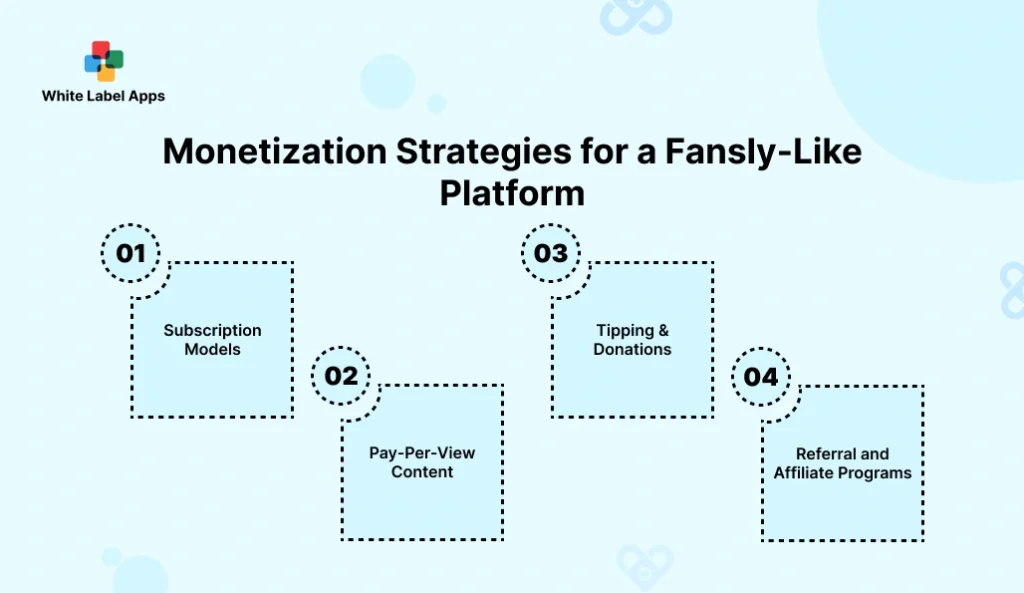
In the case of creating a platform for the creator, the always-present money aspect has the connotation of multi-channel revenue streams, which bring profits to creatives, followers, and the platform at the same time.
1. Subscription Models
The content creators provide subscription packages with multiple tiers, starting from free previews to access to premium content. Recurring monthly subscriptions become a reliable source of income and, at the same time, serve the different financial capacities of the fans.
2. Pay-Per-View Content
Content creators can gate certain images, videos, or messages for one-time payments, allowing fans to have an option to pay for exclusive content if they wish.
3. Tipping & Donations
The different types of subscriptions given by the creators start with free previews and end up with the premium content. Monthly subscriptions that are done regularly give a backbone of continuous income while satisfying fans with different budgets.
4. Referral and Affiliate Programs
Moreover, by rewarding innovators as well as viewers subscribing the new viewers on their own, the company can surely fuel organic growth through the provision of bonuses and discounts or through sharing some of the generated revenues.
Conclusion
This year is a good time to make an app like Fansly, since it will allow one to tap into the creator economy, which is becoming more and more popular and is quickly changing as well. The whole process will need a lot of things like ultimate market research, advanced feature planning, human-centered design, quality development, compliance with law, and good marketing. A platform that is completely in place will give creators ways to earn money through subscriptions with different levels, pay-per-view content, tipping, and referral programs, making it possible for them to create digital companies that last. Through these unique, secure and interactive channels, subscribers can access the content and features meant only for them. The main factors contributing to success will be continuous update, scalability, and strong community support. If properly executed, your Fansly app can be a winner in this ever-changing market.
FAQ’s
1. How much does it cost to build an app like Fansly?
The budget for a Fansly-like app is approximately between $60,000 and $280,000, influenced by the features and the sophistication of the app. A minimum viable product (MVP) that demonstrates the app’s core features might be in the price range of $60K-$110K. An app loaded with all the functionalities, including Live Streaming, Advanced Analytics, and Multi-tier Subscription, can be priced at about $156K to $280K+. On average, maintenance costs are 20% to 25% of the overall project cost which is incurred annually.
2. Which tech stack is best for a Fansly-like app?
The proposed technology stacks make use of either React or Next.js for the client side together with either Node.js or Python for the server side. As for the data storage, MongoDB or PostgreSQL are the recommendations. In addition, it is advocated to opt for either AWS or Google Cloud for the hosting and integrating payment processors like Stripe and PayPal while using CDN services, for instance, Cloudflare, to ensure fast content delivery. Also, React Native can be an option in case the mobile applications are to be developed to support cross-platform.
3. How can you ensure content privacy and moderation?
Use of end-to-end encryption, GDPR and CCPA compliance, and personal privacy settings should be included in the overall plan. AI-powered content moderation will be done in collaboration with human moderators. User reporting tools and thorough age verification for adult content will be made available. DMCA takedown processes along with secure data storage will be applied. Compliance and user trust will be sustained through regular audits and updates.
4. How do creator payout systems work?
Creator payouts are processed through the integrated payment gateways like Stripe Connect with KYC verification. The payouts will be made after a scheduled period (weekly or monthly) once the minimum payout thresholds have been met. Platforms take commission (usually 15-25%) and then issue transparent income and transaction reports. Features such as multi-currency support and tax compliance ensure that creators from all parts of the world can join.
5. What makes an app like Fansly successful?
The success of the app lies in prioritizing the empowerment of creators through flexible monetization models, user-friendly interfaces, strong security and reliable payment systems.