Food delivery is no longer a side revenue stream. It’s becoming the main engine for many food businesses. According to Grand View Research, the global online food delivery market is set to grow from USD 288.84 billion in 2024 to USD 505.50 billion by 2030, at a CAGR of 9.4%.
This growth opens the door for resellers to tap into the opportunity using White Label Online Ordering Software. You don’t need to build everything from scratch. White label apps give you a ready-made base that’s built to grow. So instead of sinking time into coding and delays, you can focus on building your brand and serving your customers. Whether you’re targeting restaurants, virtual kitchens, or retail food outlets, the right white label restaurant app can help you grow fast, without cutting corners.
In this blog, we’ll break down how this works, what pitfalls to avoid, and how to grow your own brand using white label apps without spending years in development.
TL;DR
- White label online ordering software gives resellers a quick way to launch branded food apps. No coding needed. No long build cycles.
- Restaurants get full control over orders, customer data, and pricing. They skip third-party fees and build stronger customer ties.
- It works well for many formats full-service dining, takeout joints, cloud kitchens, bakeries, and even food trucks.
- For resellers, it’s a way to earn recurring income without maintaining the tech.
- Just make sure the platform offers real branding options, solid support, POS and payment links, and tools that can grow as your clients grow.
Key Points
- White label online ordering software gives resellers a ready-made food delivery app they can rebrand and sell as their own.
- It skips the need for coding or building from scratch. You start with a working product and make it your own.
- Restaurants get full control of the customer journey. No commission cuts, no third-party interference.
- Orders, payments, and loyalty programs all run inside their own branded space.
- Resellers can sell to cafés, food trucks, ghost kitchens, or bakeries with simple rebranding options like logo, colors, and layout.
- QSRs need speed. Cloud kitchens want to run multiple brands. Bakeries care about reorders and loyalty points.
- These apps launch faster than custom builds and cost far less. Plus, updates and support are handled by the original provider.
- Good platforms support dashboards, reports, and modules that adapt to each restaurant’s needs.
- Bad picks lead to hidden charges, poor support, or vendor lock-in. Always read the fine print.
- A trusted vendor should offer easy onboarding, menu upload help, live chat support, and guides you can share with your clients.
- For resellers, it’s a way to build steady income while owning the customer relationship and branding end-to-end.
What is White Label Online Ordering Software?
White Label Online Ordering Software lets you offer your own branded food ordering app without coding it from scratch. One company builds it, but you sell it under your own logo, name, and design. For resellers, this means you save time, cut costs, and give restaurants a clean app that feels fully custom-built.
Instead of months of coding, you use a system that’s already tested. Just add your brand elements and connect your client’s menus. Many white label restaurant apps also include tools like real-time order tracking, digital payments, and loyalty programs.
This approach suits those offering tech to restaurants, cafés, or ghost kitchens. With solid white label app development, you help your clients build trust and take control of their digital orders without costly third-party platforms.
Understanding the White Label Online Ordering Software Model for Resellers
White Label Online Ordering Software works like a plug-and-play business model for resellers. You don’t have to build the tech. Instead, you rebrand a working platform usually created and maintained by a tech provider and offer it as your own. This means the restaurant sees your name, not the original developer’s.
This setup works best for agencies, freelancers, and consultants in the food tech space. Your job is to handle sales, onboarding, and client support. The software takes care of the rest. The software company handles backend updates, new features, and performance fixes. In return, you earn margins on setup, monthly plans, or support packages.
It’s ideal if you’re entering the restaurant app space but don’t want to deal with coding, servers, or app store rejections. You can even create tailored pricing bundles or niche down by targeting cafés, food trucks, or QSRs.
For a deeper look at how this model can scale, explore this guide on making money with white label apps.
Whether you sell under your name or create sub-brands, white label restaurant apps give you full control over branding and pricing without the long dev timelines. That’s the real power of white label app development.
Why Choose White Label Online Ordering Software for Your Reseller Business?
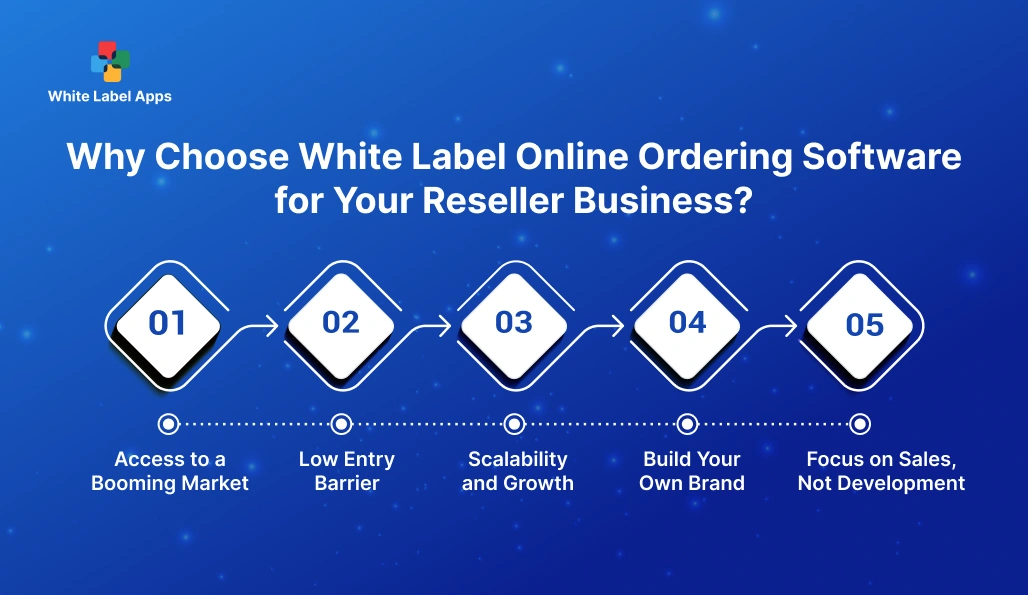
The white label model is ideal for resellers who want to grow in the food delivery space without building everything from scratch. You skip the long dev cycle and get a ready product you can sell, scale, and support under your own name.
1. Access to a Booming Market
Food delivery isn’t slowing down. That’s why restaurants are done settling for generic solutions. They want tech partners who can give them apps that feel like their own, not just another copy-paste job. That’s where your reseller advantage lies. With White Label Online Ordering Software, you help restaurants get their own branded experience in days, not months.
2. Low Entry Barrier
You don’t need a dev team or fancy setup. Most white label restaurant app systems come pre-built, tested, and ready to rebrand. That means you spend less on tech and more on closing deals. If you’re already into digital marketing, SaaS reselling, or app consultancy, this is a natural add-on.
3. Scalability and Growth
White label app development scales with you. Start with one client, then move to multi-location chains or franchise groups. Since the backend stays the same, bringing new restaurants on board is quick. No need to rebuild or reconfigure everything just plug them in and go.
4. Build Your Own Brand
When you sell white label apps, you’re not promoting someone else’s name. You build your own brand with your domain, your logo, and your support email. Every time a restaurant launches under your label, your presence grows too.
5. Focus on Sales, Not Development
There’s no need to maintain servers, chase bug fixes, or hire engineers. Your platform provider handles all of that. You focus on demoing features, signing new clients, and building recurring revenue.
Also Read: Build Your White Label Ordering App for Restaurants
Comparing White Label Online Ordering Software
When you’re choosing software to resell or launch for restaurants, it helps to compare a few key things. Think about setup time, branding flexibility, support, and how much control you’ll have. Whether you’re leaning toward a prebuilt platform or thinking of going fully custom, knowing the trade-offs early saves you time, cost, and trial-and-error frustration.
| Feature | White Label Online Ordering Software | Custom‑Built Solution |
| Time to Market | Launch often within days or weeks since core code already exists. | Can take months to develop and deploy from scratch. |
| Upfront Cost | Generally lower upfront investment since you’re rebranding existing tech. | High initial cost, including development, testing, deployment. |
| Brand Ownership | You control the brand, UI, customer data, and pricing in your version of the app. | Maximum ownership, but requires full infrastructure and maintenance. |
| Updates & Maintenance | The platform provider handles updates and backend; you focus on sales and support. | You’re responsible for updates, bugs, hosting, and infrastructure upkeep. |
| Scalability | Many systems support multi‑location and multiple clients with less extra work. | Scalability depends on how well the architecture was built; may require reinvestment. |
| Development Effort | Low to moderate branding, deployment, and onboarding are primary tasks. | Highrequires dev team, huge testing, and long timelines. |
When you compare white label models to custom builds, you’ll notice each has trade‑offs. A white label solution offers speed and cost‑efficiency, especially if you’re a reseller aiming to deliver value to restaurants without heavy tech build‑out. Custom builds offer deeper control and may be right for unique cases, but they’re resource‑intensive.
For resellers using white label app development strategies, the ideal path is to pick a platform where the core has been tested, the UI is flexible, and support is included. Your job becomes client acquisition, onboarding, and maybe value‑added services/sales, not code.
Avoiding Common Pitfalls in White Label Online Ordering Software
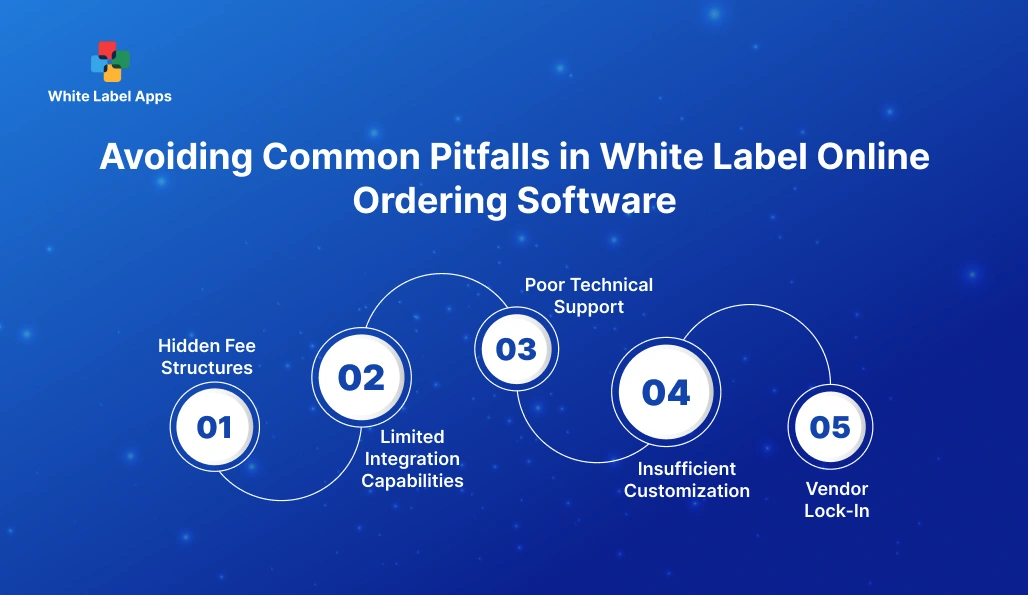
Pick the right white label ordering software, and it can grow with your business. But move too fast or miss key details, and it may cost you later. Many resellers choose flashy tools that look solid upfront but fall short once real orders start rolling in. Here’s what to watch out for:
1. Hidden Fee Structures
Some vendors say the base plan is cheap, but then add surprise fees for updates, extra branches, or even basic features. Always ask for a full cost list before signing up. Check if there’s a charge per transaction or a cap on user limits.
2. Limited Integration Capabilities
Instead of building platforms from the ground up, you start with something solid that’s already tested for scale. These white label apps let you focus on growing your brand, getting more clients, and delivering real value without spending months in development or fixing bugs.
3. Poor Technical Support
When things break they will slow or robotic support delays orders and frustrates clients. Make sure your white label partner offers responsive, human support, especially during peak hours.
4. Insufficient Customization
A real white label restaurant app should feel like it’s made just for you. If you can’t tweak the colors, layout, or user flow, you’re stuck selling someone else’s template. Steer clear of platforms that won’t let you shape the experience.
5. Vendor Lock-In
Some white label apps don’t let you export customer data, menu setups, or design files. You don’t have to build everything from the ground up. White label apps give you a solid foundation that’s already tested and ready. You skip the slow, expensive parts and focus on what matters: growing your brand, landing clients, and delivering real results without getting buried in code or delays.
For a detailed breakdown of risks and smarter vendor selection, read our blog on white label app development for startups.
Read Also: White Label Restaurant Ordering App for Your Business
Versatile Applications of White Label Online Ordering Software
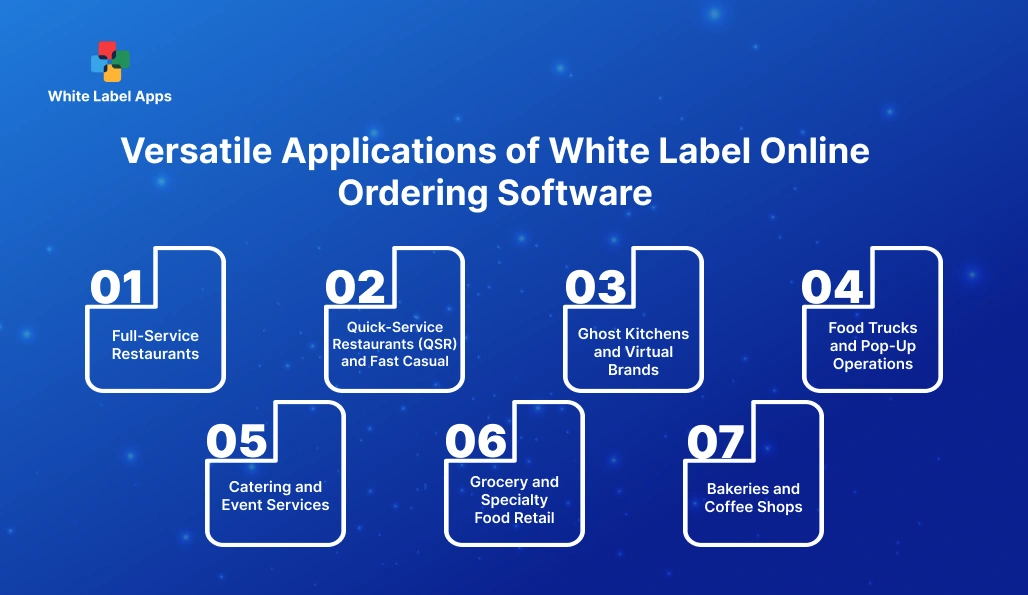
One of the biggest advantages of using White Label Online Ordering Software is how well it fits into different food and retail formats. Unlike one-size-fits-all platforms, these white label apps can be tailored to support various use cases from full-service dining to mobile food trucks. That flexibility makes them a top pick for resellers looking to target multiple business types without rebuilding the core system each time. With minimal changes, each client gets their own white label restaurant app with features suited to their needs. This section highlights how white label app development supports different service formats and retail goals.
1. Full-Service Restaurants
These restaurants need more than just order-and-pay tools. They need table booking, kitchen coordination, menu customization, and follow-up support all branded. White label apps let resellers offer restaurant platforms with useful tools like pre-ordering, QR-based dine-in, loyalty perks, and POS system links. Everything works under the restaurant’s own name, giving a smooth, branded experience from first tap to final review.
2. Quick-Service Restaurants (QSR) and Fast Casual
Speed and simplicity are key here. QSRs deal with high volume, short wait times, and walk-in or takeaway orders. A white label restaurant app lets them serve more people without long lines. Think of fast checkouts, live order updates, and stored payment details all of which increase daily order flow and reduce friction during peak hours. Custom themes let each chain stay on-brand.
3. Ghost Kitchens and Virtual Brands
These operate entirely online with no physical dine-in space. Multiple brands might run from one kitchen using a shared backend. That’s where white label apps shine. You can manage multiple menus, delivery zones, and brand-specific themes all from a single system. It’s efficient for businesses and easy to resell if you’re targeting this growing delivery-only segment.
4. Food Trucks and Pop-Up Operations
These businesses are flexible by design but often lack digital ordering. A mobile-friendly white label online ordering software gives them a way to accept orders, collect payments, and send pickup alerts. Customers can place their order while the truck is still on the way, so they’re not stuck waiting around. The setup works well for short menus, changing locations, and solo staff handling everything.
5. Catering and Event Services
Unlike daily restaurants, caterers need planning tools. Clients may want custom quotes, bulk orders, delivery timing, or even multi-day events. A white label app here helps with menu selections, lead forms, and order confirmations all tied to the brand. It removes manual errors and helps collect preferences for recurring events.
6. Grocery and Specialty Food Retail
Local stores and gourmet brands are shifting online too. White label app development helps bring them digital without relying on marketplaces. From bakery boxes to cold-pressed juices, they can manage stock, offer subscriptions, and track delivery. Bonus: push alerts help promote flash sales or restocks without running ads.
7. Bakeries and Coffee Shops
These spots run on habit, high-traffic windows, and loyal footfall. A white label restaurant app gives them a way to offer timed pickups, quick reorders, and digital queues for morning runs or evening rushes. Think saved preferences, one-tap reorders, weekend specials, or loyalty stamps less effort for staff, more stickiness for users. It’s ideal for repeat-heavy small formats.
Key Benefits of Whitelabelapps.ca White Label Online Ordering Software
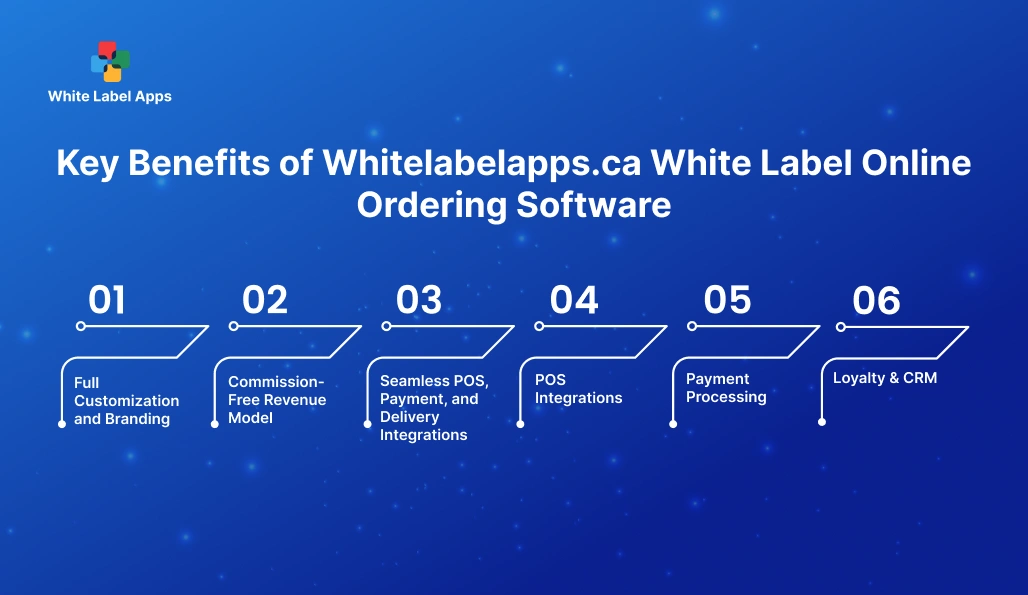
Whitelabelapps.ca offers one of the most adaptable White Label Online Ordering Software platforms in the market today. These platforms aren’t just for ticking boxes. Whether you’re working with a fine-dine outlet, a home bakery, or a dark kitchen, the tools inside are made to help businesses grow, not just get by. With white label restaurant app solutions like Whitelabelapps.ca, you get ownership of branding, direct customer engagement, and friction-free ordering across devices. Plus, there’s no code or long development cycles, just plug-and-play modules that keep your clients in full control. It’s white label app development built with real-world restaurant needs in mind.
1. Full Customization and Branding
Your clients don’t want another cookie-cutter app. They want their brand front and center. Whitelabelapps.ca gives full access to visual elements like colors, logos, fonts, and splash screens. From menu layouts to push notification tone, everything feels like the restaurant’s own. This level of branding turns the white label app into a true extension of their physical store. It helps build memory and loyalty, especially with repeat orders.
2. Commission-Free Revenue Model
Unlike third-party delivery platforms that cut into restaurant profits, Whitelabelapps.ca charges zero commission per order. That means restaurants keep more of what they earn. For resellers, this is a great selling point; it gives you an edge in client pitches. You can offer a white label restaurant app that pays for itself faster, without hidden fees. Restaurants can reinvest that money into marketing or staff instead of losing it to per-order cuts.
3. Seamless POS, Payment, and Delivery Integrations
Modern restaurants already use tools like Square, Stripe, Razorpay, or Zomato POS. Whitelabelapps.ca integrates with these systems without requiring rebuilds or extra tech help. That’s the power of flexible white label online ordering software that fits into existing workflows.
4. POS Integrations
POS syncing helps reduce human error. Orders go directly to the kitchen display system or cashier console, keeping things smooth during peak hours. No more re-entering orders by hand.
5. Payment Processing
Support for cards, wallets, UPI, and saved methods comes standard. The platform is PCI-compliant, giving peace of mind to both restaurants and customers. No external gateways needed.
6. Loyalty & CRM
Restaurants can create their own loyalty program, track behavior, and send rewards or nudges to repeat buyers. This is key for retention. You get in-built CRM tools without needing a third-party plugin.
Also Read: Brief Guide For White Label Delivery App for Food Businesses
Scalable White Label Online Ordering Software for Growing Resellers
As your reseller business grows, so do the needs of your clients. That’s where White Label Online Ordering Software truly shines. Unlike fixed or rigid platforms, white label app development allows resellers to expand offerings without restarting from scratch. Whether you’re serving ten restaurants or fifty, the same system can be adapted for each brand and outlet. With white label apps, your clients get flexibility, and you get control keeping everything under one roof while maintaining individual branding, analytics, and operations.
If you’re already offering a white label restaurant app, adding scalable modules like multi-brand support and cross-location reporting helps you attract bigger clients and offer more value.
1. Multi-Location Management
Managing orders, delivery zones, and menus across different outlets can become chaotic fast. A white label platform makes this easier with central dashboards and outlet-level overrides. This is ideal for franchises or chains with region-specific menus or pricing.
2. Multi-Brand Portfolio
Serve more than one restaurant group? You don’t need a different setup each time. The right white label restaurant app supports multi-brand portfolios under one reseller account. Each brand gets its identity, but your backend stays streamlined.
3. Customizable Reporting
Every client wants insights, but not everyone wants the same ones. With a white label app, resellers can offer flexible reporting based on client needs. Add metrics like conversion rates, average cart value, or repeat customer percentage to create value-driven conversations.
Dedicated Support and Training White Label Online Ordering Software
White Label Online Ordering Software isn’t just about code. For resellers, it’s about how well the platform supports your journey after sign-up. That includes everything from setup to client training, technical help, and learning tools. Without strong post-sale support, even the best white label apps can leave your customers confused or disappointed. This is especially true in fast-moving industries like food delivery, where things break, menus change, and clients ask for new features all the time. If you’re selling white label restaurant apps, you need a platform that grows with you and backs you at every step.
1. Onboarding Process
The onboarding process should feel smooth and quick. A good white label app development partner will walk you through setup, help import client menus, and handle initial customizations. This early stage is when trust builds. A delay or clunky setup hurts both your client experience and your brand reputation.
2. Ongoing Support Channels
When clients call you with issues, you need fast answers from your backend team. That’s why 24/7 email support, chat systems, and even shared Slack channels matter. Some platforms also offer technical documentation or ticketing dashboards so nothing slips through the cracks. Choose a provider that treats your success like their own.
3. Educational Resources
White label apps change often, especially in industries like F&B. You need updated training guides, video walkthroughs, and client-ready materials that help you sell and support without always going back to developers. The right White Label Online Ordering Software offers all these as part of the package, not as paid add-ons.
What are the Necessary Support Elements for White Label Online Ordering Software?
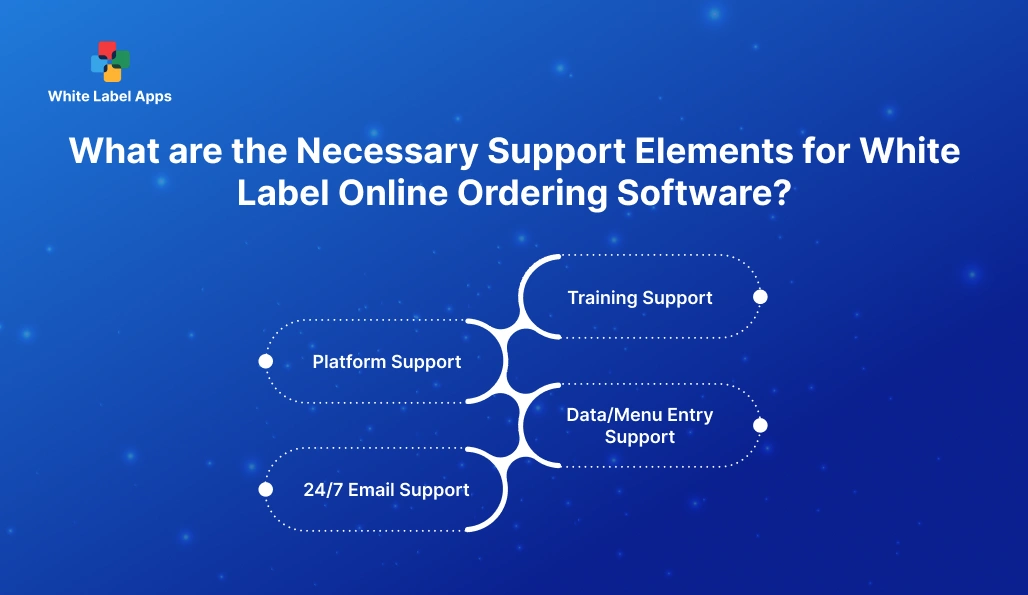
Behind every smooth-running white label restaurant app is a support system that’s fast, human, and tuned to the needs of resellers. When you’re managing multiple clients or scaling fast, you can’t afford delays, bugs, or silence when something breaks. That’s why the backbone of White Label Online Ordering Software isn’t just code, it’s real support that keeps you moving. From setting up the first menu to managing platform hiccups, each support layer matters more than most people realise. Let’s break down the four core elements that your white label apps must include to make the experience stress-free for resellers and their clients.
1. Training Support
Many first-time resellers don’t come from a tech background. They need a walkthrough, not a wall of jargon. Good white label app development partners offer one-on-one training sessions, video tutorials, or even live demos. These touchpoints help resellers understand how to set up outlets, onboard restaurants, and train their own clients quickly. The right training can save hours of back-and-forth later.
2. Platform Support
Bugs happen. Downtime happens. Features break after updates. A responsive platform team can be the difference between a lost client and a loyal one. Reliable white label restaurant apps offer tiered technical support from email to live chat based on issue severity. Faster fixes build reseller trust, and consistent communication keeps clients in the loop.
3. Data/Menu Entry Support
Entering dozens of food items with variations, categories, and prices is time-consuming. Many white label online ordering software providers now include menu upload services, CSV import tools, or even manual data support to speed up go-live time. For resellers, this reduces workload and helps them deliver finished platforms faster.
4. 24/7 Email Support
When clients run late-night kitchens or operate in different time zones, support has to match. Round-the-clock email support ensures no critical issue sits unattended overnight. For resellers, especially those managing a portfolio of businesses, 24/7 response builds confidence and shows the platform can scale globally.
Read Also: White Label Restaurant App for Food Businesses
How Can We Help Restaurant Owners with White Label Online Ordering Software Development?
If you’re a restaurant owner, reseller, or agency aiming to launch your own online ordering system, we offer the tools and tech to make it smooth and scalable. At WhiteLabelApps.ca, we focus on building White Label Online Ordering Software that feels like it was made just for your brand.
1. Custom-Built for Your Niche
Every food business runs differently. A cloud kitchen needs fast reordering and driver tracking. A bakery needs scheduled pickups. We tailor your white label restaurant app with the right modules for your audience. Want digital menus, loyalty points, or SMS alerts? We’ll make sure it fits your flow, not the other way around.
2. Full Branding, No Generic Templates
Your name, your logo, your colors from splash screen to checkout. Unlike cookie-cutter setups, our team ensures your white label apps reflect your identity across platforms. You’ll have a fully branded mobile and web app, not just a backend tool with a different skin.
3. End-to-End Development and Launch Support
Don’t have tech skills? No problem. From menu entry to payment integration, we handle it all. You get a working product tested, deployed, and ready to use. Our white label app development approach also includes app store publishing, so your iOS and Android apps go live without delay.
4. Training and Ongoing Help
You’ll get walk-throughs, help docs, and live support when needed. Whether you’re setting up a loyalty campaign or onboarding new staff, we’re here beyond launch day. Need to scale to more locations or add new brands? We’ve got you covered.
Cost Comparison for White Label Online Ordering Software
The cost of a white label online ordering software depends on simple things like how many restaurants you handle and what features they need. Some teams want basic branding. Others ask for POS links, menu sync, or their own theme. Most platforms take a small setup fee, then a monthly charge for hosting and support. These bills stay steady, so you can plan ahead. It usually works out cheaper than building your own system, which needs a big budget and long development time. A clear cost comparison makes it easier to see which option fits your clients and your profit goals.
| Model | Typical one-time/setup cost | Typical monthly/annual cost |
| Basic white-label (reseller-friendly) | USD 1,000-5,000 | USD 200-500/month |
| Full-feature white-label enterprise | USD 10,000-30,000+ | USD 1,000-5,000/month |
| Custom build from scratch | USD 50,000-250,000+ | USD 5,000-15,000+/month |
Conclusion
The reseller market is shifting fast. You’re no longer expected to build tech from scratch. With the right White Label Online Ordering Software, you can launch faster, offer smarter tools to clients, and still keep your brand in focus. Instead of months of dev work, you get a proven system that’s ready to go, then tweak it to suit different restaurant types whether it’s a café, cloud kitchen, or a full-service chain.
Look for platforms that offer deep branding control, real-time reporting, and flexible integrations. These aren’t just “white label apps” on paper, they’re scalable, revenue-friendly products that help you grow without chasing tickets or fixing bugs.
To understand how you can grow profits while skipping development headaches, explore our blog on how to make money with white label apps.
And the best part? You get to own your client relationships and profits from day one.
FAQ’s
1. What is white label online ordering software?
It’s a ready-to-use platform that agencies and resellers can brand as their own. Think of it as a shortcut you don’t build from zero, but still get something that looks custom. Restaurants, cafés, and food trucks use it to take direct orders, show their menu, and manage delivery. They don’t have to share space with rivals or lose money to commissions. With this setup, the branding, pricing, and customer data all stay in-house.
2. Who should use white label online ordering software?
This works well for digital agencies, solo freelancers, or even marketing consultants who help food businesses go online. If you’ve got restaurant clients and don’t want to build apps yourself, this is a solid route. You just plug into an existing system, put your client’s name on it, and go live. Small food joints, home chefs, chains, or cloud kitchens often want quick and clean setups and this model delivers just that.
3. How is it different from third-party delivery apps?
Apps like Uber Eats or DoorDash come with fees, rules, and their own branding. They handle the order but keep the customer. With white label app development, your client keeps their name, pricing, and offers front and center. No one else gets between them and their customers. Plus, you as a reseller earn from subscriptions or extra services. It’s not just about cutting costs, it’s about control.
4. Can I customize features in a white label restaurant app?
Yes, most providers let you tweak the look and feel like changing the logo, colors, and font. Some go further. You can often switch on extras like in-app payments, loyalty rewards, or real-time delivery tracking. If your client uses a POS or CRM, many systems plug into that too. Some providers offer levels basic for fast launch, advanced for full control.
5. What kind of support should I expect?
The best providers don’t just sell software, they help you sell it too. Look for easy onboarding, clear setup guides, and fast replies when things go wrong. You’ll also want updates, bug fixes, and training tools you can share with clients. If you’re reselling, white-labeling the help docs is a bonus it keeps your brand consistent from start to support.