Most restaurant owners feel the same squeeze today. Online orders keep rising, but third-party apps eat margins and push your menu beside hundreds of other places. It chips away at repeat business. The global delivery market is moving toward $1.40 trillion in 2025 as shown by Statista, and you can check the numbers here: global online food delivery forecast. With this kind of growth, relying only on aggregators is risky.
This guide shows how white label app development helps restaurants build their own ordering and delivery system without long delays or heavy custom coding. You get direct orders, your own brand, and full control.
If you want a deeper look at how food delivery models work, you can read this simple breakdown on our blog: food delivery app business models.
Many small cafés and multi-location brands now use white label apps to cut commissions and bring guests back to their own platform. Some choose a flexible white label restaurant app setup to manage menus and orders in one place. Others explore a white label food delivery app to run their own delivery fleet. The idea is simple. Help restaurants own the customer journey instead of renting space on crowded marketplaces.
In the next sections, you will see how these systems work, how fast they launch, and how restaurants use tools like our white label delivery app to run smoother operations. Think of it like opening your own delivery counter online. Clean. Direct. Built for 2026.
TL;DR
- Restaurants lose margin on third-party apps, so owning a delivery system gives more profit.
- White label apps help restaurants launch fast with their own branding and menu control.
- A white label platform costs less than a custom build and takes only weeks to go live.
- Food delivery scripts and clone models give proven workflows for quick adoption.
- Restaurants gain more repeat orders when customers order directly from their own app.
- Customisation, tracking, payments, offers, and driver tools come ready in one setup.
- White label delivery systems scale easily for cafés, cloud kitchens, and multi-outlet brands.
Key Points
- White label app development lets restaurants build their own delivery and ordering system without depending on aggregator platforms.
- A white label restaurant app gives full control of branding, pricing, menus, and customer relationships.
- Third-party apps charge high fees, while direct ordering helps restaurants keep more profit on every order.
- The global food delivery market is growing fast, which makes owning a personal platform even more important.
- A white label food delivery app supports menu updates, order flow, driver tracking, and customer rewards in one system.
- Food delivery scripts and clone models help restaurants launch faster by using proven delivery workflows.
- Ready setups reduce development time from months to weeks, making them ideal for small and multi-location businesses.
- Restaurants can customize menus, timings, delivery zones, offers, and categories without technical skills.
- Admin dashboards show daily sales, peak hours, and top items to help owners make better decisions.
- A white label delivery system can grow with added outlets, new delivery areas, and extra features over time.
The Food Delivery Shift: Why Restaurants Need White Label App Development
Running a restaurant today feels very different from how it was even three years ago. More people order online. Fewer wait for a table. And almost every city now depends on delivery apps for daily meals. The industry is growing fast. Statista shows the global market touching $1.40 trillion in 2025, and you can see the numbers here: global food delivery forecast. When a market grows this fast, restaurants without their own system lose control.
Third-party apps help you reach new customers, but they also take high fees. Some charge 20 to 30 percent per order. This hurts profit, especially for small kitchens with thin margins. That is why more owners now shift to white label app development. It gives you a branded setup where customers order directly from your place. No middle layers. No fee surprises.
A large share of Americans, almost 65.7 percent, will use food delivery regularly. When so many people depend on delivery, your restaurant needs a system that protects your margins.
If you want a quick breakdown of how delivery models work and which ones fit different restaurants. This will help you understand where white label restaurant apps and white label food delivery apps fit in the bigger picture.
For restaurants planning to serve more customers in less time, a reliable white label apps setup becomes a natural step. It lets you keep your brand, manage your own orders, and control your customer experience. And once the system is live, you own every order that comes in.
What Is a White Label Food App? A Restaurant-Friendly View
A white label food delivery app is a ready-made platform your restaurant can brand as its own. You get a working customer app, a menu dashboard, and simple tools to manage daily orders and delivery. The base system is already built. You only add your name, your colours, and your dishes. It feels like opening a small digital counter beside your kitchen.
When customers order through your setup, they order from you directly. No crowded pages. No mixed listings. No commission cuts that take a big share of every sale. This helps you build repeat customers and keep more of your earnings.
Restaurant owners choose a white label restaurant app because it gives them the same core features as a custom build, but without long timelines or heavy costs. The global food delivery mobile app market alone is expected to reach $36.79 billion in 2025, according to ForInsights. You can see the full report here: food delivery mobile application market. This growth is one reason ready-made systems became popular. They help restaurants join this rising market faster.
These platforms support menu changes, live order tracking, payment options, coupons, and even multi-outlet setups. So whether you manage a café or a busy restaurant, you can control everything from one place.
A solid white label restaurant app gives your brand a clean online home. It keeps your customers close and gives your kitchen a smoother way to handle online orders.
Food Delivery Script vs Custom App Development: What Restaurant Owners Should Know
Many restaurant owners want their own delivery system but feel stuck between two choices. One is a full custom build. The other is a ready food delivery script that you can brand as your own. Both work, but they fit different needs. A food delivery script is faster and cheaper. A full custom app takes time, and the cost depends on every small feature you add.
The global delivery app market is still rising. Reports show it may reach $36.79 billion in 2025, according to ForInsights. This growth is a big reason many restaurants prefer a ready system. It helps them join the market right away instead of waiting months.
A white label delivery app built on a script gives you fixed modules. You get customer ordering, menu control, tracking, and payment options right from the start. It is made for quick launch, which helps when you want to test a new area or add delivery to your existing setup.
A full custom build gives total freedom. You can change every detail of the flow. But the timeline can stretch for months, and the cost grows with each custom feature. Some restaurants do not need that level of control. They only need a clean white label restaurant ordering flow that works well during lunch rush and weekend peaks.
For owners who want a direct comparison of online ordering paths, this simple guide helps: white label ordering for restaurants. It explains how ready systems reduce launch time and help restaurants go live in a stable way.
So the rule is simple. Choose a food delivery script or white label food delivery app development when you want speed, stability, and a lower starting cost. Choose custom only when you need a very unique setup or a special workflow that ready systems cannot support. For most restaurants, a white label route is enough. It gets you online faster and keeps your menu in front without long delays.
How a Food Delivery Script Works in White Label App Development?
A food delivery script is the base engine behind many white label apps that restaurants use today. Think of it like a ready kitchen layout. The counters are in place. The shelves are set. You only bring your menu, your staff, and your colours. This makes it easy for restaurants to launch without building the whole structure from scratch.
The script handles the main delivery flow. Customers open your app, pick items, place an order, and track it on the map. Your team sees the order in the restaurant panel, prepares the food, and sends it to a driver. The system updates everyone in real time. This is why many owners prefer a white label restaurant app. It keeps the process simple and predictable.
A script usually includes these core modules:
- Customer app for browsing dishes, placing orders, and tracking delivery.
- Restaurant panel for menu edits, order updates, timings, and offers.
- Driver app for accepting tasks and following the best route.
- Admin panel for reports, payments, coupons, and user control.
If you want a clean view of how this setup works in a restaurant-focused white label model.
For many kitchens, this system is enough. It manages peak hours, supports real-time updates, and keeps all parts of the delivery chain connected. It also works well when you want to expand to new areas or add new outlets later.
When combined with white label app development, a script becomes even more helpful. You get the speed of a ready system and the branding freedom your restaurant needs. This blend is why so many small cafés, cloud kitchens, and family restaurants choose it over a slow custom build. It lets you run delivery your way.
Real-World Case Studies & Examples
1. How Restaurants Grow Faster With White Label Systems
Many small restaurants switch to their own ordering setup to keep more profit. A white label restaurant app helps them avoid high commissions and gives customers a simple way to order directly. This direct path brings more repeat orders because people trust the restaurant’s own platform.
2. Lessons From Fast-Growing Delivery Regions
The Asia-Pacific region is one of the fastest-growing markets for food delivery apps. A detailed report shows steady growth here: APAC delivery growth. This rise helps local restaurants gain more online orders when they use their own white label apps instead of relying on crowded marketplaces.
3. Simple Ordering Models That Work for Local Kitchens
Many cafés, cloud kitchens, and family restaurants use ready setups to offer clean menus, fast checkout, and real-time tracking. This smooth flow is similar to the examples shared here: White Label Online Ordering Software. These models help restaurants improve weekday evening sales and handle weekend rush without confusion.
Monetization Strategies With White Label Food App Solutions
1. Set Your Own Commission on Every Order
When customers order through your platform, you control the commission. No extra cuts. No sudden fee changes. This helps your kitchen keep more of what it earns. A White Label Ordering App for Restaurants gives you this flexibility from day one.
2. Earn More Through Offers and Loyalty Tools
Your app can include coupons, repeat-order rewards, and referral codes. These small tools help increase order value and bring customers back. Many restaurants use these features to boost lunch and dinner sales on slow days.
3. Add Extra Revenue Streams
Restaurants can also earn through priority delivery options, add-on services, or small delivery fee markups. These methods work well when you want steady income beyond food sales.
The Restaurant-Focused Development Lifecycle in White Label App Development
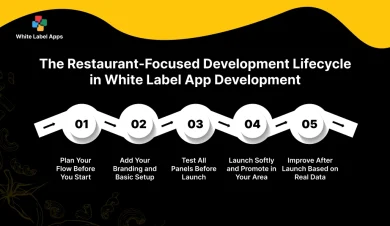
Running your own delivery system feels big at first, but the steps are simple when you follow a clear flow. Most restaurants move through the same stages. First, they decide how their delivery should work. Then they add branding, test the setup, and launch in one area to see real results. A good white label app development process follows your daily kitchen routine instead of forcing you to change everything. This keeps the experience smooth for your staff and your customers. When each step is done in order, your restaurant gets a clean, stable system that grows with your business. You can always adjust menus, timings, zones, and offers as you learn from your first few weeks.
1. Plan Your Flow Before You Start
Every restaurant works in its own way. Some take many small orders. Some handle big family meals. Some pack only takeaway. Planning your flow first makes white label app development smoother. You decide your delivery zones, prep times, menu rules, and peak-hour limits early.
2. Add Your Branding and Basic Setup
At this stage, you add your logo, colours, menu, prices, and delivery timings. You also set order limits for rush hours.
3. Test All Panels Before Launch
You test the customer app, restaurant panel, and driver flow. Place small sample orders. Change timings. Try adding offers. This helps your team understand the routine before real customers start ordering. It also reduces mistakes during peak evenings.
4. Launch Softly and Promote in Your Area
Start in one area, not the whole city. Place a QR code at your counter. Add table cards. Share the link on WhatsApp and Instagram. A small focused launch works better.
If you want to see how other on-demand apps follow the same steps, you can explore this page: on-demand app setup.
5. Improve After Launch Based on Real Data
After a few weeks, you will see new patterns. Some items sell more. Some delivery zones take longer. Some hours stay busy daily. A flexible white label apps setup lets you adjust menus, timings, offers, and delivery rules without waiting for long updates.
How Much Customization Is Possible in White Label App Development for Restaurants?
Customisation is one of the main reasons restaurants choose white label app development. Every kitchen works differently. Some have set menus all week. Some change dishes daily. Some manage many outlets. A white label setup lets you handle all this without complex tools. You can update prices, add offers, change delivery timings, or pause an item during rush hours. Most changes take only a few taps. This helps your team stay in control even on busy evenings. The system grows with your restaurant instead of locking you into one fixed flow. You get a balance of freedom and stability that fits daily operations. For most owners, this is more than enough to run smooth online ordering.
1. What You Can Change Easily
You can update banners, dish photos, categories, prices, and delivery rules anytime. Restaurants also change timings or pause delivery when the kitchen gets too busy.
2. Multi-Location and Simple Flow Adjustments
If you run more than one outlet, you can set different menus, cooking times, and delivery zones for each branch. A white label restaurant setup supports separate panels so your team can manage daily orders without confusion.
3. Areas With Some Limits
Deep workflow changes, like building a unique driver logic or redesigning the entire UI, may require more time. Most restaurants do not need these changes because the ready structure already covers online ordering, tracking, payments, and offers.
4. How Data Helps You Customise Better
Your dashboard shows peak hours, top dishes, slow items, and delivery times. These small insights help you adjust menus, timings, and layouts in a smarter way. It keeps your delivery flow clean and responsive to what customers want.
Related Read: How to launch white label mobile app
Essential Features for a Restaurant-Ready White Label Delivery App (2026)
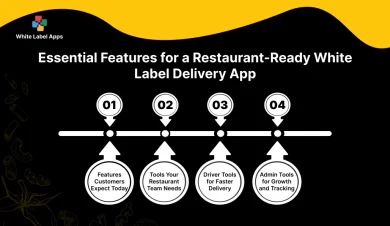
A strong delivery system needs tools that work smoothly for both your customers and your kitchen. People expect quick ordering, clear menu photos, and live tracking. Your team needs fast alerts, simple menu edits, and a clean way to manage busy hours. A white label delivery app gives you these tools in one place so your staff does not run between apps or screens. It helps you handle rush timings with fewer mistakes and keeps your customers informed from checkout to delivery. As more diners choose online ordering, these features become essential, not optional. A system that covers these basics sets your restaurant up for steady, reliable growth through 2026.
1. Features Customers Expect Today
Customers look for clean menus, fast checkout, secure payments, and real-time tracking. These simple steps help them order with confidence. A white label food delivery app gives you these tools without slow custom builds.
2. Tools Your Restaurant Team Needs
Your staff needs clear order alerts, the ability to update menus quickly, and a simple view of delivery status.
3. Driver Tools for Faster Delivery
Drivers need route guidance, order details, and task history. These help them handle peak hours without errors. A clean driver flow reduces delays and keeps customers informed.
4. Admin Tools for Growth and Tracking
Coupons, reports, ratings, payment logs, and customer history help you improve your delivery flow. These small insights guide your menu decisions, offers, and delivery timings.
Cost of White Label Food Delivery App Development
The cost of a white label food delivery app usually starts much lower than a full custom build, and this is why many restaurant owners choose it for 2026. Custom systems can reach high budgets because every small feature needs to be created from zero. A ready setup built through white label app development gives you most features from the start, so you spend less and launch faster. This matters when your restaurant wants direct online orders without long delays. A flexible white label system also means you can upgrade menus, coupons, zones, or offers later without paying heavy custom fees.
| Setup Type | What You Get | Best For | Cost Range | Launch Time |
| White Label Food Delivery App | Ready modules, branding, tracking, payments, offers | Restaurants wanting fast launch | Low to mid cost (varies by features, far below custom) | 2–4 weeks |
| Custom Delivery App | Fully built from scratch | Large chains with unique flows | High cost (can reach large budgets) | 6–12 months |
| Food Delivery Script (White Label Base) | Customer app, restaurant panel, driver app, admin tools | Small restaurants testing delivery | Low cost | 1–3 weeks |
| Multi-Restaurant Setup | Multiple panels, zone rules, schedules | Restaurants with several outlets | Mid to high cost depending on number of branches | 3–6 weeks |
How We Can Help Restaurants Build Their Own White Label Delivery System?
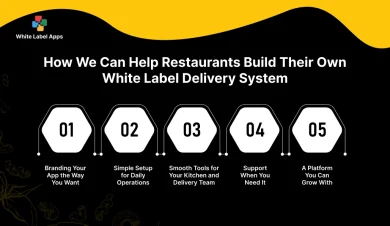
Running your own delivery platform can feel confusing at first, but our job is to make it simple for you. We guide you through each step, from planning your menu flow to setting delivery zones and testing your setup. With our white label app development approach, you get a ready system that fits your brand and daily routine without long waiting times. You learn how to manage orders, edit items, update timings, and handle peak hours confidently. The goal is straight. You stay in control of your customers, your pricing, and your repeat orders. We support you with clear instructions and tools that any restaurant team can use. Read our latest blogs to get more details on while label apps and how we develop them.
1. Branding Your App the Way You Want
Your colours, your logo, your menu. You get a clean white label restaurant app that reflects your identity. No extra screens. No mixed branding. Just your food in front.
2. Simple Setup for Daily Operations
We help you organise your categories, delivery timings, and order rules so your staff can manage everything easily. You can explore how restaurant-focused ordering works here: white label mobile app for restaurants.
3. Smooth Tools for Your Kitchen and Delivery Team
Your team gets fast alerts, menu controls, and tracking tools. Drivers get clear routes and task details. You get one dashboard to see everything.
4. Support When You Need It
From testing to launch, we guide you step by step. If you want to understand how different white label delivery setups work, you can check this page: white label delivery system.
5. A Platform You Can Grow With
Start with basic ordering and add features later. More outlets. More delivery zones. More offers. Your system grows as your restaurant grows.
Conclusion
Running your own delivery system is no longer a big step. It is the smarter move for most restaurant owners today. A white label food delivery app gives you a direct line to your customers, steady margins, and a setup you control without waiting months. You get tools to manage orders, track deliveries, update menus, and grow at your own pace. With the food delivery market rising every year, owning your platform puts your restaurant ahead. Start small, learn from your early orders, and shape a system that fits your kitchen.
FAQs
1. What is a white label food delivery app?
It is a ready-made system that your restaurant can brand as its own. You add your colours, your logo, and your menu. A white label restaurant app lets customers order directly from you without visiting crowded third-party apps. You stay in control of pricing, orders, and customer data.
2. How much does it cost to build my own delivery platform?
A full custom delivery app can reach high budgets because every feature is built from scratch. A ready system built with white label app development costs much less and launches faster. The exact cost depends on features, number of outlets, and your delivery model.
3. How fast can I launch a white label delivery system?
Most restaurants go live in 2–4 weeks because the main structure is already built. You only add your branding, menu, timings, and delivery zones. After a short testing round, you can start accepting real orders in your area.
4. Can a small restaurant compete with big delivery platforms?
Yes. A white label food delivery app gives you a direct path to customers without commission cuts. This helps you earn more from every order. Reports show the global delivery market is rising each year, and many customers prefer ordering directly from restaurants they trust.
5. Can I run multiple outlets with one system?
Yes. You can add separate menus, timings, and rules for each outlet inside one dashboard. This helps restaurants manage branches easily without switching between apps or screens.
6. What features do customers expect in 2026?
Clean menus, fast checkout, secure payments, live tracking, repeat ordering, and reliable updates.
7. How do I update my menu or delivery timings?
You can change categories, dishes, prices, delivery slots, or offers anytime. Updates appear instantly in the customer app. This helps during rush hours or slow days.
8. Does a white label delivery app support coupons and loyalty?
Yes. You can add coupon codes, limited-time offers, and referral rewards. These tools help increase repeat orders and weekend sales.
9. Is a food delivery script enough for my restaurant?
For most restaurants, yes. A food delivery script gives you all core modules like customer ordering, restaurant panel, driver app, and admin tools. It is the base layer behind many white label apps and helps you launch quickly.
10. How do I get started with my own delivery system?
Start by planning your menu flow, delivery zones, and timing rules. Then add branding and test all panels. If you want help setting up your restaurant’s delivery platform, you can reach our team here: contact us.