
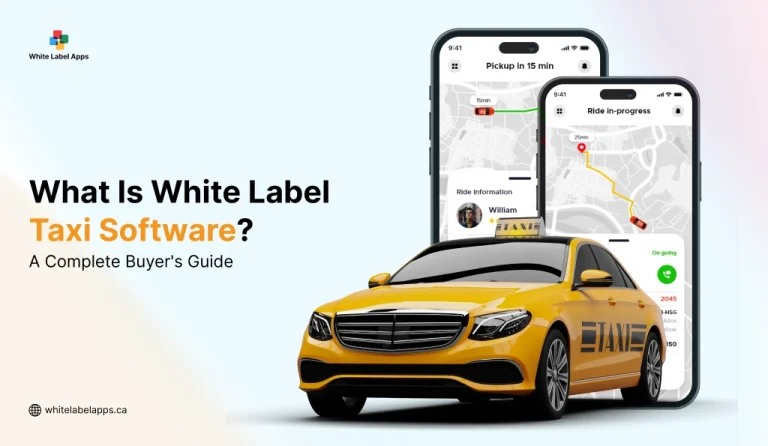
Most operators searching for white label taxi software aren’t short on options. The problem is telling them apart. Every vendor shows the same demo, quotes a similar timeline, and promises full customization. The gaps show up later, after contracts are signed and launch day is closer than you’d like.
White label taxi software is a pre-built ride-hailing platform you brand as your own and launch under your own name. No dev team. No 12-month build cycle. The provider handles the technology. You handle the business.
The market timing is real. The global ride-hailing industry sits at $140.2 billion in 2025 and is on track to hit $412.7 billion by 2035, a CAGR of 11.4%. That growth isn’t sitting with Uber and a handful of players at the top. App-based booking now covers 93.1% of all ride-hailing transactions. Riders already know what they want. They want to book on a phone. Operators who aren’t live with a working app are already behind. For anyone looking to move fast without burning through capital, white label app development is the most practical path to a working product in the market.
What’s in this guide isn’t pulled from a vendor brochure. We spent time researching how real operators evaluate platforms, what questions they regret not asking, and where white label solutions actually fall short. The goal was a resource that gives you a clear picture before you commit, not after.
This guide breaks down what the White label taxi software actually includes, what it costs, what separates a solid platform from a frustrating one, and what to ask before you sign anything.
TL;DR
- White label taxi software is a pre-built ride-hailing platform you brand and launch as your own. No code. No dev team.
- Most operators go live in 2 to 8 weeks, at a fraction of what custom development costs.
- Every complete platform has three parts: a passenger app, a driver app, and an admin dashboard.
- Choosing the right provider comes down to eight factors. Customization depth, source code access, and data ownership are the ones most operators overlook.
Key Points
- Building from scratch takes 6 to 18 months and can cost $80,000 to $500,000 or more. White label gets you live in weeks.
- App-based booking covers 93.1% of all ride-hailing transactions. Riders know what they want. Operators who aren’t live yet are already losing ground.
- White label taxi software works for startups, traditional fleets, digital agencies, and operators in emerging markets across the US, UK, UAE, Southeast Asia, and beyond.
- Per-trip commission models can look affordable upfront and quietly cut into your margins as volume grows. Know exactly what you’re paying before you commit.
- If a vendor can’t show you a live demo with real data, pay attention to that.
- You can move to a custom build once you have revenue behind you. You can’t get back the 12 months spent building before you knew whether the demand was there.
What Is White Label Taxi Software?
White label taxi software is a pre-built ride-hailing platform you purchase, brand with your own logo and colors, and launch under your own name. The provider builds and tests the technology. You configure it, brand it, and run the business.
It’s not the same as a clone app. Clone apps are knockoffs built to look like Uber or Lyft. Fragile code, minimal support, and no one to call when something breaks after handoff. White label taxi software is built differently. It’s a production-ready product designed to run across dozens or hundreds of operators at the same time. The provider keeps the infrastructure running, ships updates, and deals with the technical side so you don’t have to. You handle growth.
Every complete solution has three parts.
Riders download the passenger app to book trips, track their driver, and pay. Your fleet uses the driver app to accept requests, get directions, and keep tabs on earnings. Everything else, drivers, pricing, performance, disputes, runs through the admin dashboard. One panel, full control. If a provider is missing any of these three, you’re not looking at a complete product.
One more thing to check before you talk to any vendor. White label taxi software covers the full backend and mobile app stack. A white label taxi app, on its own, usually means just the consumer-facing mobile app. They’re not the same thing. Know which one you’re actually buying.
The Market Opportunity Behind White Label Taxi Software
Uber’s size can make the market look locked. It isn’t.
Uber and Lyft don’t have a real presence in most of Southeast Asia, large parts of Africa, or dozens of mid-sized cities across the Middle East and Eastern Europe. That’s not a gap. That’s an opening.
Operators in the UAE, Nigeria, the Philippines, and regional cities across Australia and the UK have already launched profitable ride-hailing services by moving fast with white label platforms instead of waiting years for custom builds. The model works because the conditions are right. Smartphone use keeps climbing. Digital payments are now standard in markets that ran entirely on cash five years ago. Riders want app-based booking. The infrastructure is there.
What’s missing for most operators isn’t demand. It’s a platform they can launch quickly and adjust to fit local pricing, local languages, and local payment habits.
That’s what white label taxi software does. You’re not building from zero. You’re starting on a foundation that’s already been tested across real markets, and you’re getting live fast enough to actually capture the opportunity.
Also Read: White Label Taxi Dispatch Software Features Every Fleet Needs
White Label Taxi Software vs. Building from Scratch
Most vendors won’t lay this out cleanly. They want to sell you something. So here’s the honest version.
Custom development gives you full control. You own the code, the database, every decision. The app does exactly what you need. But that control has a real price tag. Building a production-ready ride-hailing platform from scratch in the US or UK typically means 8 to 15 engineers, $150,000 to $500,000 in build costs, and 9 to 18 months before you have anything stable enough to put in front of riders. And that’s before maintenance, hosting, and new features enter the picture.
White label taxi software cuts all of that down. Most operators are live in 2 to 8 weeks. Setup costs fall between a few thousand dollars and $30,000, depending on customization scope and licensing model. Monthly fees for access, support, and updates run between $300 and $2,000 after that, based on fleet size and features.
The trade-off is control. You don’t own the underlying code unless the provider offers source code licensing. Your customization options stop where the platform stops. And for new features, you’re working with the provider’s roadmap, not your own.
For most operators, that’s a trade worth making. Especially if you’re validating a new market or trying to launch inside a competitive window. You can move to a custom build later, once you have revenue and a real user base to work from. You can’t recover the 12 months you spent building before you knew whether the demand was even there.
| Factor | Custom Build | White Label Taxi Software |
| Launch Timeline | 9 to 18 months | 2 to 8 weeks |
| Development Cost | $150,000 to $500,000+ | $3,000 to $30,000 setup |
| Ongoing Cost | In-house team or agency | $300 to $2,000/month SaaS |
| Code Ownership | Full | Depends on provider |
| Customization | Unlimited | Bounded by platform |
| Time-to-Revenue | 12+ months | 4 to 10 weeks |
Key Features Every White Label Taxi Software Must Have
A lot of vendors hand you a feature list and call it a day. Here’s what those features should actually do, and what to push back on if something’s missing.
1. Passenger App
- Real-Time Booking and Tracking
Booking must be rapid – within 30 seconds – but also a real time visual indication of the ride driver en route on the map must be available. Lack of tracking updates leads to driver phone calls, customer dissatisfaction and ride cancellations.
Timing of the ride also counts. It is preferable if the system allows passengers to book rides few hours or days in advance rather than only instantly.
- Multiple Payment Options
Card, digital wallet, cash, and local payment methods relevant to your market. In Southeast Asia and the Middle East, ignoring local payment rails will cost you riders fast.
- Promo Codes and Referral Engine
You need a way to grow. Promo codes are how most operators sign their first 500 riders. Make sure you can set them up and adjust them from the admin panel yourself, without going back to the vendor every time.
- SOS and Safety Features
Ride-hailing runs on trust. In-app emergency contact sharing, live trip-sharing with a third party, and a panic button are not optional extras in 2026. They’re baseline.
- In-App Messaging
When riders and drivers can message each other inside the app, cancellations go down. It’s straightforward.
- Ratings and Reviews
Two-sided ratings keep standards up on both sides. You should also be able to act on a low-rated driver from the admin panel right away, without a workaround.
2. Driver App
- Intelligent Order Dispatch
Manual trip selection slows everything down. The system should be assigning rides automatically, based on proximity, acceptance rate, and availability. That’s what keeps wait times short and the fleet moving.
- GPS Navigation
Not every driver knows every route. Turn-by-turn navigation belongs inside the driver app, not a tab-switch to Google Maps halfway through a trip.
- Earnings Dashboard and Trip History
Drivers track their income closely. Give them clear visibility into daily earnings, completed trips, and payout history. Transparent earnings data is one of the main reasons drivers stay or leave.
- Document Verification and KYC
Driver onboarding should include document upload, a verification workflow, and automated status updates. Manual verification breaks down fast once you’re past 50 drivers.
- Availability Toggle and Break Management
Drivers need to go offline. The system should handle that without disrupting the dispatch queue for everyone else.
3. Admin Dashboard
- Real-Time Fleet Map
You should be able to see every driver, every active trip, and every idle vehicle on a live map at any moment. Not on a delay. Live.
- Surge Pricing Controls
You need to set price multipliers by zone and time of day from the panel itself. If that requires a call to the vendor, that’s a problem.
- Dispute Resolution Tools
Riders dispute charges. Drivers dispute trip outcomes. Your dashboard needs a proper case management workflow built in. A spreadsheet is not a system.
- Driver and Rider Analytics
Peak hours, high-demand zones, average trip value, churn rates. These numbers are what you’ll use to make every operational call. If the dashboard doesn’t surface them clearly, you’re flying blind.
- Multi-City Support
If you plan to expand beyond one market, the admin panel should support multiple service zones from the start. You shouldn’t need a platform rebuild to launch in two cities.
Also Check: White Label Taxi App Development Guide
Advanced White Label Taxi Software Features That Separate Good from Great
The basics get you live. These features are what separate a platform you grow on from one you eventually outgrow.
1. AI-Powered Dispatch
The best dispatch systems don’t just find the nearest driver. They factor in live traffic, driver acceptance patterns, and predicted demand. Shorter waits and fewer cancellations follow. Both have a direct effect on whether riders book again.
2. Demand Heatmaps
Knowing where riders are likely to book before they open the app lets you position drivers early. Operators who use heatmap data regularly tend to see higher trip completion rates and fewer surge events catching them off guard.
3. Dynamic Pricing Engine
Surge pricing is standard on most platforms. Dynamic pricing that responds to real-time demand, weather, and competitor rates is where the better platforms are heading. If the one you’re evaluating can’t handle zone-based fare adjustments from the admin panel without calling the vendor, flag it before you sign.
4. Multi-Language and Multi-Currency Support
Launching in Dubai, Lagos, or Kuala Lumpur means local languages and currencies need to be built in. Not an add-on. Not something you pay extra to unlock later. Not as an extra you pay to unlock. If it’s an add-on, build that cost into your comparison.
5. Corporate Booking Module
Corporate clients bring predictable, high-volume revenue. A corporate panel lets businesses set up accounts, pre-approve drivers, manage employee rides, and receive consolidated invoices without chasing individual receipts. Most operators don’t prioritize this until year two. Most of them wish they had it from day one.
6. In-App Referral and Loyalty System
Referral-based acquisition typically costs 3 to 5 times less than paid channels. If a platform supports a configurable referral program out of the box, that’s a genuine operational advantage. Not a feature to skim past.
How to Choose the Right White Label Taxi Software Provider
Most operators get this part wrong. They go with the cheapest quote or the best-looking demo and skip the questions that actually matter. Here’s what to look at before you decide.
1. Customization Depth
Can you change the app name, colors, icons, onboarding flow, and email templates yourself? Or do you file a ticket every time you want to adjust a font? True white label means you control the brand entirely. If the vendor’s logo shows up anywhere in the rider-facing experience, that’s not white label.
2. Source Code Access
Some providers offer full source code licensing. Others run a SaaS model where you never see the code. Neither is automatically the wrong choice, but you need to know which one you’re buying. If you ever want to switch platforms, owning the source code makes that possible. Not owning it means starting over.
3. Data Ownership
Your rider data, driver data, and trip history should be yours. Some SaaS platforms retain rights to anonymized data for their own analytics or third-party use. Read the contract. Ask directly: who owns the data, and can I export it at any time? If the answer is vague, that’s your answer.
4. Scalability Evidence
Ask the vendor how many active drivers their largest client runs on the platform. A system that handles 50 drivers cleanly may fall apart at 500. Ask for references from operators at scale, not just early-stage deployments with small fleets.
5. Pricing Model Transparency
Get clear on what you’re paying and how it changes as you grow. One-time license, monthly SaaS fee, per-trip commission, or some mix of all three. Per-trip commission models can look affordable upfront and quietly eat your margins once volume picks up.
6. Support SLAs
Your app will go down at some point. Probably on a Friday night. What happens then? A serious provider has a defined response time, a dedicated contact, and 24/7 technical support. “We respond within 48 hours” is not acceptable for a live transportation platform. Push for a specific SLA in writing.
7. Compliance Infrastructure
Does the platform support GDPR-compliant data handling for European markets? CCPA for California? Can it log trip data for local taxi licensing authorities if your market requires it? These questions belong before you sign, not after you’ve already launched.
8. Demo Quality
A provider who knows their product can show you a live, working demo of the full platform, admin panel included, with real data running through it. If what you get is a slide deck or a pre-recorded video, they don’t want you looking too closely. That’s worth paying attention to.
Red Flags to Watch For
Walk away if a vendor can’t tell you where your data is hosted. Be skeptical of platforms with no references from live operators. Treat “custom pricing” with no published ranges as a reason to ask more questions. And be cautious of any provider promising unlimited customization without offering source code access. That combination rarely holds up.
Read Also: White Label Car Rental App Development: Complete Guide to Launch Rental Business
What Does White Label Taxi Software Actually Cost?
Vendor websites tend to be vague about pricing for a reason. Here’s what the numbers actually look like.
White label taxi software comes in two main licensing structures. SaaS models charge a monthly fee, typically between $300 and $2,000, depending on fleet size, features, and support tier. Some providers stack a per-trip fee on top, usually $0.05 to $0.20 per completed ride. One-time license models work differently. You pay once, generally between $5,000 and $30,000, and get the source code outright. Maintenance after the initial support period is either included or billed separately, depending on the provider.
Customization costs sit on top of either model. Basic branding and configuration are usually included. Local payment gateways, regional map providers, compliance modules, and custom features typically add $2,000 to $15,000. Budget for it upfront.
| SaaS Model | One-Time License | Custom Development | |
| Upfront Cost | Low | $5,000 to $30,000 | $150,000 to $500,000 |
| Monthly Cost | $300 to $2,000/month | Minimal after purchase | Ongoing engineering team |
| Per-Trip Fee | $0.05 to $0.20 (some providers) | None | None |
| Customization | $2,000 to $15,000 extra | $2,000 to $15,000 extra | Fully custom, fully costed |
| Time to Launch | 4 to 10 weeks | 4 to 10 weeks | 12 to 18 months |
| Source Code Access | No | Yes | Yes |
| Cost Savings vs. Custom | 70 to 85% | 70 to 85% | Baseline |
The number that matters most isn’t the build cost. It’s time-to-revenue. Custom development means zero income for 12 months or more while capital drains. White label gets you to paying customers in 4 to 10 weeks. At almost any revenue projection, that gap covers the cost of the platform several times over before the end of year one.
Who Should Use White Label Taxi Software?
White label taxi software works for more operator types than most people expect. But it’s not the right fit for everyone, and knowing where you fall matters before you start comparing vendors.
Startups have the most to gain from a fast launch. If you have a target market and a plan, white label taxi software lets you test real demand before committing to a full custom build. Get live, see what works, then scale.
Traditional taxi fleets losing ground to app-based competitors are the second group. Dispatch companies in the US, UK, Canada, and Australia are watching riders move to platforms with better apps. White label gives you a way to modernize without rebuilding everything from the ground up.
Digital agencies and technology resellers are a less obvious fit, but a real one. If your clients are in transportation or local services, white label taxi software lets you offer a ride-hailing product under your own brand without maintaining a specialized development team.
Operators in emerging markets arguably have the strongest case. Local ride-hailing services in Southeast Asia, Sub-Saharan Africa, Latin America, and the Middle East regularly outperform global platforms. Local pricing, local trust, and familiarity with how people actually pay in those markets makes the difference. A white label platform gives you a production-ready base to compete from day one.
Corporate transportation is the last segment most operators overlook. Companies running employee shuttles, airport transfers, or client transport programs need the same core technology as consumer platforms. A white label solution with a corporate module covers this without requiring an enterprise contract.
White Label Taxi Software and Compliance: What You Need to Know
Most operators skip this part during the buying process. It’s also where the most painful surprises show up, usually six months after launch.
GDPR applies if you’re operating in the EU or serving European customers anywhere in the world. Your platform needs to handle data access requests, the right to erasure, and data portability. Confirm with your provider that all three are supported before you go live. Confirm with your provider that rider and driver data can be fully exported and deleted on request, and that it’s hosted in compliant regions.
California’s CCPA applies to any business serving California residents above certain revenue or data thresholds. If your US operations touch California, you need CCPA-compliant data handling baked into the platform.
Local taxi licensing requirements are a separate issue. In most regulated markets, including the UK, Australia, the UAE, and many US cities, operators are required to maintain detailed trip logs for regulatory reporting. Your admin dashboard should generate these reports without manual work. Ask your vendor directly whether their platform supports regulatory reporting in your specific market.
On code and brand ownership: confirm in writing who owns what. On a SaaS model, the vendor owns the platform. That’s workable, but you need to know it going in. On a source code license, get explicit contractual confirmation that the code is yours after purchase.
Also Read: White Label Uber Clone vs Custom App Development for Startups
How Fast Can You Launch With White Label Taxi Software?
Some vendor websites claim you can be live in 48 hours. That’s technically possible for a bare-minimum deployment. It’s not what a properly configured, market-ready launch looks like.
A realistic timeline looks like this. Branding and configuration takes 3 to 7 days. Payment gateway integration adds another 5 to 10 days, depending on your market and provider. Driver onboarding and testing runs 1 to 2 weeks on top of that. Most operators land somewhere between 3 and 6 weeks total.
What pushes that longer? Deep UI customization, regional payment methods the platform doesn’t already support, multi-city configuration at launch, and compliance setup for regulated markets. None of these are unusual. They just need to be in the plan from the start.
The point isn’t that white label taxi software launches overnight. It’s that 4 to 8 weeks is a fundamentally different situation from 12 to 18 months, financially and strategically. You’re putting your platform in front of real riders while a custom-build competitor is still in sprint planning.
White Label Ready Taxi Apps We Can Rebrand for You
These are two white label taxi apps we’ve already built and deployed. Zefir and Cruxe are both production-ready platforms you can put your name on and launch without starting from scratch. Pick the one that fits your market, and we’ll swap in your branding, your colors, and your domain. What riders and drivers see is entirely yours.
1. Cruxe
Cruxe is a dark-themed, multi-service ride-hailing platform built for operators who want to offer more than a standard car booking. With multiple ride categories, built-in promo tools, and a clean location search experience, it’s designed for markets where riders expect options, not just one vehicle type.
- Live map home screen showing nearby drivers across all vehicle categories in real time
- Multiple ride types in a single booking flow, including standard car, moto, and premier options
- Pickup and drop location search with recent locations, favourite locations, and set-on-map option
- Upfront fare display per ride type with ETA before booking
- Payment selection at checkout: cash, saved card, or add new card
- Built-in promo code support with expiry dates and minimum order conditions
- Ride scheduling option available directly from the booking screen
2. Zefir
Zefir is a white label taxi booking platform built around one idea that most ride-hailing apps ignore: no commission fees. Drivers keep what they earn. Riders get a cleaner, more direct booking experience. It’s a strong base for operators who want to compete on driver retention and rider trust from day one.
- Instant ride booking with map-based pickup and drop location
- Real-time GPS tracking with live driver location and ETA on the map
- Ride scheduling in advance, with date, time, and assigned driver shown
- In-app Zefir Wallet with current balance, add funds, and saved debit/credit card management
- Full ride information screen showing driver name, rating, vehicle number, model, color, and fare
- Trip OTP for secure ride verification at pickup
- No commission fee model, drivers earn the full fare
Conclusion
White label taxi software removes the biggest barrier to entering the ride-hailing market. You get a tested, brandable, operational platform in weeks, at a fraction of what custom development costs, with revenue coming in while others are still building.
The opportunity is real across the US, UK, UAE, Southeast Asia, and beyond. The question isn’t whether white label taxi software makes sense. It’s whether you pick the right platform and move before the window closes.
The team at WhiteLabelApps can walk you through your options and show you a working demo. Visit whitelabelapps.ca to explore white label taxi software built for operators who want to launch fast and get to market before the window closes.
FAQ’s
1. What’s the difference between white label taxi software and a clone app?
White label taxi software is a legitimate, licensed platform built and maintained by a dedicated provider. Clone apps are copies of platforms like Uber, usually with unstable code and no support after delivery. If a vendor can’t tell you how many live operators use their platform, walk away.
2. Can I own the source code with white label taxi software?
Depends on the provider. Some offer full source code ownership for a one-time fee. Others operate SaaS models where you never access the code. Both can work, but you should know which one you’re getting before you sign. If having the platform ownership over time is important to you, source code licensing should be considered.
3. How much does white label taxi software cost compared to building custom?
Customizing development for your specific needs will cost you $150,000 to $500,000, and you will have to wait 12 to 18 months before you start operating. With a white label, you will only have to pay $3,000 to $30,000 upfront, plus $300 to $2,000 monthly. It is challenging to argue with the difference.
4. How long does it take to launch a white label taxi software platform?
Typically, the operators go live with standard branding and a supported payment gateway within 3 to 8 weeks. If the operator wants a complex customization or multi-city setup, the timeline can be extended to 10 to 12 weeks. In any case, it is only a small part compared to the 9 to 18 months that a custom build takes.
5. What happens to my data if I switch providers?
When you use a SaaS provider, your data is hosted on their servers. Make sure to get a written promise that you can export all of your data and that it will be deleted upon your departure. If you have a source code license, then from day one, your data will be stored on your own infrastructure. Before signing, always check the terms of portability.
6. Is white label taxi software scalable for larger fleets?
Yes, but only if you choose the right provider. Most platforms have been designed to scale, so they can easily handle 50 or 5,000 drivers on the same infrastructure. Besides asking the vendor for references of operators at the fleet size you are targeting, you should also independently verify their claims.