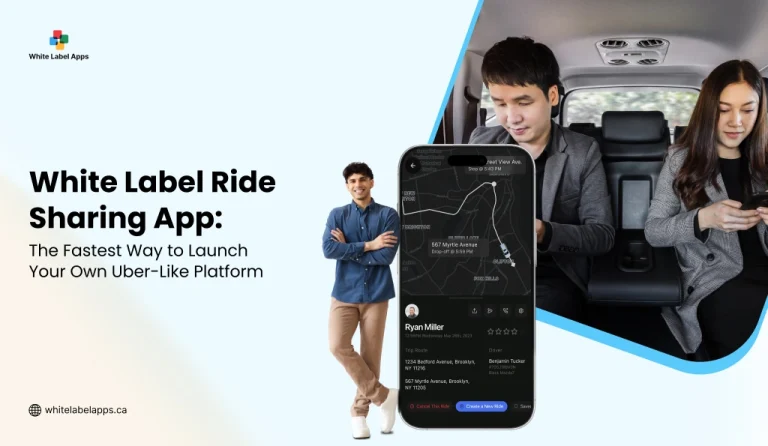
Building a ride sharing platform from scratch costs between $80,000 and $300,000 and takes 12 to 18 months. Most founders don’t have that runway. A white label ride sharing app changes that equation entirely.
The global ride-hailing market is projected to hit $179.70 billion in 2025 and grow to $342 billion by 2030, according to Statista. That’s one of the fastest-expanding sectors in on-demand services. A white label ride sharing app gets you into that market in weeks, with a fully built, branded platform that’s already been tested in production.
But most founders get the opportunity wrong. They think entering ride sharing means going head-to-head with Uber or Lyft. It doesn’t. The real gaps are in corporate mobility, regional markets without reliable coverage, campus transport, healthcare rides, carpooling, and luxury fleet services. Uber isn’t dominating those spaces. White label operators are moving in.
At WhiteLabelApps.ca, we build fully branded white label ride sharing apps for founders, fleet operators, agencies, and businesses across the US, UK, Canada, UAE, India, Southeast Asia, and Australia. We handle everything from initial configuration through launch and beyond. Your team doesn’t need an in-house dev team to go live.
This blog is built from real deployment experience and direct observation of what separates operators who launch from those who stall.
In this blog, we cover what a white label ride sharing app is, who it’s built for, which features matter, how the costs break down, and how to pick the right development partner.
TL;DR
- A white label ride sharing app gets you live in 4 to 8 weeks. A custom build takes 12 to 18 months for the same result.
- On cost, white label runs $3,000 to $25,000. Custom development starts at $80,000 and regularly clears $300,000 before you’ve completed a single ride.
- The ride-hailing market hits $342 billion by 2030, and the gaps worth entering aren’t in competing with Uber. They’re in corporate mobility, regional markets, and niche verticals that the big platforms ignore.
- To launch anything viable, you need four things at minimum: a passenger app, a driver app, an admin panel, and real-time GPS tracking.
- Choosing the wrong provider costs more than choosing the right one from the start.
Key Points
- The shared mobility market is growing at 16.61% CAGR through 2030. Southeast Asia, the UAE, and India are expanding fastest, and that’s exactly where white label ride operators are moving in.
- White label ride sharing apps cover full branding: your logo, your colors, your domain, your rates. You’re not reselling someone else’s product.
- A proper white label platform includes three separate apps: passenger-facing, driver-facing, and an admin panel for operations management.
- Revenue models go beyond ride commissions. Surge pricing, subscriptions, corporate accounts, and cancellation fees all add to platform income.
- Not all white label providers are equal. Source code ownership, SLA commitments, and customization depth vary significantly between vendors. Ask those questions before you sign anything.
- Operators who launch with a focused niche consistently outperform those who try to out-Uber Uber with a generic platform. That’s not a strategy. It’s a way to burn budget.
What Is a White Label Ride Sharing App and Why Does It Matter?
A white label ride sharing app is a ready-built, fully functional ride-hailing platform you brand and configure as your own. The passenger app, driver app, admin dashboard, dispatch logic, payment integrations, real-time GPS tracking — it’s all there. Already built. Already tested. You’re not starting from zero. Brand it, set your zones and pricing, and launch.
It’s not a template. It’s not a clone script held together with bad code. A proper white label ride sharing app is production-grade software built to handle real ride volumes, real driver fleets, and real user load. The branding gets swapped out. The technology underneath stays solid.
Why does this matter now? Because the barrier to entering the ride-sharing market used to be the technology. It isn’t anymore. The barrier today is speed. Markets move fast. A local operator who spots an underserved corridor, a corporate client who needs dedicated fleet access, a city government looking to replace aging transport systems — these opportunities don’t wait 18 months for a custom build to finish. White label solves the speed problem directly.
The White Label Ride Sharing App Market Opportunity in 2026
The numbers on ride sharing are hard to ignore. The global ride-hailing segment alone was valued at $158.65 billion in 2025 and is forecast to reach $342 billion by 2030 at a CAGR of 16.61%, according to Grand View Research. That growth isn’t coming from Uber expanding into new zip codes. It’s coming from new operators in new markets.
Southeast Asia is the fastest-growing region for on-demand mobility right now. India keeps expanding despite heavy competition — corporate and outstation services are still wide open. Nobody’s fully cracked those segments yet. The UAE is seeing demand for premium and business-class ride services that existing platforms don’t serve well. Meanwhile, in the US, rural and suburban markets remain largely ignored by major platforms.
That’s where the opportunity sits. Not in trying to replicate Uber’s global platform on day one. But in picking a specific vertical — corporate transport, campus rides, healthcare mobility, luxury fleets — and launching a white label ride sharing app built around that niche. Operators who do this consistently reach profitability faster than those who go broad.
Also Read: How White Label Ride Hailing Apps Help You Launch Faster
Who Actually Benefits From a White Label Ride Sharing App
Not everyone asking about white label ride sharing apps has the same goal. Some want to launch a local service. Others want to digitize an existing fleet. The right answer for a solo founder in Nairobi looks different from the right answer for a fleet operator in Dubai. But the underlying logic is the same: you need working software, fast, without a $200K development bill.
Here’s who this actually makes sense for.
1. Startup Founders and First-Time Entrepreneurs
If you’ve identified a gap in your local transport market and want to move on it before someone else does, a white label ride sharing app is the most direct path from idea to revenue. You’re not starting from zero. You’re not hiring a team of developers and spending six months in scoping sessions. You’re configuring a platform that already works, branding it as your own, and getting in front of your first riders and drivers in weeks.
The real advantage here isn’t just cost. It’s that you get to test your market assumptions quickly. If the demand is there, you scale. If you need to pivot to a different vehicle category or service model, a good white label platform can accommodate that without a full rebuild. Most first-time founders who try the custom route spend their entire runway before they’ve validated a single assumption. That’s a fixable problem.
2. Taxi Fleet Operators Going Digital
Traditional taxi businesses aren’t losing to Uber because their drivers are worse. They’re losing because the booking experience is stuck in 2005. Riders expect GPS tracking, upfront fare estimates, digital payments, and ratings. That’s the baseline now. Not a differentiator. A white label ride sharing app gives an existing fleet operator all of that, under their own brand, without disrupting their existing dispatch operation overnight.
Fleet operators also have one major advantage that pure-play startups don’t: they already have drivers. That solves the supply-side problem that kills most new ride-sharing platforms before they find traction. If you’ve got 30 licensed drivers and a dispatch team already, you can go from zero digital presence to a fully functioning app-based platform in under six weeks. Realistic timeline. Right partner matters though.
3. Agencies and Resellers Adding a Revenue Stream
Digital agencies are increasingly moving into white label app reselling as a service offering. Instead of closing one-off web projects, an agency can license a white label ride sharing app, rebrand it for a transport client, and deliver a fully operational platform under a retained contract. The client gets a faster, cheaper launch. The agency gets recurring revenue it wouldn’t see otherwise. Both sides win.
This works especially well in Southeast Asia, the UAE, and India. Transport businesses there want digital partners but don’t have the in-house capacity to manage a custom build. And agencies that have already delivered one or two ride platforms have a reference to point to. Each deal after that gets easier to close.
4. Businesses Entering Niche or Underserved Markets
Corporate mobility, healthcare transport, airport transfers, campus shuttles, B2B logistics — standard ride-hailing platforms don’t fully serve any of these. A corporate client needs invoicing, employee ride management, cost center allocation, and pre-approved driver rosters. Consumer apps aren’t built for that. That’s the gap.
A white label ride sharing app can be configured to serve these specific requirements without building from scratch. You’re launching into a niche where your buyers already have budget, already have a problem, and are actively looking for a solution that fits their workflow. That’s a much stronger starting position than launching a generic ride-hailing platform and hoping to out-market Uber.
Core Features Your White Label Ride Sharing App Must Include
Features make or break a ride-sharing platform. Get the basics wrong, and neither riders nor drivers will stick around. But there’s also a practical side to this: more features means more build time and more cost. White label gives you the foundation already built. What you’re configuring is which features to activate and how to tune them for your market.
Here’s what you actually need.
1. Passenger App Features
The passenger app is the face of your platform. Riders make up their mind in the first two taps. The features that earn that trust: real-time ride booking, GPS-based driver tracking, upfront fare estimates before confirmation, in-app payments with multiple gateway options, ride scheduling, driver ratings and reviews, SOS and emergency contact sharing, and trip history with digital receipts.
Add multi-language and multi-currency support if you’re targeting markets outside North America. In Southeast Asia and the UAE, local payment method integration (wallets, UPI, local card processors) can make or break your adoption rate. OTP-based ride start (where the driver can’t begin the trip until the rider confirms with a one-time code) is a fraud prevention feature worth activating from day one.
2. Driver App Features
Drivers are your supply side. A clunky, slow driver app kills retention fast. Drivers have options. If your app makes their workday harder, they’ll find one that doesn’t. The driver app needs to handle ride request acceptance and rejection, turn-by-turn navigation, real-time earnings tracking, in-app wallet and payout management, shift management, and a clear trip history view.
Some markets benefit from driver-to-driver chat and community features, especially where driver associations are active. On the compliance side, vehicle document upload, background check integration, and real-time compliance status tracking keep operators on the right side of local regulations without someone chasing paperwork manually.
3. Admin Panel Features
The admin panel is where you run the business. Zone-based pricing, driver approval and document verification, live trip monitoring, surge pricing controls, promo code management, payout scheduling, detailed analytics across drivers, rides, and revenue. All of it lives in the admin dashboard. One place, full control.
A well-built admin panel means your ops team can change your fare structure, add a new service zone, or push a promotional campaign without touching the codebase. That operational independence is one of the most undervalued features in a white label ride sharing app. The alternative is calling your developer every time your pricing model changes.
4. Advanced Features That Drive Retention
Beyond the basics, some features actively drive retention and revenue. AI-powered dispatch cuts wait times and improves match rates. Surge pricing with configurable caps keeps revenue up during peak demand without pushing riders away. Multi-vehicle categories (sedan, SUV, luxury, auto, bike taxi) let you serve different price points from one platform. In-app chat between rider and driver cuts call volume and complaints. Loyalty and referral programs grow your user base without burning ad budget.
Carpooling functionality is worth activating if your market is cost-sensitive. It’s not just a feature — it’s a different revenue model that reduces the effective cost per ride for the rider while keeping the driver’s earnings per trip competitive.
Read Also: How to Build a White Label Rideshare App Like Uber or Lyft
Tech Stack Behind a White Label Ride Sharing App
The tech stack isn’t the exciting part. But get it wrong early and you’ll pay for it later — performance issues at scale, maintenance headaches, costs that compound quietly. Here’s what a production-grade white label ride sharing app actually runs on, and why each layer matters.
A proper stack prioritizes real-time performance above everything else. Every action in a ride-hailing platform — booking, matching, tracking, payment — happens in seconds. The backend needs to handle concurrent connections across potentially thousands of simultaneous users without degrading. The database choice determines how well the platform scales as you add markets. The maps and navigation layer determines how accurately your platform works in real conditions.
| Layer / Component | Technologies Used |
| Frontend (Passenger & Driver Apps) | React Native / Flutter |
| Backend | Node.js / Python (Django or FastAPI) |
| Database | PostgreSQL, MongoDB |
| Real-Time Engine | Socket.IO, Firebase Realtime Database |
| Maps & Navigation | Google Maps API, Mapbox |
| Payment Gateway | Stripe, PayPal, Razorpay, local processors |
| Cloud Infrastructure | AWS / Google Cloud / Azure |
| Push Notifications | Firebase Cloud Messaging (FCM) |
| Admin Panel | React.js / Vue.js |
White Label Ride Sharing App vs. Custom Development — Real Cost Comparison
Custom ride-sharing app development is expensive and slow. The numbers back this up consistently. A basic custom MVP covering rider app, driver app, and admin panel built by a mid-tier agency in North America or Western Europe starts at $80,000. Anything feature-complete runs $150,000. Full-scale platforms with advanced dispatch, multi-vehicle categories, and analytics routinely hit $200,000 to $300,000 or more.
Timeline is just as painful. Custom builds take 12 to 18 months on average for a production-ready platform. That’s 12 to 18 months of runway burned before your first ride is completed. A white label ride sharing app, by contrast, is already built. Configuration, branding, and deployment typically run 4 to 8 weeks. The platform is tested. The core bugs are already found and fixed. You’re not paying for that discovery process.
| Factor | Custom Development | White Label |
| Upfront Cost | $80,000 to $300,000+ | $3,000 to $25,000 |
| Timeline to Launch | 12 to 18 months | 4 to 8 weeks |
| Team Required | 8 to 15 developers, QA, PM, designers | 2 to 4 configuration specialists |
| Ongoing Maintenance | 15 to 20% of build cost annually | Included in support plan |
| Customization | Full — but every change costs dev time | Configurable within platform parameters |
| Source Code Ownership | Full ownership | Varies by provider — ask upfront |
| Risk Level | High — budget overruns are common | Low — tested platform, predictable cost |
How WhiteLabelApps.ca Builds Your White Label Ride Sharing App
We don’t hand you a zip file and walk away. Our process runs from the initial brief through to a live platform, and we stay involved through launch and beyond.
Step 1: Discovery and Requirements
We start with a discovery call to map out your target market, service type, vehicle categories, pricing model, and regulatory context. We ask the questions most in-house teams don’t think to ask upfront. How do drivers get paid in your market? What payment gateways are locally trusted? Are there local SIM or language requirements for the driver app? This phase takes one to two weeks and produces a clear configuration brief.
Step 2: Branding and UI Configuration
Your brand goes across every touchpoint: app icons, splash screens, color palette, typography, onboarding screens, email templates. We set up the admin panel with your business name, support contact details, and initial pricing zones. Nothing goes out looking generic. You review everything before we proceed.
Step 3: Feature Activation and Integration
Based on your brief, we activate the feature set your market needs. Payment gateway integration is handled in this phase — we connect your preferred processors, configure your payout schedule, and test every transaction flow. Maps API integration is calibrated for your operating geography. Multi-language packs are applied if required.
Step 4: QA and Testing
Before anything goes to the store, it runs through our internal QA cycle: functional testing across iOS and Android, load testing on the backend, payment flow verification, real-device GPS testing. Problems caught before launch cost a fraction of what they cost after. That’s why this step doesn’t get skipped.
Step 5: Launch and Post-Launch Support
We handle app store submission for Google Play and the Apple App Store, including screenshots and listing copy. Your admin team gets a full panel walkthrough before go-live. After launch, we cover a defined support window for bug fixes and operational questions. When you’re ready to grow, the upgrade path is already mapped out.
Also Read: White Label Taxi App Development Guide
Challenges in White Label Ride Sharing App Development
White label doesn’t mean zero effort. There are real challenges in launching a ride-sharing platform. Any provider who tells you otherwise is overselling. Here’s what you’ll actually run into, and how experienced operators handle each one.
1. Driver Recruitment Before Launch
Your platform is worthless on day one without drivers. This is the classic chicken-and-egg problem in ride-sharing. It doesn’t disappear just because your app went live faster. Rider demand without driver supply creates cancellations and bad reviews. Those stick around long after you’ve fixed the supply problem.
The mitigation is straightforward: recruit drivers before you launch to riders. Run a driver sign-up campaign two to four weeks before your public launch. Offer guaranteed earnings or reduced commission for the first 30 days. Use your admin panel to manually track early driver activity and identify your most reliable operators early. Some markets also respond well to direct outreach through driver communities and local transport associations.
2. Local Regulatory Compliance
Ride-hailing is regulated differently in every market. Get it wrong and your platform gets pulled. Some jurisdictions require a transport network company (TNC) license before you can operate commercially. Others require specific driver insurance classifications or commercial vehicle registrations. In the UAE, requirements vary significantly between Emirates. Same country, different rules.
Do your compliance homework before launch, not after. Work with a local transport lawyer in your target market. Build your driver document verification flow to collect the exact credentials your jurisdiction requires. A white label platform that handles document upload and compliance status tracking makes this easier, but the legal requirements are on you to understand first.
3. Payment Infrastructure and Trust
Payments are where platforms lose riders and drivers fastest. A failed payment, a delayed payout, a confusing earnings dashboard — trust goes quickly and doesn’t come back easily. In markets where cash is still common, a cash-balance reconciliation system inside your admin panel isn’t optional. It’s essential.
The mitigation is testing payment flows exhaustively before launch, using locally trusted payment processors, and offering drivers a clear and predictable payout schedule from day one. Weekly payouts outperform fortnightly ones for driver satisfaction, particularly in markets where drivers are living close to their operating margins.
4. Scaling Beyond the First City
Most white label operators launch successfully in their first market and then stall when they try to expand. The reasons are usually operational, not technical. Different cities need different pricing structures, different vehicle categories, sometimes different driver onboarding requirements. A good admin panel handles the multi-zone configuration side. But expansion still requires on-the-ground driver recruitment, local marketing, and a compliance review for each new jurisdiction. The tech scales. The operations take work.
Plan your second-city expansion before you launch your first. Build a replicable playbook from day one: driver recruitment timeline, pricing calibration process, local marketing budget, regulatory checklist. City one is the template. Operators who treat it that way consistently outperform those who don’t.
Monetization Strategies for Your White Label Ride Sharing App
Revenue in ride-sharing isn’t limited to per-ride commissions. Operators who build multiple income streams into their platform from the start are consistently more resilient than those who live and die on ride volume alone. Here are seven models worth building into your platform from day one.
1. Commission per ride
The foundational model. You take a percentage of every fare. Typical rates run 15% to 25% depending on market and vehicle category. Your admin panel controls this in real time. Adjust by zone, by time of day, or by driver tier without touching the codebase.
2. Surge pricing
During peak hours or high-demand events, the platform applies a fare multiplier automatically. Done right, revenue goes up without ride volume dropping. Riders who need a ride in a high-demand moment will pay more. That’s just how it works. Set surge caps so you don’t price yourself out of the market during normal operations. That balance is configurable from your admin panel.
3. Driver subscriptions
Some operators skip per-ride commissions entirely and offer drivers a flat weekly or monthly subscription covering unlimited rides. It works well in dense urban markets where high-volume drivers resent handing over 20% per trip. They’d rather pay a predictable flat fee and keep the rest. You get predictable revenue; drivers get cost certainty.
4. Corporate accounts
B2B rides carry higher margins and generate reliable volume. Set up corporate accounts with invoicing, employee management, and trip reporting. A corporate client booking 500 rides a month at a negotiated rate is worth more than 500 individual riders who each use you once. Predictable volume, longer retention, higher margins. That’s the corporate account advantage.
5. In-app advertising
As your rider base grows, local businesses will pay to put offers or banners in your passenger app. Airport lounges, hotels, restaurants near common drop-off points — these convert well in a ride-hailing context. It’s passive income on top of your core ride revenue.
6. Cancellation and no-show fees
Configure a cancellation fee that kicks in after a defined waiting window. It protects driver earnings and cuts down on riders booking trips they never intended to take. Small feature, real impact on driver satisfaction.
7. Multi-service expansion
A platform that started as ride-sharing can expand into food delivery, courier services, or package logistics using the same driver network and dispatch infrastructure. Same drivers, same tech, new revenue stream.
Also Check: White Label Taxi Dispatch Software Features Every Fleet Needs
How to Choose the Right White Label Ride Sharing App Provider
The provider you pick determines how fast you launch, how much you can customize, and how much support you get when things go wrong. Most operators spend more time choosing their office furniture than evaluating their tech provider. Don’t be that operator.
Green flags to look for:
- They can show you a live demo of the platform, not a video walkthrough.
- They provide clear documentation on what can and can’t be customized.
- Source code ownership terms are spelled out in the contract, not buried in fine print.
- They have reference clients you can actually contact.
- Their SLA covers response times for production bugs, not just general support.
- Post-launch support is included for at least 30 days, not sold as an add-on.
- They’ve deployed in markets similar to yours and can speak to local compliance considerations.
Red flags to walk away from:
- No demo access before you sign. If they won’t show you a live platform, there’s a reason.
- Unlimited customization promises with no scope definition. Everything has limits — a provider who says otherwise is setting you up for a scope dispute.
- Vague answers about data ownership and where your rider and driver data is stored.
- “We’ll launch in 3 days” timelines that don’t account for branding, configuration, payment integration, and QA. That’s not a timeline. That’s a sales pitch.
Future Trends Shaping White Label Ride Sharing App Development
The ride-sharing industry is changing fast. Operators who understand where it’s going are better positioned to build platforms that last.
1. AI-powered dispatch
Machine learning is replacing static dispatch logic. AI systems predict demand by zone before it peaks, pre-position drivers automatically, and match riders to drivers in ways that reduce wait time and increase driver utilization. This isn’t experimental — platforms like DiDi and Bolt are already running AI dispatch at scale. White label platforms are beginning to incorporate this at the configuration level.
2. Electric vehicle integration
EV-specific features (charging station routing, battery range display, reduced-emission pricing tiers) are becoming standard in markets like the UK, Australia, and urban Canada. Building an EV-first fleet? You need a platform that handles these natively. Not bolted on later. Built in from the start.
3. Multi-service super-apps
The push toward super-apps combining ride-hailing, food delivery, courier, and concierge services under one brand is accelerating in Southeast Asia and the Middle East. A white label operator who launches with ride-sharing today and adds delivery or logistics tomorrow, without rebuilding anything, has a real advantage over single-service competitors.
4. Corporate and B2B mobility
Remote work created a corporate mobility problem that traditional ride-hailing platforms don’t fully solve. Dedicated driver assignment, advance booking for executive travel, and integrated expense reporting are features that corporate clients are actively paying for. This is a growth segment with higher margins and longer customer lifespans than consumer rides.
5. Ride-as-a-Service (RaaS)
Businesses, universities, and municipalities are increasingly contracting entire ride platforms as a service rather than managing transport in-house. A white label operator who packages their platform as a managed RaaS offering — including driver management, compliance, and reporting — can command significantly higher contract values than a standard ride-hailing operator.
6. Regional market expansion
The next decade of ride-sharing growth is in secondary and tertiary cities across India, Southeast Asia, and Africa. Major platforms are not prioritizing these markets. White label operators who move in early with locally tuned platforms have a window to build brand loyalty before the big players arrive.
Read Also: What Is White Label Taxi Software? A Complete Buyer’s Guide
Why Choose WhiteLabelApps.ca for Development of Your White Label Ride Sharing App
We’ve deployed white label ride-sharing platforms for founders, fleet operators, and digital agencies across the US, UK, Canada, UAE, India, Southeast Asia, and Australia. We know what breaks in production. We know what riders expect in different markets. We know which payment gateways actually process reliably in your region and which ones look good in a demo but fail in real conditions.
Our platforms go live in 4 to 8 weeks. That’s not a marketing claim — it’s the actual timeline when a client comes in with a clear brief, a defined market, and a decision-making process that doesn’t stall. We don’t pad timelines to manage expectations. We build fast because our platforms are already built.
Every platform we deliver is fully branded under your name. Your riders never see our name. Your drivers never see our name. The admin panel carries your branding. The app store listings are yours. The data is yours.
We also stay involved after launch. Our post-launch support covers bug fixes, performance monitoring, and operational questions from your ops team. When you’re ready to add a new vehicle category or expand to a second city, we’re the team that handles it — you don’t have to re-explain your platform to a new developer every time you want to grow.
Ready to get your platform in front of riders? Visit whitelabelapps.ca to book a discovery call.
White Label Ride Sharing Apps We Can Rebrand for You
We offer two proprietary ride-sharing platforms ready for rebranding today. Both are production-tested, actively maintained, and built to handle real ride volumes from day one. You’re not getting a demo-grade product dressed up as something launch-ready. These are platforms we’ve already configured, tested, and deployed across multiple markets. Pick the one that fits your business model, and we’ll have it live under your brand in weeks. Here’s what each one is built for.
Zefir runs on a zero-commission model. Drivers keep 100% of their fare earnings. The platform makes money through driver subscriptions instead. It’s gaining traction in markets where commission-based platforms have pushed drivers to look for something better. That opening is real, and it’s growing. If your target market includes gig workers who are frustrated with existing platforms, Zefir gives you a compelling positioning story from day one.
Cruxe is a multi-service, dark-themed platform built for markets that want a premium feel and broad service coverage. One brand, multiple vehicle categories: standard, SUV, luxury, bike taxi, auto-rickshaw. The dark interface performs well in evening-dominant urban markets and tends to land well with younger rider demographics. Cruxe is a strong fit for operators targeting lifestyle-oriented urban audiences or building a premium fleet service.
Both platforms are production-ready, fully tested, and available for immediate configuration under your brand. Contact us at whitelabelapps.ca to see a live demo of either platform.
Conclusion
The ride-sharing market has room for more players. Not generic Uber clones trying to go everywhere at once, but focused operators who know their market, know their riders, and launch fast enough to build real brand loyalty before competitors notice. That’s the actual opportunity here.
Custom development isn’t the gatekeeper it used to be. You don’t need 18 months and $200,000 to put a fully functional, fully branded ride-sharing platform in front of drivers and riders. A white label ride sharing app gets you there in weeks, with tested infrastructure and real post-launch support behind it.
The operators who win in this space aren’t the ones who waited for the perfect build. They’re the ones who picked the right platform, launched in their target market, and iterated from a live product with real users. That advantage compounds fast.
If you’ve got a market in mind, we can get you live. Reach out to WhiteLabelApps.ca and let’s talk about what your platform needs to look like.
FAQs
1. How Long Does It Take to Launch a White Label Ride Sharing App?
Most white label ride sharing app projects go live in 4 to 8 weeks from brief to app store. That includes branding, configuration, payment integration, QA, and store submission. Custom builds take 12 to 18 months for the same result.
2. How Much Does a White Label Ride Sharing App Cost?
White label ride sharing apps typically run $3,000 to $25,000 depending on features and customization depth. Custom development for a comparable platform starts at $80,000 and regularly exceeds $200,000. You’re paying for the speed and the tested codebase, not just the license.
3. Can I Customize a White Label Ride Sharing App With My Own Branding?
Yes. A proper white label ride sharing app replaces every visible brand element: app name, logo, color palette, splash screens, email templates, and app store listings. Riders and drivers see only your brand. Customization depth on features varies by provider, so confirm scope before you sign.
4. Do I Own the Data From My White Label Ride Sharing App?
You should. Rider profiles, trip history, driver records, and payment data generated by your platform should belong to you. Confirm data ownership terms in writing before signing with any provider. Some white label vendors store data on shared infrastructure without clear ownership provisions — that’s a risk.
5. What’s the Difference Between a White Label Ride Sharing App and an Uber Clone Script?
A clone script is typically low-cost, poorly maintained code that replicates Uber’s surface features without production-grade architecture underneath. A white label ride sharing app is a tested, supported platform that is actively maintained and updated. You get a real support SLA, ongoing updates, and a team you can contact when something goes wrong. Clone scripts are cheaper upfront and more expensive long-term.
6. Which Markets Are Best for Launching a White Label Ride Sharing App Right Now?
Southeast Asia, India, the UAE, and secondary cities across Africa and Latin America have the strongest growth fundamentals for new ride-sharing operators. In North America and the UK, niche verticals — corporate mobility, healthcare transport, campus services — offer better entry points than competing head-on with Uber in major metro markets.