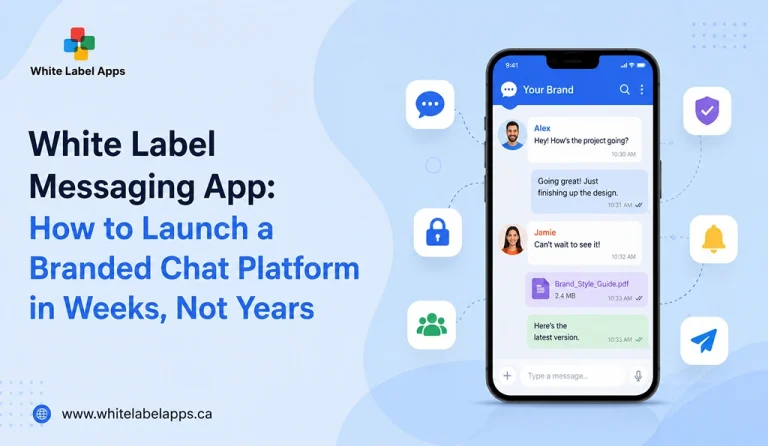
Startup founders building communication features into their products are running into the same wall. Developers quote six figures and a year-long timeline. The budget isn’t there. The runway isn’t there. And the product doesn’t launch.
The global instant messaging app market was valued at USD 28.62 billion in 2024 and is on track to reach USD 47.51 billion by 2034, growing at a steady 5.2% annually. That’s a lot of demand for branded, in-app communication. White label app development is the fastest way for a startup to capture a share of it without spending a year in development.
Startups in Canada, the US, the UK, and Australia are the ones feeling this most. They’re building marketplaces, healthcare platforms, gig economy apps, and community tools. All of them need users to communicate inside the product. None of them can afford to build a messaging platform from scratch. The ones that figure out the white label route first are the ones that get to market first.
At WhiteLabelApps.ca, we build and deploy fully branded communication platforms for startup founders, digital agencies, and enterprise teams across North America, the UAE, India, and Southeast Asia. From the first configuration call through App Store submission and post-launch support, our team handles the technical side so founders can focus on growing the product.
This blog is built on real deployment experience, direct market research, and the patterns we’ve seen across dozens of white label messaging app launches.
Here, we cover what a white label messaging app actually is, what features matter, how much it costs, what the launch process looks like, and how to pick the right development partner without getting burned.
TL;DR
- A white label messaging app is a ready-built chat platform you brand as your own. Your logo, your name, your app store listing.
- Building one from scratch costs $80,000 to $500,000 and takes 6 to 18 months. A white label solution typically costs $5,000 to $25,000 and goes live in 4 to 10 weeks.
- You own your data. Your users never know someone else built the underlying platform.
- It works for healthcare, startups, enterprise teams, and agencies.
- WhiteLabelApps.ca has ready-to-deploy messaging platforms we can brand and launch for you.
Key Points
- White label messaging apps come fully built. You’re not paying to create something from zero. You’re paying to put your name on something that already works.
- The cost difference between custom and white label is not small. Most founders save 70% to 85% compared to a full custom build.
- You don’t need a developer on your team to launch. Our team handles the technical side. You handle the branding decisions.
- Your data stays yours. Good white label providers let you host on your own servers or give you full data export rights.
- The most common mistake startups make is waiting too long. If your product needs messaging and you don’t have it, you’re losing users to competitors who do.
- HIPAA and GDPR compliance is possible with white label messaging apps. It depends on the provider and configuration, and we’ll cover exactly what to look for.
- White label also works as a reseller model. If you’re an agency, you can offer branded messaging apps to your clients and charge recurring fees.
What Is a White Label Messaging App and How Does It Work?
A white label messaging app is a chat platform that someone else built. You buy the rights to use it, put your brand on it, and sell it or offer it to your users as if you made it yourself.
The platform is built and maintained by a development company. You add your logo, your colours, your app name. Your users download it and never see the company that built the underlying system.
1. How a White Label Messaging App Works Under the Hood
You don’t need to understand the technical side to use one of these platforms. But here’s a simple version of what’s happening.
The messaging app has two parts. The part your users see (the chat screen, the contacts list, the notifications) and the part that runs behind the scenes (the server, the database, the security layer).
With a white label solution, both parts are already built and tested. When you buy it, you get access to change everything your users see. Colours, logo, app name, notification messages. The part running behind the scenes stays the same. It’s already working. You’re not touching it.
You can host the app on your own servers or let the provider host it for you on their servers. Either way, the app is yours to run.
2. White Label Messaging App vs. Building from Scratch: What’s the Actual Difference?
The difference is time and money. That’s it.
Building a messaging app from scratch means hiring a team of developers, designers, and QA testers. You’re writing every line of code yourself. You’re building the chat server, the database, the encryption layer, the push notification system. Then testing all of it. Then fixing what breaks. Then submitting to the App Store. Then waiting for approval.
That process takes 6 to 18 months and costs $80,000 to $500,000 on average. And that’s before you’ve acquired a single user.
A white label messaging app skips all of that. The code is written. The testing is done. The server is running. You’re just adding your brand and launching. Most projects go live in 4 to 10 weeks.
For a startup in Canada with $30,000 in runway, that difference is everything.
3. White Label vs. Open Source vs. Third-Party SaaS: Which Gives You More Control?
This is a question we get a lot, and the honest answer depends on what “control” means to you.
Open source messaging platforms (like Rocket.Chat or Matrix) let you see every line of code and change anything. But you need developers on your team to set it up, maintain it, and keep it secure. If something breaks at 2am, that’s your problem to fix. It’s not for founders without technical teams.
Third-party tools like Slack or WhatsApp are fast and cheap to set up. But your users are talking on Slack’s platform, not yours. Your brand isn’t front and centre. And you have zero control over the data. Slack’s terms, Slack’s pricing changes, Slack’s servers.
A white label messaging app sits between the two. You don’t control the source code (unless you negotiate that separately). But you control the brand, the data, the pricing, and the user experience. And you’re not dependent on Slack deciding to change their API one Tuesday morning.
For most startups, white label gives the right amount of control without the headache of open source.
What Features Does a White Label Messaging App Actually Include?
Not all white label messaging apps are built the same. Some come with the basics. Others include voice and video calling, AI replies, payment integrations, and more.
Here’s what a solid platform should include and what it means for your business. Don’t just buy based on a feature list. Ask to see a demo of each one working.
1. Real-Time Messaging, Group Chat, and Broadcast Capabilities
The basics. Users can message each other one-on-one. They can create groups. They can see when someone is typing. They can see when their message was read.
That’s what your users expect. Anything less and they’ll compare it to WhatsApp and find it lacking.
Beyond the basics, look for broadcast messaging. This lets you send a message to all users (or a group of users) at once. Useful for announcements, promotions, or system updates. One message goes out to everyone. Nobody else sees who else received it.
2. Does a White Label Messaging App Support End-to-End Encryption?
It should. And if a provider can’t confirm this clearly, walk away.
End-to-end encryption means that when your user sends a message, only the person they’re sending it to can read it. Not the servers. Not the provider. Not you. Just the two people in the conversation.
This matters for two reasons. First, your users will ask about it. Privacy is a real concern and Canadian users in particular expect it. Second, if you’re operating in a regulated industry like healthcare or finance, it’s often a legal requirement.
Most reputable white label messaging platforms use AES-256 encryption for stored messages and TLS 1.3 for messages in transit. Ask for this in writing before signing anything.
3. How Much Can You Customize Branding in a White Label Instant Messaging App?
More than most founders expect. Less than some providers claim.
Here’s what you can almost always change: your logo, your app name, your colour scheme, your app icon, your notification copy (“You have a new message from [contact name]” instead of a generic alert), and your app store listing.
Here’s what is usually fixed: the core chat interface layout, the underlying messaging protocol, the server architecture. You can’t usually redesign the chat screen from scratch. You’re working within the existing layout.
The honest version: if you want something that looks exactly like WhatsApp with your branding, you’ll get very close. If you want a completely different chat interface design, you’ll need custom development on top of the white label base. That adds cost and time, but it’s doable.
4. Push Notifications, Admin Panel, and User Management Tools
This is the part founders underestimate. The admin panel is where you actually run your app.
From your admin panel, you can add and remove users, see who’s active, manage groups, turn features on or off for different user types, and handle reports or flagged content. No developer call needed for any of this. It’s all point and click.
Push notifications let you reach users even when they’re not in the app. A message comes in, their phone buzzes, they open the app. Standard behaviour. But look for the ability to customise the notification text. “You have a new message” is fine. But “Your client sent you a proposal” is better.
5. Does a White Label Messaging App Support Multi-Platform Deployment?
Yes. Any decent platform ships on iOS, Android, and Web at minimum. Some also include a desktop version for Windows and Mac.
You don’t need to build a separate version for each platform. The white label provider handles that. You get one admin panel and all platforms update together.
This matters because your users won’t all be on the same device. A startup founder in Vancouver might use the desktop. Their client in Toronto might use iPhone. Their supplier in Mississauga might use Android. Your app needs to work for all three.
Also Read: How to Make Money With White Label Apps
Who Should Use a White Label Messaging App (And Who Should Not)?
White label messaging apps work really well for a specific type of buyer. They’re not for everyone. Here’s an honest breakdown.
1. White Label Messaging App for Healthcare Providers: HIPAA and Patient Communication
Healthcare is one of the fastest-growing markets for white label messaging apps in Canada and the US. And it makes sense.
Doctors and clinics need to communicate with patients. But they can’t use WhatsApp or regular text messages. Patient information is protected under HIPAA in the US and PIPEDA in Canada. Using an uncertified communication tool puts clinics at legal risk.
A white label messaging app built for healthcare gives providers a secure, branded channel to communicate with patients. Appointment reminders, follow-up messages, prescription notifications. All encrypted, all compliant, all under the clinic’s brand.
If you’re building for healthcare, ask specifically whether the platform is HIPAA-compliant and what that means in practice. Some providers say “HIPAA-ready” but leave the compliance setup to you. Others handle it for you. Know which you’re getting.
2. White Label Team Messaging App for Enterprise and Remote Workforces
Canadian enterprises with remote teams are spending money on multiple communication tools. Slack for one team, Teams for another, email for a third. Nobody’s talking in the same place and things fall through.
A white label team messaging app gives companies one branded internal platform. Everyone’s on the same tool, with the same brand, under the company’s own servers. IT has full control over who accesses what. HR can archive conversations for compliance. Managers can set permissions without calling a developer.
This is especially relevant for industries like construction, logistics, and utilities where workers are spread across locations and need reliable communication that works on a basic Android phone.
3. Can Startups Use a Private Label Communication App Without a Dev Team?
Yes. That’s actually the whole point.
Most startups that come to us don’t have a developer on staff. They have an idea, a budget, and a deadline. A white label messaging app (sometimes called a private label communication app) lets them launch a working chat feature without hiring a dev team.
You make the branding decisions. What’s the app called? What colour is the header? What does the welcome message say? We handle everything else. By the time your first user signs up, they’re using a fully working messaging app with your brand on it.
4. Can I Resell a White Label Messaging App to My Clients?
Yes, and this is a real revenue model for Canadian agencies.
Here’s how it works. You license a white label messaging platform from a provider like WhiteLabelApps.ca. You brand it for your agency. Then when a client comes to you needing a chat feature for their app or website, you deploy a version of that platform under their brand and charge them a monthly fee.
You don’t need to rebuild anything for each client. The underlying platform is the same. You’re just changing the branding and settings. Each client gets their own version. You manage everything from one dashboard.
Agencies doing this in the Toronto, Vancouver, and Calgary markets are charging clients $500 to $3,000 per month for branded messaging platforms. The platform cost is fixed. The margin scales with every new client you add.
5. When Is a White Label Messaging App the Wrong Choice?
It’s not right for everyone. Here’s when you should look at other options.
If you need a chat feature that works in a very specific way that doesn’t exist anywhere on the market, you might need a custom build. White label works within a structure. You’re customising it, not rebuilding it.
If your entire competitive advantage is the chat experience itself (think a platform where the messaging system is the product, not just a feature), you might want to own the source code fully. That’s a different conversation.
And if you genuinely have zero budget, white label platforms aren’t free. They’re a fraction of the custom cost, but there’s still a cost. Open source might be a starting point if you have technical skills or access to a developer.
What Tech Stack Powers a White Label Messaging App Development Project?
Most startup founders don’t care about all of this, and that’s largely okay. But having at least some familiarity with the technology stack enables you to have more pointed (and useful) questions when evaluating white label messaging app vendors. It’s the difference between the vendor telling you they have “scalable infrastructure” and actually understanding what that’s going to mean for your app, your users, and your pocketbook in 3 years.
| Layer | Technology | What It Does for Your App |
| Mobile (iOS) | Swift, Objective-C | Native iPhone and iPad performance |
| Mobile (Android) | Kotlin, Java | Native Android performance across devices |
| Cross-platform | React Native, Flutter | One codebase runs on both iOS and Android |
| Web app | React.js, Vue.js | Browser-based version of your messaging app |
| Backend server | Node.js, Python | Handles all messaging logic and user requests |
| Real-time messaging | WebSockets, Socket.IO | Delivers messages instantly without page refresh |
| Database | MongoDB, PostgreSQL | Stores messages, user data, and chat history |
| File and media storage | AWS S3, Google Cloud Storage | Stores photos, videos, and documents users share |
| Push notifications | Firebase (FCM), APNs | Sends alerts to iOS and Android when new messages arrive |
| Encryption | AES-256, TLS 1.3 | Keeps messages private in storage and in transit |
| Hosting | AWS, Google Cloud, on-premise | Where the app lives and how it stays online |
1. How Secure Is the Tech Stack Behind a White Label Messaging App?
Security is not an extra. It is integrated into every layer. Message level: only sender/receiver can read the message (end-to-end-encryption).
- Storage level: server storing the messages should be encrypted.
- Login level: 2-factor-authentication (users confirm their identity with a second step like a text code).
- Access level: single sign-on (enterprise users can log in with their company account instead of creating a password).
| Security Feature | What It Does | Required For |
| End-to-end encryption (AES-256) | Only sender and recipient can read messages | All use cases |
| TLS 1.3 | Protects messages while they travel between phone and server | All use cases |
| Two-factor authentication | Second login step to verify identity | Enterprise, healthcare |
| Single sign-on (SSO) | Log in with existing company account | Enterprise |
| HIPAA compliance configuration | Meets US healthcare privacy law | Healthcare |
| GDPR compliance | Meets EU and UK privacy law | EU/UK users |
| PIPEDA compliance | Meets Canadian privacy law | Canadian users |
| On-premise hosting option | Data stays on your servers, not the provider’s | High-security industries |
How Much Does a White Label Messaging App Cost to Build and Launch?
The short answer: between $5,000 and $25,000 for a white label solution. A comparable custom build would cost $80,000 to $500,000.
That’s not a typo. The difference is that real.
The reason is simple. With a custom build, you’re paying developers to write every line of code, every feature, every security system from scratch. With white label, that work is already done. You’re paying for configuration, branding, and deployment.
1. What Drives the Cost of White Label Messaging App Development?
A few things move the number up or down.
The number of platforms affects the cost. Launching on iOS and Android is standard. Adding a web version and a desktop version increases the scope.
The features you want matter too. A basic text messaging app costs less than one with video calling, file sharing, payment integration, and a multi-language interface.
Third-party integrations add cost. Connecting your messaging app to a CRM system, a booking tool, or an existing database takes development work.
Post-launch support is often underestimated. Hosting, server maintenance, security updates, and bug fixes add ongoing monthly costs. Make sure you understand what’s included in the initial price and what you’ll pay monthly after launch.
2. Is There an Affordable White Label Messaging App Option for Small Businesses?
Yes. And this is where white label genuinely stands out.
Small businesses and early-stage startups in Canada often have budgets under $15,000. That’s not enough for a custom messaging build. But it’s enough for a well-configured white label messaging app.
For that budget, you can get a branded messaging app on iOS and Android with core features (1-1 messaging, group chat, push notifications, admin panel, basic encryption) deployed and live. You won’t get video calling and a payment integration and a custom AI chatbot at that price point. But you’ll get a working, professional app that your users will take seriously.
3. One-Time License vs. Monthly SaaS vs. Revenue Share: Which Pricing Model Fits?
Providers offer different ways to pay, and none of them is universally better. It depends on your situation.
A one-time license means you pay once and own the software. No monthly fees. But you’re often responsible for your own hosting and maintenance. Good for businesses that have technical staff and want to control costs long-term.
A monthly SaaS model means you pay a recurring fee (usually $300 to $2,000 per month depending on users and features). The provider handles hosting, updates, and maintenance. Good for startups that don’t want to think about servers.
A revenue share model means you pay little or nothing upfront and the provider takes a percentage of your revenue. Good if your cash is tight at launch but can get expensive once you’re growing.
| Factor | Custom Development | White Label |
| Upfront cost | $80,000 to $500,000 | $5,000 to $25,000 |
| Time to launch | 6 to 18 months | 4 to 10 weeks |
| Technical team needed | Yes | No |
| Ongoing maintenance | Your responsibility | Provider handles it |
| Branding control | Full | High |
| Source code ownership | Yes | Negotiable |
| Scalability | High | High |
| Compliance support | Your responsibility | Provider handles it |
How Do We Build and Launch Your White Label Messaging App?
Here’s exactly what working with WhiteLabelApps.ca looks like. No surprises, no vague timelines.
Step 1: Discovery, Requirements, and Brand Audit (1–3 Days)
We start by understanding what you actually need. Not what sounds good in a sales call. What your users will do on the app: your industry-specific compliance requirements your brand. We will inquiry about your logo, your color scheme, the name of your application, your target audience and if you have any hosting decision.
This is the most important step. Decisions made here affect everything else.
Step 2: Platform Configuration and White Label Branding Setup (3–5 Days)
This is where your brand goes on the platform. We configure the app with your logo, colours, app name, and notification copy. We set up your admin panel. We set your default features.
You don’t touch any code during this step. You review screenshots and a staging version of the app and tell us what to change.
Step 3: Feature Customization and Third-Party Integration (1–3 Weeks)
If you need features beyond the standard set (a payment integration, a custom user verification flow, a connection to your existing database), this is where that work happens.
Most startups keep this minimal for v1. Launch with what users need. Add what they ask for in v2. Trying to build everything at once is how projects run over budget and over time.
Step 4: QA, Security Testing, and Compliance Review (1 Week)
Before anything goes live, we test it. We test the messaging under load (what happens when 500 users are chatting at the same time). We test the encryption. We test push notifications on iOS and Android. We test the admin panel on different browsers.
If your industry requires HIPAA or PIPEDA compliance, we do a compliance review at this stage and document what’s been configured to meet the standard.
Step 5: How Do We Publish a White Label Messaging App on the App Store and Google Play?
App store submission is one of the steps founders don’t think about until it’s too late. Apple’s review process alone can take 1 to 3 weeks. We handle the submission on your behalf.
You’ll need an Apple Developer account ($99/year) and a Google Play Developer account ($25 one-time). We walk you through setting those up if you don’t have them.
Once approved, the app appears on the store under your name. Users download it. It looks like your app. Because it is your app.
What Are the Biggest Challenges in White Label Messaging App Development?
Nobody talks about these upfront. We’re going to.
1. What Can You Actually Customize in a White Label Messaging App (and What Is Fixed)?
The most common disappointment from founders is that they wanted to be able to change everything and then found out some things were actually locked. The truth:The visual customisation (colours logo fonts, icons) is usually available.
The feature-level customisation (at the granularity of features turning features on or off) is usually available. The structural customisation (completely redesign chat interfaces, change the delivery of messages at protocol level) is generally not available at a basic white label.
If you want the chat window to work in a fundamentally different way, that’s custom development work built on top of the white label base. It’s possible. It costs more and takes longer.
Before you buy any white label platform, ask the provider to show you the exact list of what you can and can’t change. In writing.
2. Who Owns the Data in a White Label Messaging App?
You do. Or you should. Make sure the contract says so.
Your users’ messages, their contact information, their conversation history. That’s your data. Not the provider’s. A good white label agreement gives you the right to export all data at any time and take it somewhere else.
The danger is with providers who hold your data on their servers and do not give you an export. If they go bankrupt, start massively increasing their prices, or change the T&Cs, you’re stuck.
Moving to another platform means losing all your users’ history. The most secure are self-hosted (your app is on your own servers, no data off them) or a provider who has explicit contractual data export rights. Request this before you sign.
What if the provider closes up shop? If you have a self-hosted subscription, no difference. The application continues to function on your servers. If you’re on a hosted plan with export rights, you take your data and rebuild on a new platform. It’s disruptive but recoverable. If you have no export rights, you lose everything. Don’t sign that contract.
3. Is a White Label Messaging App HIPAA and GDPR Compliant?
It can be. But “HIPAA-compliant” isn’t a badge that comes automatically with a platform. It’s a configuration.
HIPAA (for US and US-adjacent Canadian healthcare) requires that patient data is encrypted, access is controlled, and there’s an audit trail of who accessed what. A white label messaging app can meet all of these requirements. But someone has to configure it correctly. Ask the provider whether they’ve done this before, for what types of clients, and whether they’ll sign a Business Associate Agreement (BAA), which is a legal document confirming their compliance responsibilities.
GDPR applies if any of your users are in the EU or UK. PIPEDA applies to Canadian users. Both require that users consent to data collection, that data can be deleted on request, and that breaches are reported quickly.
If you’re operating in the UAE or Southeast Asia, data residency laws may require that user data is stored on servers inside that country. Ask about regional hosting options before you sign anything.
4. Can a White Label Messaging App Handle Millions of Users as You Grow?
Yes, if it’s built on the right infrastructure. Not every platform can.
The question to ask is: how many concurrent users can the platform handle, and what happens when you hit that limit? A good provider will give you a real number. “It’s scalable” is not a number.
Most enterprise-grade white label messaging platforms can handle tens of thousands to millions of concurrent users. But this usually requires upgrading your hosting plan as your user count grows. Understand the pricing at different user volumes before you sign.
One thing that catches founders off guard: the cost per user usually drops as you scale. A platform that costs $500/month for 1,000 users might cost $1,500/month for 50,000 users. That’s a much better deal per user. But your revenue needs to scale with it.
5. How Do You Integrate a White Label Messaging App with Existing Business Software?
Through the API. Every decent white label messaging platform has one.
An API (application programming interface) is basically a connector. It lets your messaging app talk to other software. Your CRM. Your booking system. Your billing tool. Your HR platform.
You don’t need to understand how APIs work to benefit from them. Though, you really want to use a platform that has an API and that your developer (or ours) can hook into your current applications.
Most common integrations founders are looking for are: CRM integration (a new message from a client enters your Salesforce / HubSpot directly), user sign-on (users can sign with their existing account instead of creating new accout, again) and analytics (to see active users, busy channels and chatter dropouts).
What Should You Look for When Choosing a White Label Messaging App Development Company?
Most founders fall for expensive mistakes. They choose a provider simply because it’s cheap or because he gave a slick demo. Six months down the line, there’s either a lot of downtime, a huge hidden bill or a “help” team you can’t get hold of.
1. Green Flags: What a Reliable White Label Messaging App Provider Looks Like
Ask to see a live client reference. Not a case study on their website. A real client you can call and ask about their experience.
Look for a clear SLA (service level agreement). This is a written commitment to uptime. 99.9% uptime means less than 9 hours of downtime per year. Anything below 99.5% is a red flag for a business-critical communication tool.
Ask about post-launch support. What’s included? What costs extra? How fast do they respond to a critical bug? If they can’t answer this clearly, assume the answer is “slowly.”
Check for compliance documentation. If they claim HIPAA or GDPR compliance, ask to see the documentation. Reputable providers have this ready.
2. Red Flags: Warning Signs to Watch Before You Sign
If they can’t tell you where your data is stored, don’t sign.
If the contract has no data export clause, don’t sign. If pricing is structured so that costs balloon dramatically as your user count grows, understand the math before you commit. A platform that costs $300/month for 500 users and $5,000/month for 10,000 users might not be viable at scale.
If the demo is all they’ll show you and they resist letting you test the admin panel yourself, be careful. A solid product holds up under scrutiny. Providers who avoid detailed demos usually have something they don’t want you to find.
Watch for providers who disappear after the sale. Send a test email to their support address before signing. See how long it takes to get a reply.
How to Make Money with a White Label Messaging App?
If you’re building a messaging app as a product or a feature within a product, you need a revenue model. Here are the ones that actually work.
1. Subscription Plans and Tiered Access for Different User Groups
The most common model. Users can pay either monthly or yearly for the service. The app features several different levels each with their own advantages and disadvantages (basic standard premium).
For a B2B messaging system: free (or low cost) for up to 10 users, $49/month for up to 50 users, $199/month for up to 500 users. Easy to price, easy to sell, predictable revenue.
2. In-App Purchases and Premium Feature Unlocks
The app is free to download. Certain features cost extra. Custom sticker packs, extended message history, priority delivery, larger file sharing limits.
This works well for consumer-facing apps where you want a low barrier to entry but still want to generate revenue from engaged users.
3. Enterprise Licensing and Seat-Based Pricing
Large organisations pay per user per month. A company with 200 employees might pay $8 per seat per month, which adds up to $1,600/month. This model is predictable for you and easy for corporate buyers to justify in a budget.
4. Reselling a White Label Messaging App to Agencies and Operators
If you’re an agency, this is the most interesting model. You license one platform and deploy it under multiple client brands. Each client pays you a monthly fee. Your cost is fixed. Your revenue grows with each new client.
An agency managing 10 clients at $800/month each is generating $8,000/month in recurring revenue from one platform. That’s a real business.
5. API Access and Developer Tier Monetization
If you’re building a developer-oriented platform (marketplace or tools product), you can also charge for the API. The developer customers you’re building on top of your messaging infrastructure will be paying either for the volume of messages they send or the number of users they have.
This model takes longer to build revenue but scales very well once you have active developers on the platform.
6. Transaction Fees on In-App Payments
If your messaging app includes payments (users paying each other for services, buying goods, or settling invoices through the chat), you can take a small percentage of each transaction.
This is a common model for marketplace apps. The messaging is free. The transaction fee is where you make money.
7. Sponsored Channels and Brand Partnership Revenue
For consumer-facing community apps, brands can pay to have a presence in specific channels. A fitness brand sponsors the workout community channel. A restaurant chain sponsors the food and dining group.
This works only when you have volume (tens of thousands of active users) and only when the sponsored content doesn’t damage the user experience. Done badly, it looks like spam. Done well, it feels like relevant content.
What Future Trends Are Shaping White Label Messaging App Development?
The messaging app space is changing quickly. Here’s what’s coming and what it means for founders making decisions now.
1. Will AI Features Become Standard in a White Label Messaging App?
Yes. They already are on some platforms.
Currently existing artificial intelligence, which is implemented in a form of a feature, can be a smart reply (the app recognizes the context of the conversation and propose an appropriate answer), “smart” chatbots (artificial) which by prearranged rules reply to common questions and then pass the user to a human service representative and content moderation (AI is able to recognize offensive language).
Within the next 12 to 18 months we believe will be the use of AI-generated meeting summaries (the app summarizes the discussions during a group chat), sentiment analysis (in the admin dashboard tell you what chats are thriving and those that aren’t), and translation in real time so people in different countries can chat.
If you’re choosing a white label platform now, ask what their AI roadmap looks like. You don’t need all these features today. But you don’t want to be on a platform that won’t have them in two years.
2. Is End-to-End Encryption Now the Default Standard for Messaging Apps?
It should be, and increasingly users expect it to be.
After several high-profile data breaches involving business communication tools, users are asking more questions about privacy. “Is my data encrypted?” is no longer a question only IT departments ask. Regular users are asking it too.
Providers who don’t offer end-to-end encryption are losing deals. Expect this to become a non-negotiable baseline within the next year or two, especially in Canada where PIPEDA enforcement is tightening.
3. Why Are More Businesses Choosing On-Premise Deployment for Their Messaging App?
Data sovereignty. The idea that your data has to stay in your country.
For Canadian businesses dealing with sensitive government contracts, for healthcare providers, for financial services companies, the question of where data is physically stored has become a legal and compliance issue. Storing data on servers in the US is a problem for some Canadian operators. Storing data on servers in India or Singapore is a problem for others.
On-premise deployment means the app runs on your own servers. The data never leaves your control. You know exactly where it is. You don’t need to trust a provider’s word that they’re compliant.
This is also growing fast in the UAE, parts of Southeast Asia, and the EU where data residency laws are getting stricter. If you’re building for any of these markets, make sure your provider offers on-premise as an option.
4. What Does Omnichannel Messaging Mean for White Label App Operators?
It means one admin panel, every channel.
Right now, many businesses are managing WhatsApp conversations in one tool, in-app messages in another, SMS in a third, and email in a fourth. Nobody has a full picture. Things get missed.
The direction the market is moving is one platform that handles all of these channels from a single dashboard. A customer messages you on WhatsApp, you reply from your admin panel. They follow up in-app, you see it in the same thread. The conversation is continuous regardless of where it started.
For operators building customer-facing products, this is a real advantage. Your team doesn’t need to juggle five tools. Your users get consistent responses. And you get a full picture of every conversation in one place.
Why Do Businesses Choose WhiteLabelApps.ca for Their White Label Messaging App?
We’ve launched white label apps for startups, agencies, healthcare companies, and enterprise teams across Canada, the US, the UK, Australia, and the UAE. The reason clients come back and refer us isn’t the technology. It’s the fact that we explain things clearly, hit our timelines, and don’t disappear after launch.
Our process is built for non-technical founders. No WebSocket knowledge required. No CTO needed before the first call. Just know what you want to build and who it’s for. We handle the rest.
1. White Label Messaging Apps We Can Rebrand and Deploy for You
We have ready-to-deploy messaging platforms for a range of use cases. Team communication apps for internal enterprise use. Customer-facing messaging platforms for startups building marketplace or service products. Healthcare-specific messaging apps with HIPAA configuration built in.
Each one is configured with your branding, tested, and submitted to the App Store and Google Play. You’re not waiting 12 months to show your investors something. You’re launching in weeks.
If you want to see what’s available, get in touch and we’ll send you a demo link.
Conclusion
If you need a branded messaging app and you don’t have $200,000 and 18 months, white label is almost certainly the right answer. The cost is lower, the timeline is shorter, and the result is a real, working product your users will actually use.
The startups that get this right launch fast, watch what users do, and iterate. Waiting for the product to be perfect before going live usually means running out of money first.
Get in touch with our team at whitelabelapps.ca and let’s talk about what you’re building.
FAQs
Q. What is a white label messaging app?
It’s a chat platform built by a development company that you brand and sell as your own. Your logo, your app name, your colours. Your users download it and never know someone else built the underlying system. It’s the same model as private-label products in retail.
Q. How long does it take to launch a white label messaging app?
Most apps can take between 4 and 10 weeks to launch, including branding features testing, and app store submission. Custom build of the platform and system can take between 6 to 18 months. The platform is already built, you are just paying for the branding and deployment.
Q. How much does a white label messaging app cost?
$ 5,000 $ 25,000 for most projects. A comparable custom build will run between $ 80,000 and $ 500,000. The important distinction is white label implies that the platform is already there, has been proven. You are not paying for hours put into something not yet created.
Q. Who owns the data in a white label messaging app?
You do, and your contract should say so explicitly. Your users’ messages and data belong to your business. A good provider gives you the right to export all data at any time. Self-hosted options go further by keeping the data on your own servers so it never leaves your control.
Q. Can I resell a white label messaging app to my clients?
Yes. Agencies use this model regularly. You license one platform, deploy it under multiple client brands, and charge each client a monthly fee. Your platform cost stays fixed. Your revenue grows with every new client. It’s one of the cleaner recurring revenue models in the agency business.
Q. What is the difference between a white label app and a clone app?
A white label app is a generic platform designed to be rebranded for any business. A clone app is built to replicate a specific existing product (a WhatsApp clone, a Slack clone). White label is usually faster and cheaper because it’s built to be flexible from the start. A clone is built to match one specific product’s design and features. Both can be white labelled. WhiteLabelApps.ca builds both.
Q. Is a white label messaging app GDPR and HIPAA compliant?
It may be, but it is not automatic. It depends on your platform’s configuration and whether your provider put the time in. Request documentation. Will they sign a Business Associate Agreement (for HIPAA)? Where will your data be stored? For a Canadian business, PIPEDA compliance? A good provider will answer all these questions and be proud to do so.