
Launching late is expensive. You lose time, user feedback, and early revenue while the market keeps moving. That is why choosing the right white label app developer matters so much in 2026. For many businesses, the real goal is not to build every feature from scratch. It is to launch faster with a branded product that already covers the core user flow.
The opportunity is large, and it is still growing. Apple said the App Store reached more than 850 million average weekly users across 175 countries and regions in 2025. In a separate June 2025 ecosystem report, Apple said the App Store ecosystem facilitated nearly $1.3 trillion in billings and sales worldwide in 2024.
That kind of scale changes the question for business owners. It is no longer just, “Should we build an app?” The smarter question is, “Who should build it, how fast can we launch, and how much control do we keep?” In this guide, we will explain what a white label app developer does, how to evaluate one properly, what mistakes to avoid, and how to choose a partner that fits your business goals.
What Is a White Label App Developer and How Do They Transform Your Business?
A white label app developer builds ready-made apps that your business can rebrand and launch as its own. Instead of starting from zero, you get an existing product framework with core features already built. Your logo, colors, content, pricing model, and workflows are then adjusted to match your brand.
In simple words, it is like moving into a furnished house instead of building one brick by brick. The walls are there. The wiring is done. You only change the look, add what you need, and make it feel like your own business. That is why many startups, agencies, and local service brands choose this route.
A white label app developer can transform your business by cutting down launch time in a big way. If you want to launch a taxi app, ordering app, fitness app, or marketplace app, the main user flows are often already known. Customers expect login, booking, payments, notifications, profiles, and admin controls. A ready base helps you skip months of repeated development work.
This also changes the money side of the business. Building a custom app from scratch can take a large budget before you even test demand. A white label setup helps you enter the market faster, learn what users want, and improve the product in stages. That lowers risk, especially for businesses that want proof before making a bigger investment.
The real value is not just speed. It is focus. Your team can spend more time on branding, sales, customer support, onboarding, and growth. Instead of worrying about every small backend feature, you can focus on getting users, building trust, and improving the service experience.
For reseller agencies, the model is even stronger. They can work with a white label app developer to offer apps under their own brand without hiring a full in-house product team. That makes it easier to serve more clients and grow revenue without carrying the full cost of design, development, testing, and maintenance alone.
Still, not every white label solution is equal. A good partner should offer customization, stable code, clear support, scalable architecture, and proper ownership terms. If those basics are missing, the app may look ready on the outside but create problems later.
So, what does this model really do for your business? It helps you launch faster, spend smarter, reduce technical load, and enter the market with a product that already has working foundations. For many businesses in 2026, that is not a shortcut. It is the practical way to grow.
Types Of White Label App Developers
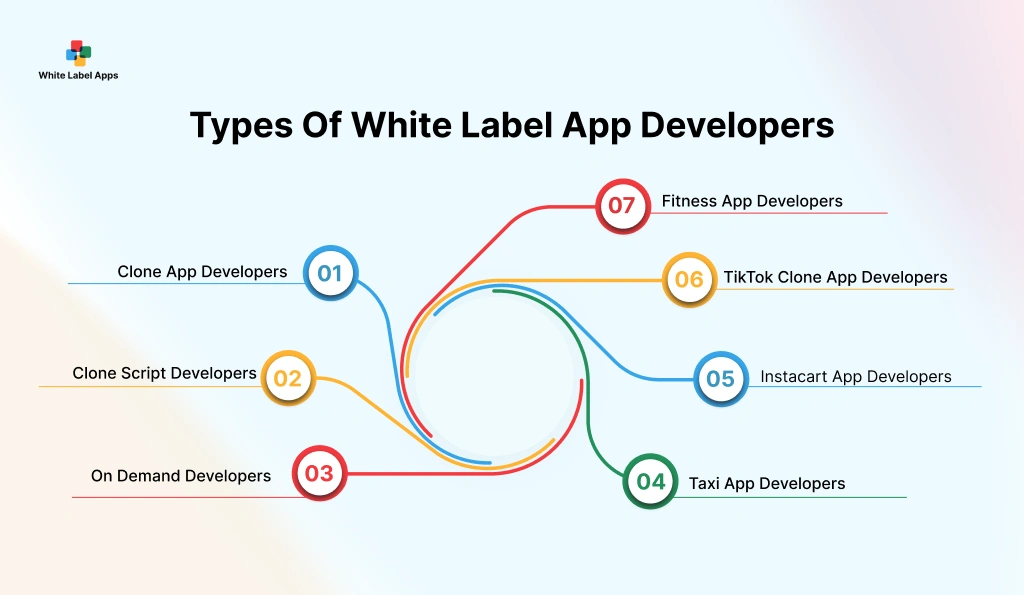
Not every white label app developer works on the same kind of product. Some teams focus on one niche. Others build across many business models. That is why choosing the right type matters as much as choosing the right company.
The best way to look at it is simple. Pick the developer type that already understands your app category, buyer journey, and daily operations. A team that builds food delivery apps every week will usually move faster than a general team learning your model from scratch.
1. Clone App Developers
A clone app developer builds apps based on proven business models already used in the market. These can include delivery apps, booking apps, marketplace apps, social apps, or service apps. The goal is not to copy blindly. The goal is to use a tested structure and turn it into your own branded product.
This type works well when you want faster launch, lower cost, and a familiar user flow. It is a common choice for startups that want to validate an idea before spending on full custom development.
2. Clone Script Developers
Clone script developers usually work from an existing codebase or pre-built software script. They customize the script, connect APIs, adjust branding, and make the product ready for launch. This is often the most practical path when speed matters more than building every feature from zero.
But this model needs care. A weak script can create long-term problems with scaling, security, and updates. So if you choose clone script developers, ask about code quality, ownership, support, and upgrade flexibility.
3. On Demand Developers
Teams that offer on demand developer services focus on apps where users request something in real time. Think ride booking, grocery delivery, handyman services, home cleaning, doctor booking, or parcel pickup. These apps usually need live tracking, instant notifications, provider panels, payment tools, and admin controls.
This type of developer understands urgency-based user behavior. That matters because on-demand apps are not just about screens. They depend on timing, matching logic, route flow, cancellations, and real-world service operations.
4. Taxi App Developers
Taxi app developers specialize in ride-booking platforms. Their work often includes rider apps, driver apps, admin dashboards, fare logic, trip tracking, wallet systems, and safety features. They usually know how dispatch systems work and how to handle live location tools.
This is a better fit than hiring a broad app team with no mobility experience. Taxi apps have their own logic. Driver onboarding, trip acceptance, surge pricing, route maps, and payout flow all need careful handling.
5. Instacart App Developers
An Instacart app developer focuses on grocery delivery and multi-store ordering platforms. These apps usually need product catalogs, store panels, shopper or delivery partner modules, cart logic, substitutions, slot-based delivery, and payment support. The workflow is different from a simple food ordering app.
If your business depends on inventory-heavy ordering, this type of specialist can save time. Grocery apps have more moving parts, and small errors in stock flow or order handling can hurt the customer experience fast.
6. TikTok Clone App Developers
A TikTok clone app developer works on short-video social platforms. These apps often include video upload, feed logic, profiles, likes, comments, sharing, moderation, and content discovery. The front end may look simple, but the backend logic is not.
This type of developer is useful when your business idea depends on content creation, creator engagement, or high user activity. Social products need smooth media handling and strong performance from the start.
7. Fitness App Developers
A fitness app developer builds products for workout plans, progress tracking, personal coaching, nutrition support, video libraries, subscriptions, and wearable integrations. Some also work on gym apps, trainer marketplaces, and wellness platforms. The right setup depends on whether your app is for direct users, coaches, or fitness brands.
If your product involves health routines, member engagement, or habit tracking, a niche team usually understands the user better. That helps with feature planning and retention flow.
Not all fitness app developers bring the same depth. Some can build a basic workout app. Expert fitness app developers usually go further. They understand trainer dashboards, challenge systems, meal planning, recurring subscriptions, community features, and long-term engagement tools.
That difference matters. Fitness users do not stay for design alone. They stay when the app makes progress easy to track and daily use feel natural.
Why Hiring a White Label App Developer Saves You Thousands
A white label app developer saves you money in places most businesses do not notice at first. You are not just paying less for coding. You are avoiding the full cost of building common features, keeping a large team involved for months, and delaying your launch while the product is still being shaped. Because the base product is already built, you can move faster, spend smarter, and put more of your budget into branding, customer growth, and real market testing. That is where the biggest savings usually happen.
1. Lower Upfront Development Costs
Building an app from scratch costs more because every part starts at zero. You pay for planning, design, frontend work, backend setup, testing, fixes, and revisions before the product is even live. That budget grows fast.
A white label app developer cuts this cost because the main product foundation is already built. Features like login, payments, notifications, admin controls, and user dashboards are often ready from the start.
2. Less Spending on Standard Features
Most apps need the same basic functions. Users expect sign-up, profiles, bookings, payments, and alerts. Paying to build these common flows again and again is where a lot of money gets wasted.
A white label app developer helps you avoid that. Instead of funding repeated development work, you pay to adapt a working base to your business.
3. Smaller Team Costs
Custom app development usually needs a bigger team for a longer time. You may need designers, developers, testers, project managers, and support staff working across many stages. That means higher payroll or agency billing.
With white label development, much of that heavy work is already done. This reduces the total effort needed and helps keep your project leaner.
4. Faster Launch Means Lower Hidden Costs
There is another cost many businesses ignore. Delay. Every extra month spent building is a month without sales, market feedback, or customer learning.
A white label app developer helps you launch sooner. That speed reduces missed revenue opportunities and lets you start improving the product in the real market, not just in planning meetings.
5. Better Use of Your Budget
When you spend less on core development, you free up budget for what actually grows the business. That can mean branding, ads, onboarding, support, retention campaigns, or feature upgrades based on user demand.
This is where the model becomes practical. You are not just saving money. You are shifting money toward growth.
6. Lower Risk of Expensive Rework
Custom projects often become expensive when the first version gets key things wrong. A weak user flow, poor feature choice, or confusing journey can lead to costly rework. That hurts both budget and timeline.
A white label app developer usually works from proven app structures. That reduces guesswork and makes the first launch version more stable.
7. Stronger Margins for Reseller Agencies
For reseller agencies, the savings can be even bigger. They can offer branded app solutions to clients without building every project from scratch. That lowers hiring pressure and improves margins across multiple accounts.
It also helps agencies scale service delivery faster. They can take on more client work without growing an oversized in-house team too early.
How a White Label App Developer Reduces Time-To-Market
Launching late can hurt more than most businesses expect. You lose early users, delay feedback, and give competitors more space to grow. A white label app developer shortens the path to launch by using a product base that already includes the main features. That means your business can spend less time building from zero and more time getting ready to go live.
1. Core Features Ready
Most apps need the same basic setup. Login, user accounts, payments, notifications, admin panels, and dashboards are common in many products. Building all of that from scratch takes time.
A white label app developer skips much of this work because the core structure is already built. That helps your project move faster from day one.
2. Planning Takes Less
Custom app projects often spend weeks on planning before real development starts. Teams need to define flows, roles, architecture, and feature logic from the ground up. That early stage can move slowly.
With white label development, much of that foundation already exists. This cuts planning time and pushes the project into execution faster.
3. Branding Moves Faster
Changing branding is much quicker than creating a full app system. A white label app developer can update logos, colors, content, and business settings without rebuilding the whole product. That saves valuable time.
This is one reason the model works well for startups, resellers, and service businesses. The app base stays ready while the brand becomes your own.
4. Testing Gets Shorter
Testing a custom app takes longer because every feature is new. More new code usually means more bugs, more revisions, and more launch delays. That slows everything down.
A white label app developer works with a more stable base. Since core flows are already tested, the quality check stage often moves faster.
5. Launch Work Improves
When teams spend months building standard features, launch preparation gets pushed back. Pricing, promotions, support setup, app listings, and onboarding plans may all get delayed. That creates stress near release.
A white label app developer reduces that pressure. Your team gets more time to focus on launch tasks that directly affect business growth.
6. User Flows Known
Many app categories already follow familiar patterns. A taxi app needs booking and tracking. A delivery app needs ordering and dispatch. A fitness app needs plans, progress, and subscriptions.
A white label app developer uses these known flows to move faster. Instead of inventing every screen from scratch, they build on structures users already understand.
7. Updates Come Faster
Time-to-market is not only about launch day. It also matters after release, when you need quick fixes and small changes based on user feedback. Slow updates can kill momentum.
A strong white label app developer makes post-launch updates easier. Since the product already has a working structure, small improvements usually take less time.
8. Early Entry Matters
Speed gives your business a real advantage. The sooner you launch, the sooner you can test demand, learn from users, and improve what is weak. Waiting too long often means lost opportunities.
That is why this model works so well. A white label app developer helps you enter the market faster, with fewer delays and less repeated development work.
How a White Label App Developer Customizes Your Brand Identity
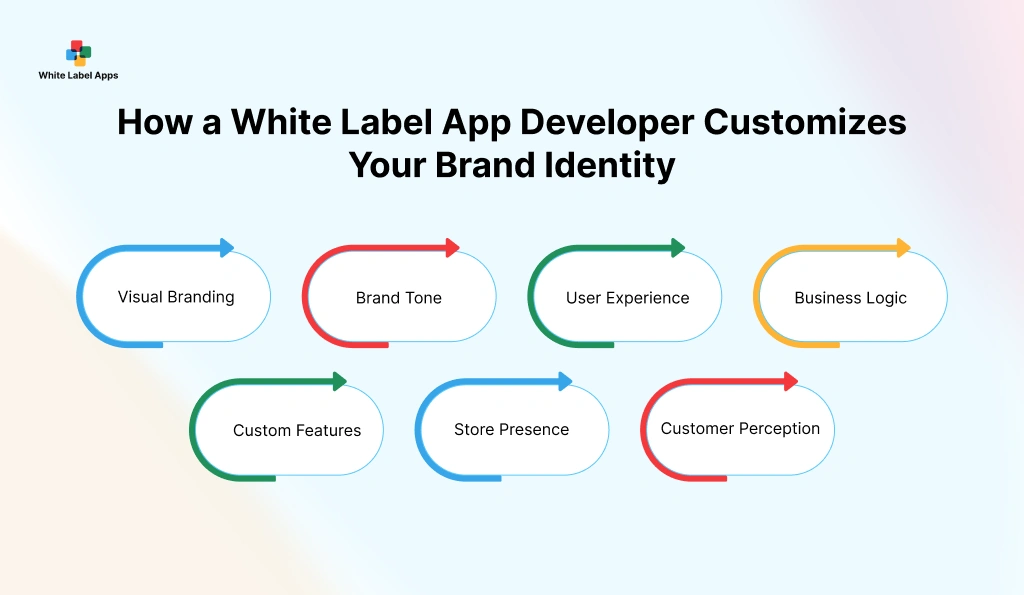
A ready-made app should not feel borrowed. It should feel like your business from the first screen to the final checkout. A white label app developer helps make that happen by reshaping the product around your brand instead of forcing your brand to fit a generic app. This is where white label becomes useful. You save time on development, but still present a product that looks, feels, and works like your own service.
1. Visual Branding
The first layer is the visual side. A white label app developer can update your logo, brand colors, fonts, icons, banners, splash screens, and store assets. These details may look small, but they shape first impressions fast.
When users open the app, they should see your business, not a template with a new name. Strong visual branding helps build trust and makes the product easier to remember.
2. Brand Tone
Brand identity is not only about design. It also includes how the app speaks. Button text, alerts, onboarding lines, support messages, and order updates should match your business tone.
A white label app developer can adjust this content so the app sounds like your brand. A serious healthcare app should not sound like a casual food delivery app. Tone matters.
3. User Experience
A good partner also customizes how people move through the app. This can include the home screen layout, service categories, booking steps, checkout flow, profile options, and navigation order. These choices affect how your brand feels in use.
For example, a luxury service brand may need a cleaner and more premium flow. A local delivery brand may need speed and simplicity. The same base product can be shaped in different ways.
4. Business Logic
Brand identity also connects to how your business operates. Pricing rules, service areas, payment methods, discount setup, commission logic, and vendor workflows all affect the product experience. These are not only technical settings. They reflect how your brand runs.
A white label app developer can tailor these rules to fit your model. That helps the app feel aligned with your business, not just decorated with your logo.
5. Custom Features
In many cases, branding goes beyond surface-level updates. You may need loyalty tools, referral logic, local payment options, multilingual support, subscription plans, or special admin controls. These additions help the product serve your real market better.
A skilled white label app developer knows where the standard product is enough and where your app needs custom touches. That balance is what makes the product feel branded, not basic.
6. Store Presence
Your brand identity also shows up outside the app itself. App Store and Play Store listings, screenshots, preview text, descriptions, privacy details, and support links all shape how your business looks to new users. These areas matter more than many teams think.
A white label app developer should help you prepare a store presence that matches your brand image clearly. A polished store listing supports trust before download.
7. Customer Perception
When all these parts work together, users stop seeing the product as just another app. They connect it with your company. That matters because strong brand identity improves recall, trust, and repeat use.
This is the real transformation. A white label app developer does not just rename a product. They help turn a ready-made system into a branded customer experience that feels built for your business.
What To Ask Your White Label App Developer About IP Rights
IP rights decide who truly owns the app you are paying for. Many businesses focus on design, features, and pricing, but forget to ask what happens to the code, branding, data, and custom work after launch. That can become a serious problem later. A white label app developer should be clear about ownership from the start, so you do not end up dependent on a vendor for changes, resale, upgrades, or full business control.
1. Source Code Ownership
Start with the most direct question. Who owns the source code after payment and delivery? Some white label app developers give full ownership of custom work, while others only give a usage license.
This matters because ownership affects your freedom later. If you do not own the code, moving to another team can become harder and more expensive.
2. License Terms
Ask whether the product is sold under a license or full transfer model. A license may let you use the app, but still limit resale, redistribution, or deep modification. That is common in white label development.
A good white label app developer should explain these terms in simple words. You should know exactly what you can do, and what you cannot.
3. Custom Work Rights
Many projects include extra features, design changes, or workflow updates. So ask who owns the customizations built specifically for your business. Do those belong to you, or do they remain part of the developer’s reusable system?
This is important because custom work is often where your real business value sits. If you pay for it, the ownership terms should be clear.
4. Brand Asset Control
Your logo, brand name, app content, store assets, and marketing materials should remain yours. Ask how these assets are stored, used, and protected during the project. A reliable partner should not reuse your brand materials for other client products.
This may sound obvious, but it is worth confirming in writing. Brand confusion can create trouble later.
5. Reseller Rights
If you are a reseller agency, this question matters even more. Can you resell the product under your own brand? Can you offer it to multiple clients? Can the same base app be used across many customer accounts?
A white label app developer should state this clearly. Reseller rights should never be left to assumption.
6. Third-Party Dependencies
Many apps use third-party APIs, payment gateways, maps, chat tools, analytics systems, or cloud services. Ask which parts of the product depend on outside providers and who controls those accounts.
Even if you own the app, some services may still sit under the developer’s control unless this is planned properly. That can create lock-in.
7. Data Ownership
You should also ask who owns the customer data, order data, usage data, and admin records collected through the app. The answer should be simple. Your business data should belong to your business.
This is not only a legal point. It affects reporting, migration, customer communication, and long-term growth.
8. Exit Terms
A smart business also asks what happens if the relationship ends. Can you take the code, data, assets, and admin access with you? Will the developer help with transition support if needed?
A strong white label app developer will not avoid these questions. Clear exit terms are a sign of a mature and trustworthy partner.
9. Written Agreements
Do not leave IP rights inside sales calls and verbal promises. Ask for these terms in the contract, proposal, or statement of work. If something matters to your ownership, it should be written down clearly.
That is the safest way to protect your business. Good IP terms give you freedom, control, and fewer surprises later.
Why a Quality White Label App Developer Prioritizes Scalability
An app may launch well and still fail later if it cannot handle growth. More users, more orders, more vendors, more traffic, and more feature requests can put pressure on the whole system. That is why scalability matters from the start. A quality white label app developer does not only think about getting your app live. They also think about how the product will perform when your business grows, enters new markets, adds new services, or handles heavier daily usage.
1. Future User Growth
A small launch can turn into a busy platform faster than expected. If the app struggles when user numbers rise, the customer experience suffers. Slow loading, failed payments, delayed notifications, and system crashes can damage trust very quickly.
A quality white label app developer plans for this early. The product should be able to support growth without breaking under pressure.
2. Flexible Architecture
Scalability starts with the way the app is built. Clean structure, modular setup, and organized backend logic make it easier to expand later. Without that, every new feature can feel like a repair job.
A strong white label app developer builds with room to grow. That makes future updates smoother and less risky.
3. Feature Expansion
Most businesses do not stop at version one. They add loyalty tools, new payment methods, multilingual support, analytics, subscriptions, or extra user roles. Growth often means more features.
A scalable app makes these additions easier. A good white label app developer prepares the product so new features can fit in without creating technical mess.
4. Higher Traffic Loads
As your business grows, app traffic can change fast. More users may log in at the same time, place orders together, or use live features during peak hours. The system has to stay stable.
This is why quality matters. A white label app developer should think about server load, response speed, and performance before these problems appear.
5. Multi-Market Support
Many businesses start in one city or one niche and later expand. That may mean new service areas, new vendor panels, more currencies, different tax rules, or local language support. These changes can stretch a weak app fast.
A quality white label app developer builds with expansion in mind. The app should not need a full rebuild every time the business enters a new market.
6. Admin Control
Growth becomes harder when the backend is hard to manage. Admin panels should support more users, more vendors, more orders, and more reporting needs as the business expands. A weak backend slows operations.
A scalable product gives your team better control as the platform grows. That makes daily management easier and reduces pressure on manual work.
7. Upgrade Stability
An app that cannot take updates cleanly becomes expensive over time. Every improvement turns into a long fix. Every new feature creates new bugs. That is not scalable.
A quality white label app developer plans for stable upgrades. The goal is simple. Help the product grow without making every change painful.
8. Long-Term Value
Scalability protects your investment. It helps your app stay useful for longer, support bigger goals, and avoid early rebuild costs. That is a major business advantage.
This is why serious businesses look beyond launch speed alone. A quality white label app developer prioritizes scalability because growth is the real test of whether the product was built well.
How White Label App Developer Handles App Store Submission Rules
Getting an app built is only part of the job. Getting it approved is another challenge. App Store and Play Store submissions come with their own rules, checks, and review steps. A white label app developer should know how to prepare your app properly before it reaches that stage. This includes technical setup, policy alignment, branding clarity, account readiness, and document support. A weak submission process can delay launch, trigger rejection, or force last-minute changes that waste time and money.
1. Store Guidelines First
A good team does not wait until the last day to think about store approval. They plan around submission rules from the start. That means building features, permissions, and account flows in a way that fits platform requirements.
This matters because many rejection problems begin much earlier in the project. Fixing them late can slow launch badly.
2. Clean App Identity
Stores do not want apps that look confusing, unfinished, or too similar to something else. Your app needs a clear brand name, proper screenshots, polished descriptions, and a real business identity. That helps reviewers understand what the product does and who it is for.
A white label app developer should help you present the app as a real brand, not a generic clone with surface-level edits.
3. Permission Checks
Many apps ask for camera, location, storage, contacts, or notification access. But not every permission is always needed. Unnecessary access requests can raise questions during review and hurt user trust too.
A strong white label app developer checks permissions carefully. The app should only ask for what it truly needs, and the reason should be easy to explain.
4. Policy-Safe Content
Content also matters during submission. App descriptions, onboarding text, screenshots, and in-app messages should be clear, accurate, and safe for the category. Misleading claims or vague language can create problems.
A white label app developer should make sure your app content matches the actual user experience. What you promise in the listing should match what users get after install.
5. Account Setup Help
Submission often depends on more than the app file. You may need developer accounts, privacy policy pages, support links, login details for review teams, and business information. Missing one small item can hold up approval.
A reliable white label app developer helps organize these pieces early. That makes the submission stage smoother and less stressful.
6. Testing Before Upload
Apps that crash, load badly, or break during common actions are more likely to face trouble in review. That is why proper testing matters before submission. A launch-ready build should feel stable, complete, and easy to use.
A white label app developer should test the full flow before upload. Login, checkout, notifications, dashboards, and account actions should all work cleanly.
7. Rejection Recovery
Sometimes even good apps get rejected. What matters then is how fast the team understands the issue and responds. A slow or confused developer can turn a small setback into a long delay.
A strong white label app developer should know how to review rejection notes, fix the real issue, and resubmit with clear changes. That support matters a lot during launch.
8. Launch Confidence
Submission is not only a technical step. It is part of launch readiness. When your white label app developer handles rules properly, your business faces fewer delays, fewer surprises, and a better chance of going live on time.
That is the real value here. A good team does not just build the app. They help carry it through the approval stage with better preparation and fewer costly mistakes.
Working With a White Label App Developer as a Reseller Agency
For reseller agencies, white label development is not just a delivery option. It is a growth model. You can offer branded apps to clients without building every product from zero or hiring a large in-house team too early. That saves time, keeps margins healthier, and helps you take on more projects with less operational strain. A strong white label app developer becomes your backend delivery partner while your agency stays front-facing with the client.
1. Faster Client Delivery
Clients do not want long waits for standard app builds. They want a working product, clear timelines, and a launch plan they can trust. Slow delivery can damage confidence fast.
A white label app developer helps reseller agencies move quicker. Since the base product is already built, your agency can deliver faster without starting from scratch every time.
2. Better Profit Margins
Hiring a full product team for every client project can eat into profit quickly. Designers, developers, testers, project managers, and support staff all increase delivery cost. That model can become hard to scale.
Working with a white label app developer helps control that cost. Your agency can keep better margins because the heavy technical foundation is already in place.
3. More Service Capacity
Agencies often hit a growth wall when too many projects come in at once. The sales side grows, but the delivery side starts feeling stretched. That is when deadlines slip and quality drops.
A white label app developer gives you more delivery capacity without forcing immediate team expansion. You can handle more client work while keeping operations leaner.
4. Branded Client Delivery
The reseller model works best when the client experience still feels fully yours. Your agency may manage communication, proposals, onboarding, and strategy, while the white label app developer handles the product build in the background. That keeps your brand in front.
This setup helps you grow as a solution provider, not just a middle layer. The client sees a complete service under your agency name.
5. Niche Market Focus
Sometimes agencies work in highly specific industries like food delivery, ride-hailing fitness health care or other local services. Here, it can be really helpful if you partner with a white label app developer who is already familiar with the target niche. They do not need to be educated on the product model every time.
That speeds up scoping, reduces confusion, and helps your agency sound more confident in sales conversations. Niche understanding supports smoother delivery.
6. Lower Hiring Pressure
Creating an in-house team may seem appealing however it also leads to fixed cost stress.
Employee compensation education acquisition of instruments and even the management of the project by the team members can be the factors causing the fixed cost to get higher before the time the revenue gets stabilized. That puts smaller agencies at risk.
A white label app developer reduces that pressure. You can expand delivery without making permanent hiring decisions too early.
7. Support Structure
Reseller agencies also need to think beyond launch. Clients may need updates, fixes, app store help, or feature changes after going live. If support is weak, your agency will feel the pressure first.
That is why support matters in this relationship. A dependable white label app developer should help your agency manage post-launch work smoothly, not disappear after delivery.
8. Clear Partner Terms
For reseller agencies, partnership clarity is critical. You need to know pricing, turnaround time, ownership terms, reseller rights, support scope, and communication flow before taking projects live. Confusion at this level can hurt both margins and trust.
The best reseller setup is simple. Your agency owns the client relationship, and the white label app developer supports delivery with clear boundaries, stable quality, and reliable execution. That is what makes the model work at scale.
Data Security Standards Every White Label App Developer Must Follow
Data security is not a bonus feature. This is one of the pillars of the product. When sharing phone numbers, payment details addresses health records or business data, users expect that information to be safe and secure. Security should be a fundamental responsibility for a white label app developer right from day one and not an afterthought to be fixed after the product launch. Strict security standards not only protect your users but also mitigate the risk of laws violation, facilitate app store approval, and ensure that your brand does not suffer from mistakes that can be easily avoided.
1. Secure Authentication
User access should never be loose. A white label app developer should build secure login flows with strong password handling, session control, and support for added layers like OTP or two-factor authentication where needed.
This helps stop unauthorized access and protects both users and admins. Weak login systems create easy entry points for bigger problems.
2. Data Encryption
Sensitive data should be protected both in transit and at rest. That means information moving between the app and server should be encrypted, and stored data should also be handled safely.
A white label app developer should never leave customer data exposed through poor storage or weak transmission practices. Encryption is a basic standard, not an extra.
3. Role-Based Access
Not every user should see everything. Admins, staff, vendors, drivers, trainers, and customers all need different levels of access. Good apps control who can view, edit, export, or manage data.
A white label app developer should set clear role-based permissions. This reduces internal risk and keeps the system easier to manage.
4. Safe Payments
If your app handles transactions, payment security becomes even more important. Payment information should move through trusted gateways and should not be stored carelessly inside the app system.
A good white label app developer should follow safe payment practices and connect secure payment tools properly. This protects both users and your business reputation.
5. API Protection
Most modern apps rely on APIs for maps, payments, chat, notifications, analytics, and other services. If those connections are left open or poorly managed, attackers may find weak spots.
A white label app developer should secure APIs with proper authentication, controlled access, and safe request handling. Hidden backend risks often start here.
6. Secure Storage
User records, uploaded files, reports, and business settings should be stored in a secure environment. Open databases, weak cloud settings, or poor file controls can create serious exposure.
A white label app developer should use safe storage practices and limit unnecessary data collection. Good security also means not storing more than the business truly needs.
7. Backup Systems
Data loss can happen through bugs, server issues, bad updates, or human error. That is why regular backups matter. A business should not lose key records because one failure was not planned for.
A white label app developer should set up backup systems and recovery steps. Strong backup planning protects business continuity.
8. Update Policy
Security is not a one-time setup. Apps need updates to fix bugs, close vulnerabilities, and stay safe as systems change. Old code becomes risky code very quickly.
A reliable white label app developer should have a clear process for patches, maintenance, and version updates. This shows the product is being managed responsibly.
9. Compliance Readiness
Some apps must meet stricter privacy and data rules based on industry or region. Healthcare, finance, education, and child-focused apps often need stronger protection standards than a simple local service app.
A white label app developer should understand when compliance matters and how to prepare for it. Even if legal review comes later, the product should not be built carelessly.
10. Audit Visibility
You should be able to track what happens inside the system. Audit logs, admin activity records, login history, and change tracking help businesses spot misuse and investigate problems faster.
A white label app developer should not build a black box. Good visibility improves trust, control, and response when something goes wrong.
How To Choose the Right White Label App Developer
Choosing the right partner is not only about price or delivery speed. It is about finding a team that can build, customize, support, and scale the product without creating trouble later. A white label app developer may look strong in a sales call, but the real test is in code quality, ownership terms, niche experience, support process, and long-term flexibility. The right choice can help your business grow faster. The wrong one can lock you into delays, poor support, and weak product performance.
1. Check Niche Fit
Start with relevance. A developer who has already worked on your app category will usually understand the user flow, admin needs, and business logic much better. That saves time and reduces avoidable mistakes.
A taxi app, food ordering app, fitness app, or marketplace app all work differently. Choose a team that already understands your business model.
2. Review Product Quality
Do not judge the developer only by screenshots. Ask for demos, admin panels, user journeys, and real feature walkthroughs. A polished design can still hide weak logic and poor backend structure.
Look at speed, navigation, stability, and flow clarity. The product should feel usable, not just presentable.
3. Ask About Customization
Some white label products only allow basic branding changes. Others let you adjust workflows, features, payment logic, language support, and admin settings. That difference matters more than many businesses expect.
Ask what can actually be changed. A good white label app developer should explain the limits clearly, not hide them behind vague promises.
4. Confirm IP Rights
Ownership should never be assumed. Ask who owns the code, custom work, branding assets, and business data after delivery. Also ask what happens if you move to another team later.
If the answers are unclear, that is a warning sign. Strong partners are usually direct about IP terms from the beginning.
5. Evaluate Scalability
Do not choose only for launch. Choose for growth. Your app may start small, but it should still support more users, more orders, more vendors, more features, and new markets later.
Ask how the product handles scale. A white label app developer should be able to explain this in simple business terms.
6. Check Support Scope
A good launch is not enough if support disappears after delivery. Ask what happens after the app goes live. Will they help with bugs, updates, app store issues, server needs, and future improvements?
Support quality often decides whether the partnership stays smooth or becomes frustrating. Make this clear before signing anything.
7. Review Submission Help
App Store and Play Store approval can delay launch if the process is handled poorly. So ask what support the developer gives during submission. Do they help with listings, assets, policy issues, and rejection fixes?
A strong white label app developer should treat submission as part of launch readiness, not as your problem alone.
8. Test Communication
Good communication saves projects. Watch closely the way the team talks about deadlines, changes made, problems faced, and the way forward. If the transcripts don’t seem very specific while performing sales who stage, they mostly get even more unclear after the payment step is done. You are going to need a companion that is transparent, down-to-earth, and agreeable. Quick response is not that means if the ones given are not understandable.
9. Compare Real Costs
Do not focus only on the first quote. Look at the full cost picture. Ask about setup charges, customization fees, third-party tools, maintenance, upgrade costs, and support pricing after launch.
A cheap starting price can become expensive later. The better question is simple. What will this cost over time?
10. Look For Proof
Ask for real examples, live products, case studies, or sample dashboards. You do not need flashy promises. You need proof that the team can deliver what they claim.
A reliable white label app developer should be able to show practical work, not only polished pitch material.
11. Watch Red Flags
Be careful if the developer avoids direct answers, hides ownership terms, overpromises impossible timelines, or gives no clarity on support and upgrades. These issues usually become bigger after the contract is signed.
The right partner should feel transparent, steady, and realistic. That kind of clarity protects your business from costly surprises later.
Common Mistakes To Avoid While Hiring a White Label App Developer
Hiring the wrong partner can slow your launch, waste your budget, and create technical problems that stay with the business for years. Many companies make the same mistakes because they focus only on price, design, or fast promises. A white label app developer should be chosen with care, not rush. The smart move is to look beyond the sales pitch and check how the product, support, ownership, and long-term fit actually work.
1. Chasing Low Prices
A very low quote can look attractive at first. But cheap pricing often hides weak code, limited customization, poor support, or extra costs that appear later. What looks affordable in the beginning can become expensive over time.
Choose based on value, not only price. A white label app developer should save money, not create new costs after launch.
2. Ignoring Product Demos
Some businesses hire based on screenshots, sales decks, or feature lists alone. That is risky. A polished presentation does not prove that the app works well in real use.
Always ask for a real demo. You should see the user side, admin side, flow logic, speed, and overall stability before making a decision.
3. Skipping Ownership Terms
Many buyers forget to ask who owns the code, custom work, data, and brand assets after delivery. That mistake can lead to major problems later, especially when the business wants to scale, switch teams, or resell the product.
A white label app developer should explain ownership clearly. If those terms feel vague, stop and ask again.
4. Overlooking Support
A project does not end at launch. Bugs, updates, store issues, and feature changes often come after release. If support is weak, your business will feel stuck very quickly.
Do not assume support is included. Ask what happens after go-live and what kind of help is actually available.
5. Forgetting Scalability
Some businesses choose a solution only for today. They do not ask how the product will handle more users, more vendors, more locations, or more features later. That can lead to painful limits as the business grows.
A strong white label app developer should be ready for growth, not just launch. Scalability should be part of the early decision.
6. Trusting Vague Promises
Be careful with broad claims like full customization, instant launch, or lifetime support if there is no detail behind them. Vague promises sound good in sales calls, but they create confusion after payment.
A good partner should explain what is included, what is limited, and what needs extra work. Clarity matters more than flashy wording.
7. Missing Niche Fit
Not every developer fits every app type. A team that works mainly on social apps may not be the best fit for a taxi app, fitness app, or grocery platform. Business logic changes from one category to another.
Choose a white label app developer with relevant niche experience. That usually saves time and reduces product mistakes.
8. Ignoring Submission Help
Some teams build the app but leave the store submission process to the client. That can become a problem if the business is not ready for policy checks, listing rules, or rejection handling.
Ask what help is included for App Store and Play Store submission. Launch support should not be treated as an afterthought.
9. Rushing the Decision
Pressure leads to poor choices. Some businesses pick a developer too fast because they want to launch quickly. But a rushed hire can delay the project even more if the partner turns out to be weak.
Take time to review the product, terms, support, and communication style. A careful decision is usually the faster decision in the long run.
10. No Written Clarity
One of the biggest mistakes is relying on verbal promises. Timelines, ownership, support scope, deliverables, and upgrade terms should all be written down. If it is not in the agreement, it may not exist later.
A professional white label app developer should be comfortable putting the details in writing. That protects both sides and reduces future disputes.
Why Choose WhiteLabelApps.ca for Hiring White Label App Developers
Choosing the right white label app development partner is not only about getting an app built. It is about working with a team that understands speed, branding, customization, and long-term support. At WhiteLabelApps.ca, we help businesses launch ready-made app solutions faster while keeping the product aligned with their own brand, market, and growth goals. Our approach is practical. We focus on helping you go live with less delay, less repeated development work, and more control over the final product.
1. White Label Expertise
We do not treat white label development like a side service. It is one of our core strengths. That means our process is shaped around faster rollout, smoother customization, and business-ready launches.
For clients, this matters because the work moves with more clarity. You are not spending time teaching us how white label delivery should work.
2. Ready Business Models
We build on app models that already match how users behave in the real market. That includes ordering apps, delivery apps, booking apps, fitness apps, service apps, and marketplace platforms. The goal is simple. Help you launch with a structure users already understand.
This saves time and makes the product easier to bring to market. You do not need to rebuild common features from zero.
3. Brand-Focused Delivery
A white label app should not look generic. We customize the product around your brand identity so the app feels like your business, not someone else’s template. That includes visual branding, content changes, business logic updates, and user-facing adjustments.
This helps create a stronger customer impression. Your users see your brand at every step.
4. Faster Launch Process
Speed matters when you want to test demand, start onboarding users, or begin generating revenue. We use a ready product base to reduce the time spent on repeated development work and move your project closer to launch sooner.
That does not mean cutting corners. It means starting from a stronger foundation and using time where it matters most.
5. Reseller Agency Support
We also work with reseller agencies that want to offer app solutions under their own brand. Instead of building a large technical team too early, agencies can use our white label development support to expand delivery capacity and serve more clients with less strain.
This makes growth easier to manage. Your agency stays front-facing while we support the product side in the background.
6. Clear Communication
We believe projects move better when communication stays simple and direct. Our team focuses on clear updates, realistic timelines, practical answers, and less confusion during the delivery process.
That helps clients make decisions faster. It also reduces delays caused by unclear expectations.
7. Room To Scale
Your app may start with one version, but business needs change fast. We keep that in mind when handling customization, feature planning, and future updates. The idea is not only to help you launch. It is to help you grow without getting boxed into a rigid setup.
That flexibility matters over time. A product should support the next stage of the business too.
8. Support Beyond Launch
Launching the app is only one step. Most businesses need help with updates, fixes, store submissions, and post-launch improvements. We continue supporting clients after go-live so the product stays usable, stable, and ready for the next move.
That kind of support protects the work already done. It also makes long-term app management easier.
9. Built For Your Growth
At WhiteLabelApps.ca, we focus on helping businesses launch branded apps faster, with less wasted time and less repeated effort. We combine white label speed with practical customization and ongoing support, so you get more than a ready-made product. You get a solution built to support real business growth.
Final Thoughts
Choosing the right white label app developer is really about one thing. Finding a partner that helps you launch faster without creating problems later. Speed matters, but so do product quality, customization, ownership, scalability, submission support, and long-term reliability.
For many businesses in 2026, white label development is the smarter path because it cuts repeated work and gets the product closer to market sooner. You do not have to spend months rebuilding common features just to prove demand. You can launch with a stronger base, shape it around your brand, and improve it as the business grows.
That said, not every white label app developer offers the same value. Some only provide surface-level branding. Others create real business-ready products with room to scale. That is why the hiring decision matters so much. The right partner saves time, protects your budget, and helps you move with more confidence.
At WhiteLabelApps.ca, we build white label app solutions that are meant to work in the real world. Our focus stays on practical business models, faster launch paths, custom branding, and support that continues after go-live. If your goal is to launch a branded app with less delay and more control, this model can be a very strong fit.
FAQs
1. What Is a White Label App Developer?
A white label app developer builds ready-made apps that businesses can rebrand and launch as their own. Instead of creating the full product from zero, the developer customizes an existing app structure to match your brand, business model, and market needs. This helps reduce development time and cost.
2. How Is a White Label App Developer Different From a Custom App Developer?
A white label app developer operates on a pre-made product base, whereas a custom app developer crafts the app entirely from beginning to end. Usually white label apps are quicker to market and cheaper. Custom development offers a lot more freedom, but at the same time it is more time-consuming, costly, and requires extensive planning.
3. Is Hiring a White Label App Developer a Good Option for Startups?
That’s certainly one of the strong points of white label apps. Startups regularly require launching at high speed, checking the market, and not investing too much initially. White-label app developers become their partner in getting a product onto the market that already possesses the essential features and can still be individualized for the brand.
4. Can a White Label App Developer Fully Customize My App?
It really depends on the builder and the base product. Very often white label app developers are capable of changing branding content workflows, admin settings, and some functionalities. However, not all systems provide room for extensive customization. That is why it is very important for you to first ask very specific questions before you commit by signing.
5. Do I Own the App After Hiring a White Label App Developer?
Ownership depends on the contract. Some developers offer full source code ownership. Others offer a license to use the app. You should always ask about code ownership, custom feature rights, business data ownership, and reseller rights before starting the project.