You are juggling coaching on 4–5 tools every day. WhatsApp for messages. Sheets for tracking. Zoom for calls. Payment links for money. It works, but it also breaks in small places. A client misses a check-in. You miss a follow-up. Then the momentum is gone. After a point, it does not feel like coaching. It feels like managing tiny tasks all day.
That is where a white label coaching app comes in. With white label app development, you can run your program inside one branded app, so clients know where to go every day. Plans, check-ins, content, and messages stay in one place. That simple change can improve consistency, and it can also reduce your admin load. You spend more time guiding people, and less time chasing updates.
This shift is growing in health and wellness too. Grand View Research estimated the global digital health coaching market at $10.99 billion in 2024 and expects it to reach $12.24 billion in 2030.
This guide is written after research. It is based on what founders usually compare, like features, pricing ranges, setup steps, and the problems that show up after launch. In this blog, you will see what a white label coaching app is, key advantages, future trends, and quick FAQs.
TL;DR
- White label coaching app replaces scattered tools and messy follow-ups.
- White label helps you launch faster and test your coaching offer sooner.
- AI can support daily nudges and progress tracking between sessions.
- Costs depend on branding, users, add-ons, and support level.
Key Points
- A white label coaching app keeps plans, check-ins, content, and messages in one place.
- White label coaching apps reduce admin work because reminders, onboarding, and tracking become system-led.
- A white label AI coaching app helps clients stay consistent with simple prompts and progress summaries.
- A white label coaching app platform should match your niche, like a white label fitness coaching app or a white label health coaching app.
- A white label life coach app setup works best when goals, reflections, and lessons are easy to find daily.
- A health coach app white label solution needs clear privacy controls and safe data handling for personal logs.
- The best white label coaching app is the one your clients can use without training or repeated support calls.
- A white label coaching app free plan is usually a trial, so check the paid tiers and add-on costs early.
What Is a White Label Coaching App and How Does It Benefit Coaches?
Running coaching can feel like juggling too many things at once. One client is on WhatsApp. Another is on email. Payments are on a link. Notes are in a notebook. Then one day you miss a follow-up, and the client goes silent. A white label coaching app helps you put all this into one place.
A white label app is a ready app you can brand as your own. You change the logo, colours, app name, and key screens. Your clients see your brand, not the software maker’s brand. That is why many founders pick white label coaching apps when they want to launch fast.
A white label coaching app platform usually gives you the base setup you need for coaching. It is like renting a fully set-up kitchen instead of building a kitchen from scratch. You can start cooking on day one, then upgrade tools later.
The Advantages of White Label Coaching Apps

A coaching business looks simple from outside. Talk to clients, give guidance, collect payment. Inside, it can feel like a daily traffic jam. Too many messages, too many files, too many follow-ups. White label coaching apps help because they turn your coaching into a repeatable system, not a “manual effort” every single day.
For startups, the big benefit is speed. You can launch early, test pricing, and improve your program without waiting months. For enterprises, the benefit is control and scale. You can run many coaches, many clients, and still keep the experience consistent.
1. Customize Branding and Personalization
Clients remember your brand when they see it often. A white label coaching app lets you use your name, logo, colours, and tone across the full journey. It feels like your own product, not a borrowed tool.
Personalization is not only about branding. It is also about how the program looks for different users. A white label life coach app can show weekly goals and journaling prompts. A white label fitness coaching app can show workouts and check-ins. Same base system, different feel.
2. Create Unique Coaching Programs
Many coaches sell “programs,” but deliver them in scattered pieces. Some videos here, some PDFs there, and reminders in chat. A coaching app lets you package your offer properly.
You can build a clear path. Day 1, Day 7, Week 4, and so on. You can add tasks, content, and check-ins in the right order. Clients do not feel lost. This is where a best white label coaching app makes a difference, because it supports program structure, not just messaging.
3. Optimize Costs
Custom apps can cost more, and they take longer. For a new startup, that can be risky. A white label option reduces the upfront spend because the core product is already built.
Many founders compare this like renting versus building. Renting lets you start earning first. Building is great later, but it needs a runway. That is why white label coaching apps are popular in early growth stages.
Some people look for white label coaching app free options. Free trials are useful for testing. But full branding usually needs a paid plan. The smarter goal is not “free.” The goal is “fast learning with low risk.”
4. Streamline Administrative Tasks
Admin is where time disappears. Taking payments, sending reminders, collecting forms, updating plans, and chasing check-ins. A white label coaching app platform puts these actions inside one system.
That means fewer “Can you resend the link?” messages. Fewer missed updates. Fewer manual follow-ups. Your day feels lighter, and you can coach better.
5. Enhance Client Engagement
Clients stick when they feel progress. They also stick when the next step is clear.
A coaching app shows tasks, goals, and progress in one place. Clients see what to do today. They see what they completed yesterday. They feel movement. For health and wellness programs, this is a big deal. A white label health coaching app can keep daily habits visible, which improves consistency.
6. Boost Scalability and Efficiency
Scaling coaching is hard if your process depends on you remembering things. You cannot grow on memory. You need a system.
A white label setup helps you handle more clients without losing quality. You can reuse program templates. You can onboard faster. You can add coaches and keep the same standard. This is why enterprises like white label coaching apps too.
7. Strengthen Integration and Collaboration
Most coaching businesses still use tools like Zoom, calendars, payment gateways, email, and sometimes wearables. A good platform supports integrations or APIs, so your workflow stays connected.
For enterprise teams, collaboration matters too. Notes, handovers, coach access, and reporting must be clean. A strong white label coaching app platform makes teamwork easier, especially when more than one coach is involved.
8. Improve Professional Image and Competitive Edge
Clients compare. Even if they do not say it, they compare your experience with other apps they use daily.
A branded coaching app gives a more professional feel. It builds trust. It also helps you stand out when competitors are still sending PDFs and using random chat threads. In fitness and wellness, this matters a lot. A clean health coach app white label experience can become your “silent advantage.”
Also Read : Why Startups Choose White Label Solutions Over Building From Scratch
White Label Coaching Apps vs. Custom App Development
Both options can work. The right pick depends on your timeline, budget, and how “unique” your coaching flow is. White label coaching apps are ready systems you brand and launch fast. Custom app development means you build everything from zero, screen by screen, rule by rule. That gives more control, but it also brings more cost, more time, and more decisions.
For most startups, speed matters first. You want proof that people will pay, stay, and get results. A white label coaching app helps you test that faster. For enterprises, custom builds can make sense when you need strict workflows, deep integrations, and heavy reporting across teams.
| Parameter | White Label Coaching Apps | Custom App Development |
| Time To Launch | Fast. You can go live in weeks, sometimes sooner. | Slower. Often takes months because everything is built and tested from scratch. |
| Upfront Cost | Lower upfront cost in most cases. You pay for setup + plan. | Higher upfront cost. Design, development, testing, and revisions add up. |
| Branding | Strong branding options like logo, colours, app name, and themes. | Full freedom. Every screen and flow can match your exact brand idea. |
| Feature Flexibility | Good flexibility, but inside the platform limits. | Maximum flexibility. You decide every feature and rule. |
| Maintenance | Platform handles core updates and fixes. You manage content and programs. | You own maintenance. You need a team for fixes, upgrades, and ongoing testing. |
| Scalability | Usually easy to scale on the platform’s infrastructure. | You must plan scaling, hosting, and performance work as you grow. |
| Integrations | Common integrations are easier. Deep custom integrations may be limited. | Deep integrations are possible, but they increase scope and time. |
| Best Fit | Startups, solo coaches, small teams, and fast-growing programs. | Large enterprises, unique workflows, strict compliance, heavy reporting needs. |
| Risk Level | Lower risk early. Faster learning with less spend. | Higher risk early. Big spend before you know what users truly want. |
If you are building a white label fitness coaching app or a white label health coaching app, white label often wins at the start because your core needs are common: plans, check-ins, tracking, messaging, and payments. If you need something very specific, like custom scoring logic, unusual data rules, or complex team permissions, custom may be the better long-term bet.
Pros and Cons of Using the Best White Label Coaching Apps
A best white label coaching app can make your coaching feel like a real product, not a bundle of tools. You get faster launch, smoother client journeys, and less daily admin. But it is not magic. White label also comes with limits, like fixed modules, platform rules, and pricing tiers that can grow as you scale. The smart move is to know both sides before you sign.
This matters more if you plan to run niche coaching. Like a white label life coach app that needs deep journaling flows, or a health coach app white label setup that needs custom tracking. White label can still work, but you must check what is editable and what is fixed.
| Area | Pros of White Label Coaching Apps | Cons of White Label Coaching Apps |
| Launch Speed | You can launch quickly and start selling sooner. | You may need to adjust your process to match the platform. |
| Cost Control | Lower upfront cost than building from scratch. | Monthly or yearly fees can rise as you add users, coaches, or add-ons. |
| Branding | You can brand the app with your name, logo, and colours. | Some platforms limit layout changes or deep UI edits. |
| Client Experience | One clean place for programs, check-ins, content, and messages. | If the platform UX feels dated, you cannot fully redesign it. |
| Admin Work | Reminders, onboarding, and tracking become easier to manage. | Some automation features may be paid extras. |
| Features | You get common coaching features without building them. | You may not get every niche feature you want. |
| AI Support | A white label AI coaching app can add nudges, summaries, and simple insights. | AI features can be shallow if the platform is not built well, so you must test. |
| Fitness + Health | A white label fitness coaching app and white label health coaching app setup often matches common flows. | If your tracking needs are unique, you may hit limits. |
| Ownership | You focus on coaching, not fixing bugs and updates. | You rely on the vendor for updates, downtime handling, and roadmap decisions. |
| Free Options | Trials are useful for testing a white label coaching app free style setup. | Fully free branding is rare, and “free” plans are often limited. |
Key Features of White Label Coaching Platform
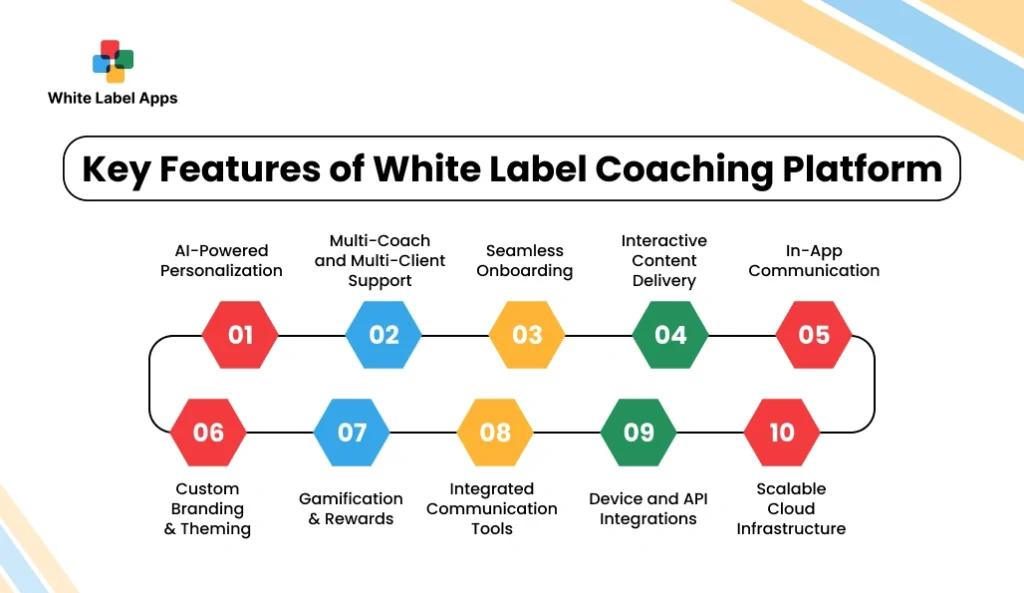
A coaching app should not feel like a big tech project. It should feel like a clean notebook that also sends reminders and tracks progress. That is the goal of a white label coaching app platform. It helps you run programs in a repeatable way, without losing the personal touch that clients pay for.
This section lists the core features most founders look for when they want a white label coaching app that can serve startups now and scale later. Some features are “must have.” Some are “nice to have.” The smart part is choosing what supports your coaching style, not what looks fancy on a demo call.
1. AI-Powered Personalization
Personalization is more than using a client’s name. It is about giving the right nudge at the right time. In a white label AI coaching app, personalization can help clients follow the program with fewer drop-offs. For example, the app can prompt a quick check-in when a client misses two days. It can also recommend the next lesson based on what the client completed. This saves you time and keeps the client moving.
2. Multi-Coach and Multi-Client Support
If you plan to grow beyond solo coaching, this matters early. Multi-coach support means more than adding two logins. It means separate coach permissions, client assignments, and clean notes that do not get mixed up. This is useful for fitness teams, wellness clinics, and corporate coaching. It is also helpful when one coach is on leave and another needs to step in without confusion.
3. Seamless Onboarding
A client’s first 10 minutes decide a lot. If onboarding is slow, they lose interest. A good white label coaching app makes onboarding simple. Forms, goals, preferences, and payment should be in one flow. No long back-and-forth messages. For a white label fitness coaching app, onboarding can also include fitness level, equipment, and injuries. For a white-label health coaching app, it can include habits, medical history notes, and lifestyle goals.
4. Interactive Content Delivery
Coaching content should be easy to consume. Not only PDFs. Interactive delivery means short lessons, videos, quizzes, checklists, and weekly action steps. This keeps clients engaged, especially those who do not love reading long guides. It also helps your program feel like a product. A white label life coach app benefits a lot here because lessons and reflections work best when they are short and regular.
5. In-App Communication
Clients will always have questions. In-app chat or messaging keeps everything in one place. It also keeps context, so you do not scroll through old WhatsApp threads. Good communication tools also allow you to set boundaries, like office hours, reply windows, and templates for common responses. That keeps your time protected while still supporting clients.
6. Custom Branding & Theming
Branding is what makes your app feel like yours. A strong white label coaching app platform lets you change the logo, colours, app name, and core screens. It should also allow branded emails, login pages, and program templates. This is one reason many teams prefer white label coaching apps over generic coaching tools. It builds trust and makes clients remember you.
7. Gamification & Rewards
Not every coach needs gamification, but it can help for habit building. Rewards can be as simple as streaks, badges, milestones, and weekly wins. In fitness and wellness, this is useful because clients get small motivation boosts. Just keep it aligned with your brand. A premium health coaching program may prefer soft nudges over loud badges.
8. Integrated Communication Tools
Some clients prefer email. Some prefer push notifications. Some want SMS. A good platform supports multiple channels, so reminders do not get missed. It also helps you avoid spamming clients. The best systems let clients choose what they want. This becomes important when your client base grows.
9. Device and API Integrations
Many coaching businesses want integrations with calendars, payment tools, CRM systems, and wearable data. This is common for fitness and health brands. A health coach app white label setup can become stronger if it can pull basic data like steps or activity logs, but only if it is accurate and easy to manage. API support matters more for enterprises, because they often have existing tools that must connect.
10. Scalable Cloud Infrastructure
Even if you start small, your app should not crash when you grow. Scalability means the app stays fast when you have more clients, more videos, and more check-ins. Cloud infrastructure also helps with data backups and uptime. This is not a “nice extra.” It protects your brand. If clients cannot open the app, they will stop trusting the program, no matter how good your coaching is.
Also Read : White Label Wealth Management Platform: A Complete Guide With AI Features
Top 5 White Label Coaching Apps in 2026
Choosing the app is not about picking the most popular name. It is about picking what matches your coaching flow. A white label coaching app for fitness will need tracking and plans. A wellness program may need habit logs and reminders. A white label life coach app may need journaling, goals, and content modules.
Also, do not get trapped by “free” tags. A white label coaching app free plan is usually a trial or a limited version. It is still useful, but only for testing. The real question is simple. Can the platform run your program smoothly, without making you do extra manual work.
Below are common options people shortlist when they look for white label coaching apps.
1. Mighty Pro
Mighty Pro fits coaches who sell community-led programs. Think group coaching, paid memberships, short lessons, and a space where clients talk to each other. If your program is more “content + community” and less “daily tracking,” this can feel like a strong white label coaching app platform option.
Key Features
- Branded community space with your name and theme.
- Courses and content delivery inside the app.
- Groups, challenges, and member discussions.
- Events and live sessions support.
- Member management and basic analytics.
| Pros | Cons |
| Strong for groups and community coaching. | Not built mainly for fitness tracking. |
| Content and engagement tools are easy to use. | May need extra tools for deep health tracking. |
| Helps keep clients active between sessions. | Pricing can feel high for early-stage coaches. |
2. Virtuagym
Virtuagym is often picked by fitness coaches, gyms, and trainers. It is closer to a white label fitness coaching app style setup, where the plan, workouts, and tracking are the main focus. If you coach many clients at once and need structure, this can fit.
Key Features
- Workout planning and training routines.
- Client progress tracking and dashboards.
- Coach and client management tools.
- Content and guidance delivery options.
- Integrations depending on plan and setup.
| Pros | Cons |
| Strong fit for fitness programs and gyms. | Can feel heavy if you only need simple coaching. |
| Clear structure for plans and tracking. | Some customisation may be limited by plan. |
| Good for managing many clients. | Not always ideal for life coaching style journeys. |
3. Nudge Coach
Nudge Coach works well for habit-based coaching. It can match a white label health coaching app because many health programs are built on daily habits, not just workouts. If your program uses reminders, check-ins, and small steps, this is worth a look.
Key Features
- Habit nudges and reminders for clients.
- Check-ins and progress tracking.
- Coaching workflows and client journeys.
- Messaging and client engagement tools.
- Simple reporting to spot drop-offs early.
| Pros | Cons |
| Strong for behaviour change and habit coaching. | May not suit heavy workout planning needs. |
| Keeps clients consistent with nudges. | Deep branding options may vary by plan. |
| Fits wellness programs and health journeys. | AI features may be limited depending on setup. |
4. Disciple
Disciple is mainly known for branded communities and memberships. It can work for coaches who run groups, challenges, and content-led programs. If your coaching model is “members learn together,” it can be a solid white label coaching app choice.
Key Features
- Branded community app for members.
- Groups, channels, and discussions.
- Events and announcements for members.
- Content sharing and engagement tools.
- Moderation and community controls.
| Pros | Cons |
| Great for membership coaching and community growth. | Not designed for detailed health or fitness tracking. |
| Keeps clients connected, which improves retention. | You may still need a separate tracking tool. |
| Clean space for group coaching and updates. | Can feel less “coaching workflow” and more “community app.” |
5. My PT Hub
My PT Hub is built for personal trainers. It supports training plans and progress tracking, which makes it relevant for a white label fitness coaching app setup. If your core offer is PT-style coaching, this can be practical.
Key Features
- Workout plans and training schedules.
- Progress tracking and client check-ins.
- Client management and admin tools.
- Basic communication and updates.
- Program delivery tools for trainers.
| Pros | Cons |
| Practical for personal trainers and fitness programs. | May feel limited for life coaching journeys. |
| Helps reduce admin work for coaches. | Custom branding depth depends on plan. |
| Clear tracking for workouts and progress. | Wellness features may not be as strong as fitness features. |
Also Read : White Label Online Ordering For Restaurants
How to Implement and Integrate White-Label Coaching Software?
Buying a white label coaching app is the easy part. Making it work in daily life is the real job. The good news is, you do not need a tech background for this. You just need a clear setup plan and a small test group.
If you are setting up a white label fitness coaching app or a white label health coaching app, keep your first version small. One program. One onboarding flow. One payment plan. Get that stable first. Then expand.
1. Assess Your Current Workflow
Start by listing what you do today, step by step. Where do leads come from? How do you onboard? How do you deliver the plan? How do you collect payments? How do you track progress?
This helps you spot what must move into the white label coaching app platform and what can stay outside for now. Example: Zoom calls can stay on Zoom, but check-ins, plans, and content should live inside the app.
2. Set Clear Objectives
Pick 2–3 goals only. Not ten.
Common goals for white label coaching apps are:
- Reduce daily admin time.
- Improve client consistency.
- Increase renewals and referrals.
If you are using a white label AI coaching app, add one more goal. Decide what AI should do. Like reminders, progress summaries, or simple nudges. Do not try to make AI do deep coaching. That usually backfires.
3. Plan for Customization
Branding is not only logo and colours. It is also tone and structure.
Set these up early:
- App name, logo, colours, and basic theme.
- Program names and module order.
- Templates for messages, check-ins, and weekly reviews.
If you want a white label life coach app feel, keep the home screen simple. Goals, reflections, and weekly actions should be easy to find. If it is a health coach app white label setup, make logs and habit tracking the first thing clients see.
Also, do not chase “free” forever. A white label coaching app free trial is fine for testing. But for a real launch, you will likely need a paid plan for full branding and stable support.
4. Organize Training and Onboarding
Train your own team first, even if it is just you and one assistant.
Do a simple practice run:
- Create one client profile.
- Assign a plan.
- Send a message.
- Log a check-in.
- Do one payment test.
Then make a short onboarding note for clients. Keep it simple. “Download app, login, fill form, start Day 1.” That is it.
5. Communicate with Clients
Clients do not like sudden changes. Tell them why you are moving.
Keep the message clear:
- One place for plans, check-ins, and content.
- Faster replies because everything is organised.
- Easier progress tracking.
Also tell them what will change. Like where they will message you now, and where they will find their program.
If you already have clients, move them in batches. 10 at a time is better than 100 in one day.
6. Evolve and Adapt
After launch, watch what people actually do. Not what they promise to do.
In week 1 and 2, check:
- Are people completing check-ins?
- Are they opening lessons?
- Are they replying to nudges?
- Are they getting stuck on login or payments?
Then make small fixes. One at a time. This is how a white label coaching app becomes your real product, not just an app you bought.
Also Read : White Label Restaurant Software: Features, Integrations, And Reseller Tips
Monetization Models for AI Coaching Apps
A coaching app is not only a service tool. It can also become a product that earns without you doing 1:1 calls all day. That is where pricing and monetization matter. A white label AI coaching app can support many models because it can deliver content, reminders, and check-ins even when you are not online.
Still, keep it simple in the beginning. Pick one model, test it for 30 to 60 days, then add more.
1. Subscription-Based Access
This is the most common model for white label coaching apps. Clients pay monthly or yearly to stay inside your program. It works well for fitness, wellness, and life coaching because results take time.
This model is a strong fit for a white label fitness coaching app where you update workouts every week. It also fits a white label health coaching app when clients follow habits daily. Subscriptions can include weekly calls, or can be app-only with optional paid calls.
2. Freemium with Paid Upgrades
Freemium means you give a basic version for free, then charge for the full plan. This works when you want more leads at the top.
For example, users can access a free 7-day starter plan. Then they pay for a full 8-week program. Some founders search for white label coaching app free options because they want to offer free access. A better way is to keep your offer free, not the platform. Use the platform trial for testing, then run a free starter inside your paid system.
3. Pay-Per-Session
This is simple. Clients pay for each session, like a call or a review. It fits coaches who do deep 1:1 work and do not want monthly subscriptions.
You can still use a white label coaching app platform here. The app holds notes, tasks, and content, while payment happens per session. It also makes the experience look premium, which helps you charge better.
4. Corporate or Group Licensing
This model fits enterprises. A company pays for a group of employees, a team, or a department. It works well for leadership coaching, wellness programs, and learning tracks.
A white label coaching app is helpful here because it keeps the journey consistent across many users. If AI support is included, it can also help with reminders and progress summaries, so the program does not depend only on live sessions.
5. Affiliate & Referral Programs
This is a side income model. You recommend tools, products, or services that your clients already need. If they buy through your link, you earn a fee.
This model can work well in fitness and wellness. Like equipment, meal tools, or learning resources. The app makes it easier because you can place links inside lessons and resource sections.
Just keep it honest. Only recommend what matches your coaching.
6. White Label Reselling
This is when you sell the same platform to other coaches under your brand. You become the provider, not only a coach. This is more advanced and usually suits agencies or coaching networks.
If you want to resell, check if your white label coaching app platform allows multi-brand setups, separate admin panels, and clean billing per coach. This model can grow well, but it needs support and clear processes.
7. Merchandise & Resources
Some coaching brands sell meal guides, journals, workout bands, templates, or short paid courses. This is not the main revenue for most coaches, but it adds value and increases revenue per client.
A white label life coach app can sell journals and reflection packs. A health coach app white label setup can sell habit trackers and meal templates. Keep it simple, and make sure the resource is actually useful.
8. Ad-Supported Model
This is not common for premium coaching. Ads can reduce trust. Clients paying for coaching usually do not want ads.
But it can work in one case. If you are building a mass free app with a large user base and a light coaching layer. For most startup coaches, subscriptions and programs are a cleaner path.
Read More : White Label Restaurant Ordering App
Use Cases of Our White Label AI Coaching Platform
A coaching app works best when it matches the coaching style. One coach runs weekly calls. Another coach runs daily habit coaching. Another runs group programs with lessons. A white label coaching app platform should support all these, without making you hack the process.
Below are common use cases where a white label AI coaching app fits well. Think of these as “real business models,” not just features.
1. Fitness Coaching and Personal Training
Fitness coaching needs structure and consistency. Clients want clear workouts, easy check-ins, and visible progress. A white label fitness coaching app helps trainers deliver plans without sending PDFs every week.
AI can support small things here. Like reminding clients to log a workout, or showing a progress summary before the next check-in. This keeps clients active, especially the ones who start strong and then drop after week 2.
2. Mental Wellness and Emotional Well-being
Mental wellness coaching is often about daily habits, small reflections, and steady support. Clients may not message you every day, but they still need a sense of guidance.
A white label coaching app can deliver short lessons, journaling prompts, and check-ins. AI can help with simple nudges like breathing reminders, mood tracking prompts, or a “quick reflection” question. It should stay supportive, not bossy.
3. Health and Lifestyle Coaching
Lifestyle coaching covers food, sleep, stress, water intake, and daily routines. This is where a white label health coaching app or a health coach app white label setup makes sense.
Clients can log habits in seconds. You can review patterns without reading long messages. AI can help highlight trends, like “sleep is low on weekdays” or “weekend meals break the plan.” That makes your next session more focused.
4. Education and Academic Coaching
Academic coaching is about plans, deadlines, learning blocks, and focus habits. Students often struggle with consistency, not intelligence.
A white label coaching app can hold study plans, lesson content, revision tasks, and weekly goals. AI can help with reminders, small quizzes, and progress summaries. It can also help keep students accountable without you sending daily messages.
5. Corporate Coaching and Leadership Development
Corporate coaching needs structure, reporting, and group handling. Leaders also want privacy and a clean experience.
A white label AI coaching app can support leadership tracks like communication, time management, and decision-making. It can also support cohorts and group learning. AI can help with session recaps, action items, and reminders, so people do not forget what they committed to.
This is also where enterprises care more about control, permissions, and integration with existing tools. So the white label coaching app platform must support multi-coach, multi-team workflows.
Also Read : White Label Apps: What They Are and How to Resell Them
The Real Costs of White Label Coaching Apps
Cost is not only the price you see on day one. The real cost is what you pay as you grow. A white label coaching app can be cheaper than building a custom app, but pricing still changes based on branding depth, number of coaches, number of clients, and add-ons like AI, integrations, and support.
A simple way to think about it is this. Startups usually pay for “launch and basics, which can cost from $5,000 to $10,000.” Mid-level teams pay for “scale and automation, which can cost from $10,000 to $15,000” Enterprises pay for “multi-coach, reporting, security, and integrations, which can cost between $15,000 to $20,000.” If someone promises a fully white label coaching app free forever, treat it as a trial or a limited plan, not a long-term setup.
| Plan Level | Typical Budget Range | Who It Fits | What You Usually Get |
| Startup | $5,000- $10,000 | Solo coaches, small teams, early startups | Branding setup, core coaching modules, basic onboarding, simple tracking, standard support. |
| Mid-Level | $10,000- $15,000 | Growing teams, multiple programs, higher client volume | Deeper customization, more automation, better analytics, stronger client engagement tools, more integrations. |
| Enterprise-Level | $15,000- $20,000 | Large coaching brands, corporate coaching, multi-coach operations | Multi-coach permissions, advanced reporting, security controls, scalable infrastructure, priority support, deeper integrations. |
Questions to Ask Before Investing in a White Label Coaching App
This is the part most people skip. Then they regret it later. A demo can look smooth, but your real problems show up after launch. So ask questions that protect your time, your money, and your brand.
These questions work for any white label coaching app, whether you are building a small program or running an enterprise setup. They also help you judge if the platform can truly support a white label fitness coaching app, a white label health coaching app, or a white label life coach app without forcing you into awkward workarounds.
1) What is truly white label, and what is not?
Ask what you can brand. App name, logo, colours, splash screen, email templates, login screen, and domain. Some platforms only allow partial branding. If you want the best white label coaching app feel, you need deeper branding, not only a logo swap.
2) Can clients use it easily on day one?
Ask them to show the onboarding flow from a client’s view. Not the admin view. Test it on a normal phone, not a high-end phone. If clients struggle to login or find Day 1 tasks, engagement drops fast.
3) How flexible are programs and plans?
Ask if you can:
- Create program templates.
- Assign different plans to different clients.
- Edit a plan mid-way without breaking progress.
This matters for fitness and health. A health coach app white label setup often needs plan changes based on real life, like travel, illness, or schedule changes.
4) How does messaging and communication work?
Ask about:
- In-app chat.
- Push notifications.
- Email reminders.
- Reply windows and coach boundaries.
If clients message you at midnight and you feel forced to reply, you will burn out. The app should support healthy limits.
5) What AI features are real, and what is just automation?
Many tools say “AI.” Ask for clear examples. In a white label AI coaching app, check if AI can actually help with summaries, nudges, and insights. Also ask what data AI uses. If it guesses or feels random, clients will lose trust.
6) What integrations are supported today?
Ask for the exact list. Calendar, Zoom, Stripe, PayPal, CRM tools, email tools, and wearable integrations if needed. If you are enterprise, ask about APIs. A white label coaching app platform should connect with the tools you already use, not force you to change everything.
7) Who owns the data, and how can you export it?
This is critical. Ask:
- Who owns client data?
- Where is the data stored?
- How do backups work?
- How to export data if you switch platforms?
If answers are vague, it is a red flag.
8) What support do you get after launch?
Ask about:
- Response time for support tickets.
- Bug fix timelines.
- App store update handling.
- Training for your team.
A platform can be great, but poor support can ruin your launch week.
9) What is the full pricing, including add-ons?
Ask for the full price sheet, not only the base plan. Check costs for:
- More coaches.
- More clients.
- Extra storage for videos.
- AI modules.
- Integrations.
- Priority support.
If you are hunting for white label coaching app free, ask what happens after the trial. Also ask what features disappear on the free plan, because sometimes the free version is too limited to judge the real product.
10) Can you see real examples in your niche?
Ask them to show:
- A fitness setup if you want a white label fitness coaching app.
- A wellness setup if you want a white label health coaching app.
- A mindset or journaling setup if you want a white label life coach app.
This is the fastest way to judge fit. If they cannot show real examples, be careful.
Also Read : Top 21 Industries to Target With Your White Label Mobile App Reseller Program
How to Choose the Right White-Label Coaching Software?
This choice decides how smooth your coaching business feels for the next 6 to 12 months. So do not pick only based on a demo call. Pick based on your real program, your real clients, and your real daily work.
A simple rule helps. The right white label coaching app is the one that makes your process easier, not heavier. If you need 5 extra tools around it, it is not the right fit. If clients need a 10-minute tutorial to use it, it is not the right fit.
Use the steps below like a checklist. It works for startups and for larger teams using white label coaching apps at scale.
1. Define Your Coaching Requirements
Write down what you coach and how you coach. Keep it short. Example: “8-week fitness plan with weekly call and daily check-ins.” Or “health coaching with habit tracking and weekly review.” Or “life coaching with journaling and goals.”
If you need a white label fitness coaching app, workouts and progress tracking must be strong. If you need a white label health coaching app, daily logs and habit flows must be smooth. If you need a white label life coach app, content and reflections must feel natural.
2. Evaluate Customization Options
Customization is not only colour changes. Ask what you can control.
Check:
- Branding depth: app name, logo, colours, and theme.
- Program structure: modules, tasks, lesson order.
- Client journey: onboarding steps, check-in forms, reminders.
If you want a true white label coaching app platform feel, the client should feel they are inside your product, not inside a generic tool.
3. Look for a User-Friendly Interface
Your client should not struggle. Simple.
Test the app like a client:
- Can a client find Day 1 in 10 seconds?
- Can they log a check-in in under a minute?
- Can they message you without getting lost?
Also test it on a normal phone. Many clients are not using the newest devices. If the experience is slow or confusing, engagement drops.
4. Consider Integration Capabilities
Most coaches need some integrations. Payments, calendar, email, Zoom, and sometimes wearables.
If you need a health coach app white label setup, integrations may matter more, because tracking and reporting can pull from other tools. For enterprises, API support can be important if you already have internal systems.
Do not assume integrations exist. Ask for the exact list today, not “planned.”
5. Review Security and Privacy Capabilities
This is not a tech-only topic. It is a trust topic.
Ask:
- How is client data stored and protected?
- Who has access inside your team?
- How do exports work?
- What happens if you leave the platform?
If you coach health-related topics, be extra careful. A white label health coaching app holds sensitive habits and personal details. Privacy must be clear.
6. Assess Support and Training Options
Support matters most in the first 30 days. That is when you face real users, real payments, and real confusion.
Ask about:
- Support response time.
- Training calls or onboarding help.
- Help docs and videos.
- Bug fix timelines.
Even the best white label coaching app can feel painful if support is slow.
7. Explore Scalability and Pricing
Startups should avoid pricing surprises. Ask what happens when you grow.
Check:
- Limits on clients or coaches.
- Costs for extra storage and videos.
- Costs for AI modules or automation.
- Costs for advanced analytics.
If you are testing, a white label coaching app free trial is fine. But always ask the full pricing after the trial. Many founders get stuck here later.
8. Read User Reviews and Recommendations
Do not rely only on marketing reviews. Look for patterns in feedback.
When reading reviews, focus on:
- App stability and downtime.
- Quality of support.
- Ease of use for clients.
- Hidden costs and add-ons.
Also, try to find reviews from your niche. Fitness feedback helps if you want a white label fitness coaching app. Wellness feedback helps if you want a white label AI coaching app for health journeys.
White label Coaching App: Potential Challenges and Mitigation Strategies
A white label coaching app can make your business smoother, but it will not remove every challenge. Some problems come from tech. Some come from people. Some come from unclear processes. The good part is, most issues can be handled early if you plan for them.
Below are the common challenges, plus simple ways to reduce the damage.
1. Learning Curve
Even a simple app feels “new” to clients and your team. People resist new things, even when the new thing is better. Some clients will ask basic questions like “Where is my plan?” or “How do I log today’s update?”
Mitigation strategy: Keep onboarding short. Make a 1-page guide with 4 steps. Also do one welcome message inside the app that shows where Day 1 sits. Start with 10 clients first, fix confusion, then move the rest.
2. Resistance to Change
Clients get comfortable with WhatsApp and email. If you force them into an app without explaining why, they may feel annoyed. Teams also resist, because they think the app will add more work.
Mitigation strategy: Explain the benefit in plain words. One place for plans, check-ins, and progress. Faster support because everything is organised. Also, run a 2-week transition where you support both WhatsApp and the app, then shift fully.
3. Data Security and Privacy Concerns
A coaching app holds personal information. For wellness and health coaching, it can be sensitive. Clients will ask, “Is my data safe?” Enterprises will ask tougher questions.
Mitigation strategy: Ask the vendor for clear answers in writing. Who owns the data, where it is stored, who can access it, and how exports work. Set role-based access for your team. Keep only needed fields. Do not collect extra personal data “just in case.”
4. Integration Challenges
Many coaches use payment tools, Zoom, calendars, email tools, and sometimes wearables. If the white label coaching app platform does not integrate well, your workflow becomes messy again.
Mitigation strategy: List your “must-have” tools before you sign. Confirm integrations in the plan you are buying, not just in the vendor’s roadmap. If you need a white label fitness coaching app with wearables, test that integration early with one device and one client.
5. Cost Considerations
White label usually costs less than custom builds, but costs can creep up. More clients, more coaches, more storage, more features, then the monthly bill feels bigger than expected. Some founders also get stuck chasing a white label coaching app free option and waste time on tools that cannot scale.
Mitigation strategy: Ask for the full pricing sheet, including add-ons and upgrade tiers. Decide your first 90-day plan and stick to it. Pay only for what supports your current program. Add features only when they solve a real problem.
6. Technical Support and Updates
When something breaks, you need fast help. Slow support can hurt your client trust. Updates can also change how the app looks or works, which can confuse clients.
Mitigation strategy: Check support response time before you buy. Ask if updates are planned or sudden. Keep a short “help” page inside your onboarding, so clients know where to get support. Also, test the app after every major update with 2 to 3 common user flows, like login, payment, and check-in.
Also Read : White Label Mobile Apps Benefits
Future Trends in AI Coaching Platforms
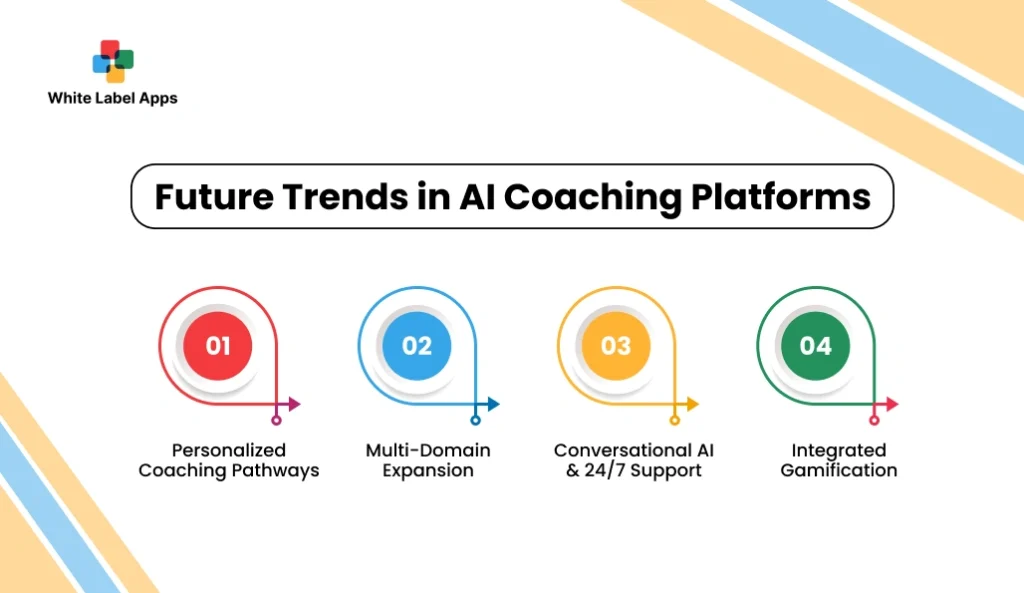
AI in coaching is moving fast, but the basics stay the same. Clients still want clear steps. They want support when motivation drops. They want to see progress. A white label AI coaching app will matter more in 2026 because it can do the small follow-ups at scale, without making coaching feel cold.
Here are the trends that are showing up again and again.
1. Personalized Coaching Pathways
One-size plans are losing steam. People want plans that adjust based on their actions. If a client skips workouts, the plan should get simpler, not stricter. If a client is doing well, the plan should level up.
This is where AI can help. It can suggest next steps based on check-ins and progress. In a white label coaching app, this keeps clients from feeling stuck or judged.
2. Multi-Domain Expansion
Earlier, coaching apps were often single-purpose. Only fitness. Only nutrition. Only mindset. Now coaching brands are mixing it. Fitness plus habits. Nutrition plus stress. Leadership plus wellbeing.
So a white label coaching app platform that supports multiple program types will win. A coach should be able to run a white label fitness coaching app style program and also run a wellness track inside the same system, without confusing clients.
3. Conversational AI & 24/7 Support
Clients get stuck at odd times. Late night cravings. A stressful morning. A missed workout. They want a quick nudge, not a long wait for the next call. That is where chat-style support helps. It can point them to the right lesson, remind them about today’s task, or ask a short check-in question, so they do not drift for days.
This works best when AI stays inside limits. It should not give medical advice. It should not pretend to be the coach. It should act like a helpful assistant inside your app, so your coaching still feels human.
4. Integrated Gamification
Gamification is becoming more mature. Less “points for everything.” More meaningful progress signals.
Examples include streaks for habits, weekly milestones, and “small wins” screens that show progress in a calm way. This is especially useful for a white label health coaching app because health change needs steady motivation, not pressure.
Conclusion
A coaching business grows when the delivery is clear and the client stays consistent. That is hard to do on chats, sheets, and scattered tools. A white label coaching app brings your full coaching flow into one place. It helps clients follow the plan without getting lost. It helps you spend less time on admin and more time on real coaching.
For startups, the biggest win is speed. You can launch, test offers, and improve your program without waiting months. For enterprises, the win is control at scale. You can run many coaches, many clients, and keep the experience steady. With a white label AI coaching app, clients can get small reminders and short progress updates between sessions. It helps them stay on track on busy days, or on days when motivation is low.
Want a branded coaching app that looks like your product and works smoothly as you grow. WhiteLabelApps can help you set it up. We build and customise white label coaching apps for fitness, health, life coaching, and enterprise programs. Share your coaching model and your audience, and they can guide you on the setup, branding, and launch steps.
FAQs
1. What is a white label coaching app?
A white label coaching app is a ready-made coaching app that carries your brand. You add your app name, logo, and colours, then share it with clients. For them, it feels like your own app. Most of these apps already include the daily coaching basics, like onboarding, programs, check-ins, chat, and progress tracking.
2. How much does a white label coaching app cost?
Pricing depends on how much you want to change and how many users you plan to onboard. It can also go up if you add AI tools or connect extra systems. Many setups fall in these ranges: Startup $5,000–$10,000, Mid-Level $10,000–$15,000, and Enterprise $15,000–$20,000. Before you pay, ask for the full fee list in writing, including add-ons, upgrades, and support.
3. What features should a white label coaching app include?
Start with features that support daily coaching. Client onboarding, program delivery, check-ins, messaging, and progress tracking. If you run fitness programs, a white label fitness coaching app should also handle workouts and structured plans. If you run wellness, a white label health coaching app or health coach app white label setup should support habit logs and simple daily tracking.
4. What’s the difference between white label and custom app development?
White label means the app is already made. You put your name, logo, and colours on it and start using it. Most of your work is setting up your program, choosing the features you need, and hiding the ones you do not.
Custom app development starts from scratch. You decide every screen and every flow. It gives you full control, but it also takes longer and costs more. There is also more reviewing and rework before the first version is ready.
5. What’s the best white label coaching app for fitness and wellness coaches?
There is no one best white label coaching app for everyone. The right one is the app that fits how you coach and feels simple for your clients to use. For fitness, check plan structure and progress tracking, so the white label fitness coaching app feels natural. For wellness, check habit logs, reminders, and daily check-ins, so the white label health coaching app works smoothly. A simple test is to run a small pilot with 5–10 real clients and see where people get stuck.