Building an app from scratch may sound like the right move, but for many businesses, it is not the smartest place to start. It takes more time, more money, and much more effort. That is why White Label App Development has become a strong choice for businesses that want to launch faster without starting from zero.
The app market is growing very fast. Grand View Research says the global mobile app market was worth $252.89 billion in 2023 and may reach $626.39 billion by 2030. That shows one clear thing. More businesses want apps, but not all of them need a fully custom app right away.
This is where white label app development makes sense. You start with an app that is already built, add your own brand, and launch much faster. For startups, agencies, restaurants, healthcare businesses, and local service brands, it can be a simple and smart way to begin.
This blog is based on research and review done by our experts. We looked at market trends, real business needs, buyer questions, product limits, launch goals, and the real difference between white label and custom apps.
In this guide, we will explain what white label app development is, how it works, what it costs, where it fits best, where it may fall short, and how to choose the right partner for your business.
What Is White Label App Development?
White Label App Development means using an app that is already built and launching it under your own brand. You add your business name, logo, colors, and content, then make the changes the platform allows.
The basic setup is already done. You are not building the whole app from scratch. You are taking something ready and making it fit your business.
That is why many businesses choose this route. It saves time and lowers the early cost. Common parts like sign-in, payments, alerts, and admin controls are often already in place, so the app can go live much faster.
This works well for startups and growing businesses that want to move quickly. It is common in food delivery, fitness, booking, healthcare, and online selling. The main goal is simple. Launch sooner, get real users, and learn what works.
But white label also has limits. You can change the branding and some parts of the app, but not everything. Since the app already runs on an existing system, you do not get full freedom.
White label is therefore perfect for those firms that desire a faster beginning, less initial expense, and a tested model of an app. In case your concept requires something quite unique, then perhaps a tailor-made app is the right option.
To put it simply, white label app development can be a way for you to bring out your own branded app sooner since you have something quite prepared at hand and not having to craft the entire structure from scratch.
What Are the Different Types of White Label Apps?
Not all white label apps are built the same way. Some are very basic. You add your brand, make a few small changes, and launch. Others give you more room to shape the app so it feels closer to your business.
The type you choose depends on what you need right now. Some businesses care most about speed. Others want more control. Some just want a simple branded app. Others want something that feels less off-the-shelf.
Most white label apps fall into three common types.
1. Multi-Tenant Apps
A multi-tenant app is one shared app used by many businesses. Each business gets its own name, logo, and setup, but the main system behind it stays the same for everyone.
This works well when the goal is to launch fast and keep the cost lower. You will see this model in food ordering, booking, fitness, and service apps. It does the job, but there is a limit. Since the app is shared, big changes are usually hard to make.
2. Rebranded Codebase Apps
This type gives you an app that already exists, but it is dressed up for your business. You can usually change the app name, logo, colors, and content. Sometimes you can change parts of the design too.
It is a good option if you want your own branded app without waiting for a full custom build. You get more freedom than a shared setup, but not total control. If you want bigger changes, the cost and time usually go up.
3. Fully Customizable White Label Apps
This is the most flexible option in white label. The app still starts from a ready base, but you can change much more to match your needs.
This can include the design, screens, features, and the way people use the app. It is a better fit for businesses that want a faster start but do not want the app to feel too standard. The downside is simple. It takes more time and costs more than a basic white label setup.
Also Read: How White Label App Development Can Help Your Business Grow
White Label vs. Custom App Development: A Direct Comparison
This choice is usually about one simple thing. Do you want to launch fast, or do you want full control?
White label works well when you need to move quickly and keep the starting cost lower. Custom works better when your app needs special features, a different user experience, or something built around the way your business works.
Both choices have drawbacks. A white-label app lets you get to market quicker, but it also has its restrictions. A custom app provides you with greater control and ownership, but it will most likely require more time, more money, and more planning.
| Factor | White Label App Development | Custom App Development |
| Starting Point | Built on a ready-made app base | Built from scratch for your business |
| Launch Time | Faster, often in weeks | Slower, often takes months |
| Upfront Cost | Lower initial investment | Higher development cost |
| Customization | Limited to moderate, depends on vendor | Full control over design, features, and flows |
| Branding | Easy to brand with your logo, colors, and content | Fully unique brand experience from the start |
| Feature Flexibility | Best for standard business models | Best for custom ideas and complex needs |
| Maintenance | Usually handled by the vendor | Managed by your in-house or hired development team |
| Scalability | Depends on the platform limits | Can be planned around long-term growth goals |
| Ownership Control | Partial control, vendor dependency stays | Full product and technical control |
| Risk Level | Lower build risk, but more vendor risk | Higher build risk, but more independence |
| Best For | Startups, small businesses, agencies, and businesses that want a faster launch | Businesses with special needs, bigger budgets, or long-term app plans |
When Should Businesses Consider White Label Mobile App Development?
White Label App Development is a good choice when a business wants to launch an app fast without building everything from the start. Not every business needs a fully new app in the beginning. Sometimes a ready app is the smarter choice, especially when the goal is to start quickly, spend less at first, and see if people like the idea.
White label mobile app development works best when a business needs a simple, working app now and can add more later if needed.
1. When You Need Speed
Some businesses do not want to wait many months for a new app. They want to launch soon, start getting customers, and begin earning faster. In that case, a white label app can help.
This is common in food delivery, booking, fitness, and local services. The main parts are already there, so the business can focus on its name, look, prices, and offers.
2. When Money Is Tight
Developing a brand new application can turn out quite pricey. For startups and small businesses, it might be difficult for them to even consider it.
A white label app is typically less expensive upfront, which makes it appear as if it’s more manageable. It doesn’t necessarily have to be the cheapest alternative always. Yet, it is usually cheaper than creating a complete app from scratch.
3. When the Idea Is Already Common
White label works well when people already know how the app should work. Think of food ordering, doctor booking, taxi booking, rental booking, or fitness classes.
In these cases, the business does not need to create something totally new. It just needs a good version with its own name and style.
4. When You Want to Test First
Many business owners have a good idea, but they are not sure how people will react. They want to test it before spending too much money. A white label app helps them start faster and learn from real users.
That can be a smart first step. If people like the app, the business can improve it later.
5. When Your Team Is Small
Not every business has a big team to handle app work. Some do not have enough people or time to manage a full build. A white label app makes things easier because much of the hard work is already done.
This helps founders, agencies, and small teams who want to focus on customers and daily work instead of app problems.
6. When Your Brand Matters Most
Some businesses mainly want an app that looks like their own. They want their logo, colors, name, and store listing. But they do not need lots of special changes right away.
That is where white label mobile app development fits well. It gives the business a clean, branded app without a long and costly build.
7. When You Want Less Risk
Building a full app from scratch can bring many surprises. It can take longer. It can cost more. Plans can change in the middle. A white label app lowers some of that risk because the app is already made and used before.
That makes it a safer first step for many businesses.
8. When This Is Just the Start
For many businesses, white label is not the final plan. It is the first step. It helps them launch faster, learn what customers want, and grow without spending too much too soon.
That is why White Label App Development often works best for businesses that need a quick start now and may want bigger changes later.
Read Also: Affordable White Label App Development for Startups
What Are the Benefits of White Label App Development?
The biggest benefit of White Label App Development is simple. It helps businesses launch faster without building a full app from the ground up. Instead of starting with a blank screen, you start with something ready and shape it around your brand.
For many businesses, that makes the early stage much easier. White label mobile app development is often a smart choice when speed, budget, and lower risk matter more than building every small part from scratch.
1. Lower Upfront Investment
Starting to build a new app from scratch can be very expensive. You need to cover the costs for designing development testing, launching, and supporting. When it comes to white label, most of these tasks have been completed anyway. Of course, you have to pay for branding, installation, and modifications if that is what you want. However, the initial price is generally more affordable in comparison to that of a fully personalized app.
2. Faster Time to Market
This is one of the biggest reasons businesses choose white label. The main app is already built, so you can launch much faster.
That matters when time is important. Maybe you want to test an idea, enter the market quickly, or start getting orders sooner. A faster launch helps with all of that.
3. Easier Maintenance
In many cases, the company providing the white label app also handles updates, fixes, and support. That takes a lot of pressure off the business owner.
This is helpful for small teams. Instead of worrying about app problems every week, they can spend more time on customers, sales, and growth.
4. Tried and Tested Setup
A new custom app starts from zero, so there is always more uncertainty. A white label app usually starts with a setup that has already been used before.
That makes things feel more stable. Basic parts like sign-in, payments, alerts, and admin controls are often already working, which lowers the chance of early mistakes.
5. Faster Branding
White label apps make it easier to launch under your own brand. You can add your logo, colors, business name, and content without waiting for a long build process.
That helps your business look more established from the start. Customers see your app, not a third-party tool.
6. Easier Testing
Not every business should spend big money before knowing if the idea will work. Sometimes it is smarter to test first.
White label gives you that chance. You can launch sooner, see how customers respond, and learn what works before putting in more money.
7. Less Stress
A custom app can get difficult very fast. There is more work, more decisions, and more chances for things to slow down.
White label makes the process lighter. The base is already there, so the path to launch feels simpler and easier to manage.
8. More Time for Growth
Most businesses grow when they focus on customers, service, offers, and daily operations. They do not grow by spending all their energy managing app development.
That is why white label mobile app development works well for many startups and growing brands. It lets them focus more on running the business and less on building the product from zero.
Also Check: 10 Best White Label App Development Companies
What Are the Drawbacks of White Label Apps?
White label apps can help you launch faster and spend less at the start. That is the good part. But they are not the right fit for every business.
The same ready-made setup that saves time can also create problems later. You may get less control, fewer changes, and more limits than you expected. That is why businesses should look at the downsides as seriously as the benefits before choosing this path.
For many brands, white label is a good first step. It helps them go live faster and test the market. But if your app needs special features, a very different user experience, or full control in the long run, the limits can start showing up quite early.
1. Limited Customization
This is a common downside of white label apps. The app is already made, so you have to work within what is already there. You can usually change the branding, layout, and some features, but not every part of the app.
That can be a problem if your business needs something very specific. At first, the app may feel flexible enough. Later, once your needs grow, those limits can start to feel much smaller.
2. Less Control Over Security
In many white label apps, the main system is handled by the company you buy it from. They handle the server, updates, and safety checks. That eases work for your staff however it also means a major component of your app is in the hands of a third party. Some businesses are okay with that. But others, especially those handling private customer information, might find it quite a concern. Then, you are trusting the vendor to secure things, act fast, and fulfill their role effectively.
3. App Store Rejection Risk
A white label app can still face App Store or Google Play review issues. This usually happens when the product looks too similar to other apps, uses weak content, has template-like quality, or does not meet store policy requirements.
That risk is important to understand early. A ready-made app may speed up development, but it does not guarantee smooth approval. The vendor’s experience with store submissions matters a lot here.
4. Scalability Constraints
White label apps are usually designed around common use cases. That works well in the early stage, but it can become restrictive as the business grows. You may hit limits in feature expansion, system performance, third-party integrations, or admin controls.
This does not happen in every project. But if your business grows faster than expected, the platform may struggle to keep up with what you want next. That is where custom development starts looking more attractive.
5. Brand Identity Overlap
A white label app carries your logo, colors, and business name, but the base structure may still feel similar to other apps built on the same product. That can make it harder to create a truly distinct brand experience.
For some businesses, that is not a major issue. A fast launch matters more. But for brands that want strong product identity, a white label setup can feel too close to a template underneath the surface.
6. Vendor Dependency
This is another drawback businesses often notice later. With White Label App Development, your app may rely heavily on the vendor for updates, fixes, support, feature changes, and technical decisions. If the vendor is slow, expensive, or hard to work with, your business feels that impact directly.
That dependency can affect your flexibility. You are not just choosing a product. You are also choosing an ongoing relationship that may shape how your app evolves over time.
Also Check: Benefits of White Label Apps for Startups and Entrepreneurs
When Should You Skip White Label and Go Custom?
White Label App Development is a good option for many businesses, but it does not fit every app idea. It helps you launch faster, but it also comes with limits. You may get less control, fewer changes, and less freedom over time.
That can become a problem when your app needs something more specific, more complex, or more different from the usual setup.
That is where custom development makes more sense. White label mobile app development works best for standard business models and faster go-to-market plans. Custom development is the better option when the app itself is a core business asset and needs to reflect your exact product vision.
| Situation | White Label May Not Be Enough | Why Custom Is Better |
| Your app idea is unique | White label platforms are built for standard use cases | Custom lets you shape the product around your own concept |
| You need full feature control | Vendor limits may restrict how features work | Custom gives complete control over logic, flows, and backend behavior |
| User experience must stand out | Branding alone may not make the app feel truly different | Custom helps create a unique experience from the ground up |
| You are planning for long-term scale | Platform limits may appear as your business grows | Custom can be designed around future growth and expansion |
| You need stronger security control | Vendor-managed systems may not meet all internal requirements | Custom gives more direct control over security and data handling |
| Compliance matters a lot | Regulated industries may need tighter workflows and controls | Custom is easier to align with specific compliance needs |
| You want less vendor dependency | White label keeps you tied to another company’s roadmap | Custom gives more product independence over time |
| The app is your main business product | A shared product base may feel too restrictive | Custom gives full ownership of the product direction |
Industries Where White Label Apps Work Best
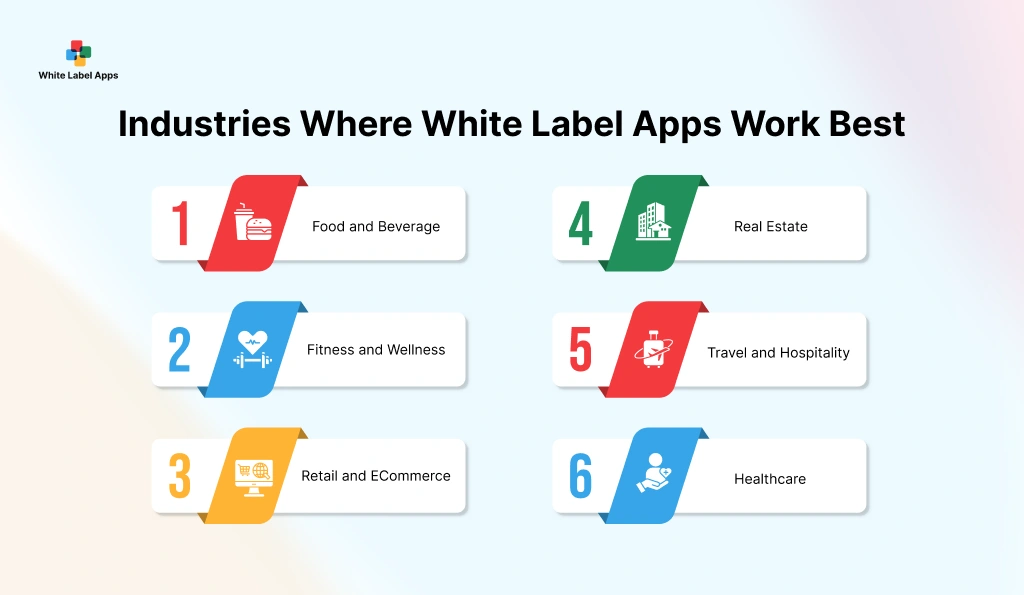
Not every industry needs a brand-new app. At a lot of companies, the primary customer needs are pretty obvious. People around are familiar with ordering food, arranging a service, doing e-commerce, or monitoring a delivery. Under such circumstances, White Label App Development may be a wise choice as it allows businesses to go to market faster without the need to create every fundamental feature from the ground up. This solution is most effective where the main priorities are fast, simple, and a user-friendly app experience rather than a totally new concept. In such cases, white label mobile app development enables enterprises to get their product out there quicker, test the market sooner, and allocate more time to growth instead of a lengthy build process.
1. Food and Beverage
Food businesses are one of the strongest fits for white label apps. People are already familiar with online ordering, delivery tracking, menu browsing, loyalty offers, and payments, which a lot of restaurants don’t have to invent something entirely new to an app idea. They need a branded version that works reliably.
That is why white label works so well here. Products like this make it easier for restaurants, cloud kitchens, cafes, and food chains to get their own ordering app up and running quickly rather than depending solely on third-party platforms.
2. Fitness and Wellness
Gyms, personal trainers, yoga studios, and wellness brands often use similar digital features. Class booking, membership management, video sessions, push notifications, and progress tracking are common needs across the industry.
A white label setup makes sense because the structure is already proven. Businesses can focus on their program, community, and branding without building the full tech stack from scratch.
3. Retail and ECommerce
Retail businesses often need standard app functions like product browsing, cart management, payment checkout, order tracking, and customer accounts. These are not new systems. They are repeatable commerce flows that white label platforms can support well.
If you are running a store and looking to get a branded shopping app delivered quickly, then this kind of model could be just what you need. It is really geared towards and works best for niche sellers who are small time locals or who are on the journey of direct-to-consumer businesses and want to sell via mobile without having to wait for a long time.
4. Real Estate
Real estate apps usually focus on things people already know how to use, like property listings, filters, home details, inquiry forms, saved searches, and agent contact. That is why this industry can work well with white label solutions.
Agencies and property businesses can use ready-made app structures to launch faster and build stronger brand presence. It is a useful option when the goal is better lead generation and easier listing access, not a highly unusual platform concept.
5. Travel and Hospitality
Travel businesses often need the same basic things, booking, package details, payments, customer support, trip plans, and special offers. Hotels, tour operators, and travel agencies all use similar app journeys, which makes white label a good fit for many of them.
That makes this space a strong fit for White Label App Development. Businesses can launch booking and service apps faster while keeping the customer experience under their own brand.
6. Healthcare
Healthcare can also be a good fit, but only in the right use cases. Appointment booking, teleconsultation, patient reminders, doctor listings, and basic health service access can work well through white label apps, especially for clinics and wellness providers.
Nevertheless, this industry requires more caution than the rest. Handling data, privacy regulations, and compliance requirements can be much stricter, therefore one ought to be very careful in choosing a white label platform.
Also Read: How to Make Money With White Label Apps
How White Label Mobile Apps Are Developed
White Label App Development does not start from a blank screen. It starts with a working product base that already has the core features, backend logic, and common user flows in place. The job is not to build everything from zero. The job is to adapt that base to your brand, business model, and launch goals.
That is what makes the process faster. In white label mobile app development, the focus shifts from heavy product invention to smart setup, branding, configuration, testing, and deployment. The app is still shaped for your business, but the foundation is already there.
1. Product Base Selection Comes First
Choosing a suitable white label platform is step one. This is the area where the developers examine if the product already has the features, user roles, integrations, and workflows that your business requires.
This matters more than many buyers think. If the base platform is weak or too rigid, no amount of design polish will fix the bigger limitations later.
2. Business Requirements Are Mapped to the Existing System
Once the platform is selected, the team studies your business model and matches it with the product’s current structure. This includes things like user journeys, admin controls, payment flow, content setup, delivery logic, booking rules, or service categories.
This step is important because white label is never just about adding a logo. The team has to make sure the product fits how your business actually runs.
3. Branding and Visual Customization Are Applied
Next, your app is customized to your brand. Normally, it may involve logo placement colors typography, splash screens banners icons, and other visual design elements that help the app visually represent your business
This is the stage where the product starts feeling more real. The core system may already exist, but the visual layer helps turn it into something customers recognize as your own.
4. Required Features and Integrations Are Configured
Most white label apps already come with standard modules, but they still need to be configured properly. Payment gateways, push notifications, maps, analytics, SMS tools, email systems, and admin settings are usually handled at this stage.
In some cases, extra features are also added. That depends on how flexible the platform is and how much customization the vendor supports.
5. Content and Operational Settings Are Added
An app cannot go live with code alone. It also needs business content and rules. Menus, service lists, pricing, locations, time slots, user permissions, commission settings, tax setup, and support details all need to be entered and checked.
This step often looks simple from the outside, but it has a big effect on launch quality. A good white label app still fails if the setup details are messy.
6. Testing Happens Before Launch
Even though the base product is already built, proper testing is still necessary. The team checks branding accuracy, payment flow, user registration, notifications, admin actions, device compatibility, and app performance before submission.
This part matters because small setup issues can create a bad first impression. A white label app may be faster to launch, but it still needs real QA.
7. App Store Submission and Deployment Follow
Once testing is done, the app is prepared for launch. This includes packaging the Android and iOS builds, creating store assets, meeting app policy requirements, and submitting the product to Google Play and the App Store.
This stage is often where vendor experience makes a big difference. App store approval is not automatic, so the submission process needs to be handled carefully.
8. Post-Launch Support Keeps the App Running
Launch is not the end of the process. After the app goes live, the team usually handles fixes, updates, monitoring, and support. This is one reason businesses choose White Label App Development in the first place. They do not want to manage every technical issue on their own.
A good vendor keeps the app stable after launch, not just before it.
Also Check: What is White Label App Builder: What They Are & How To Use Them
What Are Common Challenges in White Label App Development and How to Overcome Them?
White Label App Development helps businesses launch faster, but that does not mean the process is always smooth. The product base may already exist, yet real challenges still show up around customization, branding, app store approval, vendor dependency, and long-term growth. These issues are not deal-breakers, but they do need attention early.
That is why businesses should go into white label mobile app development with a clear view of both the speed and the limits. The better you understand the common friction points, the easier it is to avoid expensive mistakes later.
1. Limited Customization Can Slow the Right Fit
One of the first problems businesses face is customization. Many white label platforms look flexible at the start, but once the project begins, the available changes may be smaller than expected. You may be able to update branding and content, but not deeper workflows or feature logic.
The best way to handle this is simple. Finalize the customization scope before signing. Ask what can be changed, what stays fixed, and what needs extra development. That one step prevents a lot of confusion later.
2. The App May Still Feel Too Generic
A branded logo and color palette do not always make the app feel unique. Sometimes the structure, flow, or visual style still looks too similar to other apps built on the same base. That can weaken brand recall, especially in competitive markets.
To overcome this, focus on more than surface branding. Improve the app copy, banners, onboarding, offers, service flow, and customer experience details. Small product decisions often do more for identity than color changes alone.
3. Vendor Dependency Can Become a Long-Term Problem
In many white label setups, the vendor controls the core platform, updates, backend logic, and sometimes hosting too. That makes launch easier, but it can become frustrating if the vendor is slow, expensive, or not transparent.
The safest move is to review dependency early. Clarify support terms, update timelines, ownership rights, hosting control, and how future feature requests will be handled. A good white label partner should explain this clearly, not vaguely.
4. App Store Rejection Risk Is Real
A white label app can still be rejected by the App Store or Google Play if it looks too templated, has weak content, or misses policy requirements. This catches many businesses off guard because they assume a ready-made product will automatically pass review.
The fix is careful preparation. Make the app feel complete, brand it properly, add real business content, and work with a team that understands store guidelines. Submission quality matters almost as much as app quality.
5. Scalability Limits May Show Up Later
A platform that works well for launch may start feeling tight as the business grows. You may want deeper analytics, new integrations, role-based access changes, or better performance under higher usage. Not all white label systems can grow smoothly with those needs.
This challenge can be reduced by planning ahead. Ask the vendor how the product handles growth, feature expansion, and third-party integrations before launch. It is much better to check now than rebuild under pressure later.
6. Security Control May Feel Too Light
Some businesses get uncomfortable when they realize the vendor manages important parts of the backend, server setup, or data protection. That concern becomes bigger in industries where user trust and sensitive information matter more.
To handle this, ask direct questions. How is data stored? Who manages server security? How are updates handled? What protections are already in place? In White Label App Development, security should be reviewed as a business issue, not just a technical one.
7. Poor Requirement Clarity Creates Bigger Problems
A lot of white label projects go wrong for one simple reason. The business is not fully clear about what it needs before the work begins. Then expectations keep changing during the project, and both sides get frustrated.
The solution is strong requirement mapping from day one. Define your must-have features, preferred branding changes, launch goals, and non-negotiable business rules before development starts. Clarity saves time on both sides.
8. Support Gaps After Launch Can Hurt Operations
Some vendors are highly responsive before the deal is closed, then much less helpful after the app goes live. That becomes a real problem when bugs appear, store issues come up, or urgent updates are needed.
The best way to avoid this is to check support structure in advance. Ask about response time, maintenance plans, update coverage, and post-launch help. A reliable vendor should support the app after launch, not just up to it.
9. How Businesses Can Avoid Most White Label Problems
Most white label challenges are not caused by the model itself. They come from poor fit, weak planning, or unclear vendor communication. That is why the smartest approach is not just to buy fast. It is to choose carefully.
When businesses go into white label mobile app development with realistic expectations, clear scope, and the right partner, they usually avoid the biggest problems. White label works best when speed is matched with planning, not rushed decisions.
Also Read: White Label Apps: What They Are and How to Resell Them
What Is the Average Cost of White Label App Development?
Generally, White Label App Development costs range between $15,000 and $70,000 on average, whereas less complicated launches can be around $11,000 to $35,000, and highly customized setups can even exceed $70,000. At present, the price level of custom apps is significantly higher overall, with Clutch reporting many app development projects falling in the $10,000 to $49,999 range, and broader 2026 market guides indicating custom app development anywhere from about $15,000 to $500,000+ depending on complexity. The difference is that white label apps are essentially started from a pre-existing product. You are mostly paying for installation branding configuration, integrations, and a few custom changes. Custom development is more expensive since the team has to create design build, test, and support the whole product from the beginning.
| Cost Factor | White Label App Development | Custom App Development |
| Typical Starting Cost | $11,000 to $35,000 for simpler setups | $30,000 to $100,000+ for many serious business apps |
| Average Business Range | $15,000 to $70,000 | $50,000 to $200,000+ |
| Higher-End Projects | $70,000 to $150,000+ for deeper customization | $200,000 to $500,000+ for complex products |
| What You Pay For | License or setup, branding, feature configuration, integrations, testing, launch | Product strategy, UI/UX, frontend and backend development, QA, deployment, maintenance |
| Timeline Impact on Cost | Lower because the core platform already exists | Higher because everything is built from zero |
| Maintenance Cost | Often bundled or lower, depending on vendor plan | Usually separate and ongoing |
| Best Fit | Faster launch, lower upfront spend, proven app model | Full control, unique workflows, long-term product freedom |
How to Choose a Reliable White Label App Development Partner
The success of White Label App Development relies much on the partner you select. A capable supplier can speed up your launch, prevent you from making errors that most people fall into, and maintain the stability of the product even after the release. On the other hand, a weak one can result in delays, poor assistance, app store problems, and a product that will feel limited very quickly. This is the reason why the choice should not be made on price only. In white label mobile app development, the real value lies in product fit, technical reliability, support quality, and how well the partner describes what is and is not possible.
1. Check If Their Product Actually Fits Your Business
Start with the product, not the sales pitch. Ask whether their existing platform truly supports your business model, user roles, workflows, and launch needs. A white label solution may look good in a demo, but that does not mean it fits your real operations.
The right partner should be honest about fit. If the platform cannot handle an important requirement, they should say it early instead of hiding the limitation until later.
2. Look at Customization Scope Carefully
Many vendors say their app is customizable, but the real question is how much you can actually change. Some only allow logo and color updates. Others allow design changes, feature additions, and workflow adjustments.
This matters because customization limits affect how your app performs in the market. A reliable partner will clearly explain what can be changed, what cannot, and what will cost extra.
3. Review Their Past Work and Use Cases
A proven track record matters. Ask to see live apps, similar projects, or examples from industries close to yours. This helps you judge whether they have real experience or just polished sales material.
Try to look beyond screenshots. A real partner should be able to show how the app works, what kind of businesses use it, and what they have delivered before.
4. Understand Who Handles Support After Launch
This is one of the biggest things businesses miss. Launch is only the beginning. Apps need updates, bug fixes, store support, and technical help after they go live.
So ask direct questions. Who handles post-launch issues? How fast is support? Is maintenance included? A reliable partner should not disappear after delivery.
5. Ask About App Store Submission Experience
A good white label product can still face app store problems if the submission is weak or the app feels too generic. That is why vendor experience with Google Play and the App Store matters a lot.
The right partner should understand store guidelines, submission steps, and common rejection reasons. This helps reduce risk before launch, not after.
6. Check How Much Vendor Dependency You Will Have
Every white label setup involves some level of dependency, but the level can vary a lot. Some vendors control almost everything. Others give you more freedom with code access, hosting flexibility, and feature planning.
You need clarity here. A reliable partner should explain what stays in their hands, what stays in yours, and how future upgrades will work.
7. Look for Clear Communication, Not Just Fast Promises
A dependable partner will explain things simply. They will talk clearly about timeline, customization limits, pricing, support scope, and launch steps. They will not hide behind vague lines like “everything is possible.”
That is usually a good sign. Strong communication early often reflects how the full project will be handled later.
8. Compare Value, Not Just Price
The cheapest option is not always the smartest one. A low-cost white label app may save money at the start, but it can create bigger problems through poor support, weak quality, or rigid platform limits.
So compare the full picture. Product fit, support, flexibility, stability, and experience matter more than a low quote on paper.
Also Check: White Label App Builders: Features, Pricing & Benefits
How Our White Label App Development Process Works
A good white label project should feel clear from the first step. You should know what is being customized, what stays fixed, how long each stage takes, and who is handling what. That is why our White Label App Development process is built to keep things simple, practical, and launch-focused.
We do not treat white label mobile app development like a copy-paste job. We treat it like a branded product rollout. The core system may already exist, but the setup still needs the right planning, customization, testing, and support to make the app feel ready for your business.
1. Discovery and Business Understanding
We start by understanding your business model, goals, users, and launch priorities. This includes the app type, target audience, key features, branding needs, and any limits around budget or timeline.
This stage matters because not every white label product fits every business. Before anything moves forward, we make sure the solution matches what you actually need.
2. Platform and Feature Fit Review
Once we understand the requirement, we map your needs against the available platform. We review user roles, workflows, integrations, admin features, and the flexibility of the product base.
This helps avoid the biggest white label mistake. Choosing a system that looks fine at the start but cannot support the business properly later.
3. Branding and Design Customization
Once the platform has been identified correctly, the next step is to incorporate your brand identity into the app. You can think of this as everything that visually connects the app to your brand, such as the logo colors icons banners splash screens, typography, and other graphic elements. Putting a brand name in a ready-made template is far from our goal. Instead, we want your app to look sleek, harmonious, and welcoming to your customers.
4. Feature Configuration and Integration Setup
At this stage, we configure the features your business needs for launch. That may include payments, notifications, maps, delivery logic, booking rules, service areas, user permissions, or dashboard controls.
If third-party tools are part of the scope, we connect them here as well. This is where the app starts working like a real business system, not just a branded shell.
5. Content and Business Rule Setup
Next, we add the details that make the app usable in daily operations. Menus, categories, product lists, pricing, tax rules, schedules, locations, offers, support details, and internal settings are all set up carefully.
This part is often underestimated. But in real projects, launch quality depends heavily on how well the content and business rules are handled.
6. Testing Across Key User Flows
Before launch, we test the app across the main journeys. We check user signup, browsing, ordering or booking flow, payments, notifications, dashboard actions, and basic device performance.
Even in White Label App Development, testing cannot be skipped. The product base may be ready, but every branded rollout still needs proper QA before it goes live.
7. App Store Submission and Launch Support
Once testing is complete, we prepare the builds for release. We help with store assets, package setup, submission handling, and the final launch process for Android and iOS.
This is an important step because store approval depends on more than code. Policy fit, app presentation, and submission quality all matter.
8. Post-Launch Support and Ongoing Help
After launch, we continue supporting the app with updates, fixes, technical help, and platform guidance. That way, your team is not left alone after the product goes live.
This is one of the biggest reasons businesses choose white label mobile app development. They want faster launch, but they also want ongoing support without building a full tech team in-house.
Tech Stack We Use for White Label App Development
Our White Label App Development tech stack is built for one thing, fast launch without weak foundations. We use practical technologies that support branded app rollouts, smooth admin control, secure APIs, third-party integrations, and easier long-term maintenance. For white label mobile app development, the goal is not to chase trendy tools. It is to use stable frameworks that help businesses launch faster, scale cleanly, and manage updates without friction.
The exact stack can change based on the app type, features, and client needs. But in most projects, we use a mix of mobile, backend, web, cloud, database, and DevOps tools that keep the product reliable from build to launch.
| Layer | Tech Stack We Use |
| Mobile App Development | Flutter, React Native, Swift, Kotlin |
| Frontend Web Panels | React.js, Next.js, Vue.js |
| Backend Development | Node.js, Laravel, PHP, Python |
| Database | PostgreSQL, MySQL, MongoDB, Firebase |
| Cloud and Hosting | AWS, Google Cloud, DigitalOcean |
| Authentication and Security | JWT, OAuth, Firebase Auth, SSL, role-based access control |
| Payments | Stripe, PayPal, Razorpay, local payment gateways |
| Maps and Location Services | Google Maps API, Mapbox |
| Notifications and Communication | Firebase Cloud Messaging, Twilio, SendGrid, WhatsApp API |
| Analytics and Tracking | Firebase Analytics, Google Analytics, Mixpanel |
| CMS and Content Control | Custom CMS, headless CMS setup when needed |
| DevOps and Deployment | Docker, CI/CD pipelines, GitHub, GitLab, Bitbucket |
| Third-Party Integrations | CRM, ERP, POS, booking APIs, delivery APIs, chatbot tools |
| Testing and QA | Postman, Selenium, manual QA, device testing |
A good tech stack should support the product quietly in the background. It should not make the app harder to maintain, slower to launch, or more expensive to update. That is why our White Label App Development stack stays focused on speed, reliability, integration support, and real business use, not just technical show.
Why Partner With WhiteLabelApps For Your Next White Label App Development Project
The success of a white label app does not depend on code alone. It depends on how well the product fits your business, how clearly the process is handled, and how much support you get after launch. That is why choosing the right team matters. With White Label App Development, a ready product can save time, but only when the partner behind it knows how to shape it properly for real business use.
At WhiteLabelApps, we focus on more than just app delivery. We help businesses launch branded products faster, with the right feature setup, the right customization scope, and the right support structure. For companies looking at white label mobile app development, that makes the rollout smoother and far less confusing.
1. Right Fit
A good white label project starts with one basic question. Does the product actually fit your business? We look at your model, your users, your goals, and the kind of app experience you want before pushing any platform.
That matters because a fast launch only helps when the product supports your real workflow. A polished demo means very little if the system cannot handle what your business needs day to day.
2. Clear Process
One reason white label projects go wrong is poor clarity. Businesses are often told the app is fully customizable, then later find out the changes are limited. That creates delays, frustration, and wrong expectations.
We keep the scope practical and direct from the start. You know what can be changed, what stays fixed, how the rollout works, and what support looks like after launch.
3. Brand Ready
A white label app should not feel like a shared product with a new logo pasted on top. It should feel aligned with your brand, your service flow, and the customer journey you want to offer.
That is why we pay attention to the details that shape the real app experience. Design consistency, business content, settings, onboarding flow, and feature setup all matter if the final product is meant to feel like your own.
4. Fast Launch
Speed is one of the biggest reasons businesses choose White Label App Development. But speed without structure can create weak launches, store issues, and poor first impressions.
Our approach is built around fast but careful delivery. We use the ready product base to save time, then handle customization, setup, testing, and launch properly so the app feels complete, not rushed.
5. Honest Guidance
Not every business should use white label in the same way. Some need basic branding and quick launch. Others need more flexibility, deeper integrations, or custom business rules. A good partner should understand that balance early.
We do not treat every project the same. We help businesses see where white label works well, where it may feel restrictive, and when a more customized direction may be the smarter move.
6. Ongoing Support
Going live is only one part of the project. After launch, businesses still need fixes, updates, technical guidance, and help when app store or platform issues come up.
That is one reason many companies choose white label mobile app development in the first place. They want a simpler path, not a handoff with no support once the app is live.
7. Real Use
Some app products look fine in presentations but fall apart in daily use. A strong white label rollout has to work for customers, admins, staff, and operations, not just in a demo.
That is why we focus on practical business use from the start. The app should support real orders, bookings, listings, transactions, or service flows without creating extra friction for your team.
8. Smart Choice
The real value of working with WhiteLabelApps is not just faster launch. It is getting a clearer path, a better fit, and fewer costly surprises along the way. We help businesses use White Label App Development the way it should be used, as a practical, lower-risk way to launch a branded app with speed and structure.
If your goal is to launch faster without getting trapped in the usual white label problems, the right partner makes all the difference.
White Label Ready Apps We Can Rebrand for You
If you want a faster launch, these ready apps give you a practical starting point. We can rebrand them with your business name, logo, colors, content, and market setup, so you get a product that feels like yours without building the full app from zero. Each one fits a different use case, from grocery access and taxi booking to food ordering and delivery operations.
1. Gogo Grocer
Gogo Grocer is best described as a community grocery app, not a standard grocery delivery app. Its live site presents it as a scheduled mobile grocery storefront for residential communities, where residents can browse products, get alerts when the market is coming, and order ahead for pickup. That makes it a strong fit for housing communities, senior living properties, and local grocery access models that want a simple branded ordering experience.
Key Features:
- Browse and shop for grocery items
- Live schedule and stop notifications
- Order-ahead pickup support
- Apple Pay support
- SNAP/EBT support in applicable areas
2. Zefir
Zefir is a taxi booking app built for quick ride requests, live trip visibility, and smoother driver-side operations. It works well for businesses that want to launch a branded ride-hailing product without spending months on a custom build. If your goal is to start with core rider and driver flows already in place, this app gives you a clean base to rework around your market, pricing model, and brand identity.
Key Features:
- Quick ride request flow
- Live trip tracking
- Driver management support
- Branded taxi booking setup
3. Yummi Runs
Yummi Runs is a food ordering app designed for users who want to browse local restaurants, place orders easily, and track deliveries from one place. It suits food startups, local restaurant groups, and delivery-focused brands that need a customer app with the main ordering journey already built. This makes it easier to launch under your own brand and focus more on menus, service areas, and repeat orders instead of building the entire product from scratch.
Key Features:
- Browse local restaurants
- Place food orders online
- Track delivery status
- Branded food ordering experience
4. Rapido Food Delivery
Rapido Food Delivery is a broader food delivery platform built around four sides of the business, customer, driver, restaurant, and admin. That makes it a stronger fit for businesses that need more than a basic ordering app. If you want a full delivery operation with restaurant handling, dispatch flow, user ordering, and admin control already structured, this app gives you a more complete launch base that can be rebranded for your market.
Key Features:
- Customer app management
- Driver app management
- Restaurant-side controls
- Admin panel management
Conclusion
White label app development makes sense when your business wants speed, lower upfront cost, and a simpler path to launch. It helps you enter the market faster with a ready product base, while still giving you room to build your own brand experience. For many startups, agencies, and growing businesses, that is a smart first move.
At the same time, white label is not the right fit for every case. If your app needs deep customization, complex workflows, or full technical control, custom development may be the better route. The key is to choose the model that matches your business stage, budget, and long-term product goals.
If you want to launch faster without starting from zero, WhiteLabelApps can help. We build and rebrand white label app solutions that are designed for real business use, smooth rollout, and long-term support. Whether you need a food delivery app, taxi app, marketplace app, or another ready product, WhiteLabelApps can help you bring it to market with less delay and less guesswork.
FAQs
1. What Is White Label App Development?
White label app development involves the adoption of a template or a pre-developed app that can be customized and therefore rebranded to reflect your business. The main part of the software has already been developed, and your firm merely incorporates its logo colors content, and selected customized changes prior to the launch. This allows organizations to start their operations more quickly without having to develop the entire application from scratch.
2. How Much Does a White Label App Cost?
Generally, the price of White Label App Development depends on the type of the app, the extent of features, the number of control panels, the branding requirements, the integrations, and the level of support. Quite often, white label apps are significantly cheaper than custom developments because the foundation of the product is already there. A basic configuration can be substantially cheaper than a highly customized application with multiple user roles and complex workflows.
3. Can White Label Apps Be Rejected by App Store or Google Play?
Yes, they can. The app store can reject a white label app especially if it is too closely modeled on other apps, has weak branding, poor content, broken features, or is not compliant with store policies. This is the main reason why proper customization, testing, and app store submission support are highly relevant before launch.
4. Is White Label App Development a Good Option for Startups?
Yes it can be. Many times a white label mobile app development is a wise move for startups that want to get to market faster, evaluate the demand, and avoid the expenses of building from scratch. It is particularly effective when a business follows a tried and tested model and does not require highly custom product logic at the initial stage.
5. What Industries Are the Biggest Users of White Label Apps?
White label apps find their strongest usage in industries where business models and user flows are quite standard. Some examples are food delivery grocery taxi booking fitness healthcare retail real estate, travel, and local service platforms. These verticals can usually benefit from a quick go-to-market and a good branded app ownership.