
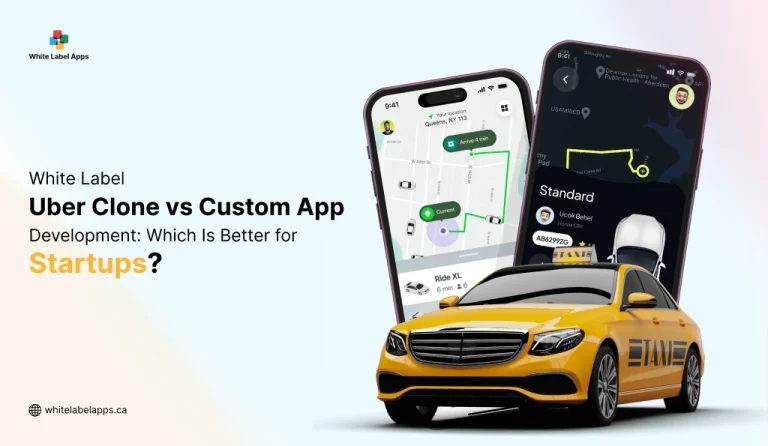
Ride-hailing startups do not get many cheap mistakes. A long build can drain cash before the first real driver comes on board. That is why many founders weigh a white label Uber clone against custom app development much earlier than they expect.
The market is still worth chasing. Grand View Research says the global ride-hailing services market was valued at USD 47.61 billion in 2025 and is projected to reach USD 181.54 billion by 2033. The same firm says the Canada ride-hailing market generated USD 1,828.1 million in 2025, with strong growth expected through 2033.
That sounds exciting. It also raises the cost of choosing the wrong product path.
A white label setup can help a startup launch faster, test one city, and keep more budget for driver onboarding, support, and rider acquisition. A custom build gives more control, but it usually asks for more time, more product decisions, and a much larger upfront spend.
For an early-stage company, this is rarely just a tech choice. It is a timing choice, a budget choice, and a survival choice.
In this blog, we will break down the real difference between the two. You will see how each model works, what features matter, what affects cost, where startups usually make mistakes, and when white label or custom development makes more sense for your growth plan.
TL;DR
- A white label Uber clone is usually the better first step for startups that need speed and lower upfront cost.
- A custom taxi app makes more sense when the business model is different and needs deeper control.
- White label helps founders launch faster and test real demand before spending big.
- Custom development gives more flexibility, but it also takes more time, money, and planning.
- The better choice depends on your budget, launch timeline, and how unique your ride-hailing model is.
Key Points
- A white label Uber clone gives startups a ready-made ride-hailing base with rider, driver, and admin panels already built.
- It helps reduce launch time and keeps early product costs lower than custom app development.
- This model works best for startups that want to enter the market quickly and validate demand with less risk.
- A custom-built taxi app gives more control over features, workflows, design, and long-term product direction.
- Custom development is better for startups with a unique business model, stronger funding, and a clear long-term vision.
- The cost gap between white label and custom matters because startups also need budget for marketing, support, onboarding, and operations.
- For most early-stage founders, speed, learning, and budget discipline matter more than building every feature from scratch.
- That is why many startups begin with white label first, then move toward deeper customization later if the business proves itself.
What Is a White Label Uber Clone?
A white label Uber clone is an off-the-shelf ride-hailing app that a startup can brand as its own and use for launch. The main product is pre-made. Typically, the core package would cover the rider app, driver app, admin panel, booking flow, fare setup, and trip tracking. Rather than creating all that from scratch, the firm reworks the base and launches faster. Imagine it like moving to a ready-fitted store instead of constructing the whole space brick by brick. The counters, the lights, and the shelves are already there. You still change the name, the look, the pricing rules, the service zones, and some features to align with your business.
This approach is beneficial when a startup aims at market entry quickly and wants to test demand with a minimized upfront risk. Passengers get to make bookings, drivers get availability for requests, and the management can handle all the operations through a single dashboard. The layout is already something users recognize, which is an added advantage to lowering the resistance at the early roll-out time. However, a white label Uber clone is not the perfect solution for every company. In case the startup requires a very different way of booking, dispatching based on an unusual logic, or a product experience designed around a unique business model, the custom app may actually be the smartest solution.
Also Read: White Label Taxi App Development Guide
Why Cost-Effective Entry Matters in the Ride-Hailing Market
Most startups do not lose because the app idea is weak. The main reason for their failure is that the initial launch is both very costly and time-consuming. When the product finally launches, the budget has typically been stretched thin as a result of the various expenses related to development, testing, marketing, driver onboarding, and support.
A few startups also opt for additional features such as scheduled trip bookings, promo codes, multi-language support, wallet systems, or loyalty tools. Such features can be handy after the primary platform is stable. However, at the very beginning of the launch, the key objective should be to have a seamless and reliable ride-booking experience.
A leaner launch also protects cash. Money saved on the first build can go into local promotions, referral offers, support staff, and daily operations. Those things matter because a ride-hailing business does not grow on code alone. It grows when supply and demand start moving together.
There is also a timing angle here. A startup that launches a simpler version early can start collecting real booking data much sooner. That makes later decisions sharper. Pricing becomes easier to adjust. Service zones become easier to refine. Future feature planning becomes less of a guess.
This is why many founders start with a white label model. It gives them a practical way to enter the market without carrying the full cost and delay of a custom product from day one.
Key Features of a White Label Uber Clone App for Startups
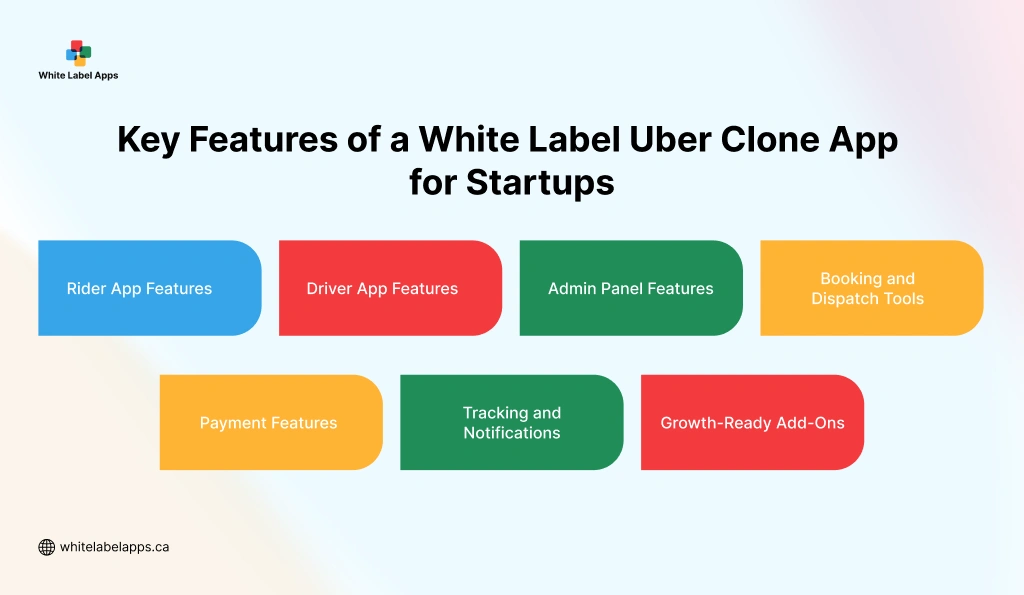
A strong white label Uber clone should cover the core tasks a ride-hailing startup needs from day one. The focus should stay on booking, dispatch, trip handling, payments, and basic business control. Startups do not need feature overload early. They need a stable product that works cleanly in real conditions.
1. Rider App Features
The rider app should make booking simple and quick. It usually includes account signup, pickup and drop location entry, fare estimates, ride confirmation, live tracking, payment options, ride history, and ratings. These are the basic actions users expect without thinking twice.
2. Driver App Features
The driver app should help drivers respond fast and manage trips without confusion. Common features include trip alerts, accept or reject controls, route support, trip history, earnings view, and profile management. If the driver side is weak, service quality drops very quickly.
3. Admin Panel Features
The admin panel helps the business manage the full operation. It usually includes driver approvals, rider records, trip oversight, fare settings, commission setup, service zones, discounts, and support control. This is where the startup handles daily decisions behind the scenes.
4. Booking and Dispatch Tools
A ride-hailing app needs a reliable booking and dispatch system. That includes ride requests, driver matching, trip status updates, and cancellation handling. This part must work smoothly because it affects the whole customer experience.
5. Payment Features
Payment support is a core feature, not an extra one. A white label Uber clone should support fare calculation, payment method handling, trip invoices, and transaction records. Without solid payment flow, even a good booking experience can break down.
6. Tracking and Notifications
Real-time tracking and notifications help both riders and drivers stay updated during each trip. Riders need driver arrival details and trip progress. Drivers need trip alerts and booking updates. These features reduce confusion and improve trust.
7. Growth-Ready Add-Ons
Some startups also choose extra features like scheduled rides, promo codes, multilingual support, wallet systems, or loyalty tools. These can be useful once the core platform is running well. But for early launch, the main goal should still be a smooth and dependable ride-booking flow.
What Are the Benefits of a White Label Uber Clone App for Startups?
Startups usually need pace, less risk, an offer, which they can launch without spending too much money too soon. This is exactly where a white label Uber clone is handy. It supplies a working ride-hailing foundation, thus startup may decide to allocate more time for market entry, driver onboarding, rider growth rather than starting to build each core feature from scratch.
1. Faster Time to Market
A white label Uber clone helps startups launch much faster than a custom build. The core rider, driver, and admin systems are already built, so the team can focus on setup, branding, testing, and launch. In a competitive market, getting live earlier can matter more than having a deeply custom product on day one.
2. Lower Upfront Investment
Custom app development usually demands a much bigger initial budget. A white label model reduces that pressure because the base product already exists. That makes it easier for startups with limited funds to enter the market without taking on a heavy development burden.
3. Easier Market Validation
A startup rarely knows everything before launch. It needs real user behavior, not just assumptions. A white label Uber clone makes it easier to test pricing, service zones, booking volume, driver response, and customer demand before investing more money into deeper product changes.
4. Reduced Development Risk
Building from zero always comes with more unknowns. There can be delays, missed features, testing issues, and budget drift. A white label setup reduces some of that risk because the product structure is already in place and the core workflow has usually been built before.
5. Built-In Core Functionality
Most white label Uber clone apps already include the core features needed for daily operations. That often means booking flow, trip management, fare calculation, driver controls, payments, and admin tools. Getting these basics ready from the start saves a lot of product effort.
6. Better Focus on Business Growth
When founders spend less time worrying about deep app development, they can focus more on the business itself. That includes driver acquisition, rider offers, local partnerships, support quality, and daily operations. For many startups, that shift creates better early momentum.
7. Practical Path to Future Upgrades
Choosing white label does not mean staying limited forever. Many startups launch with a white label base, then add custom features later once demand is proven and revenue starts coming in. That gives them a more practical growth path instead of forcing a big all-at-once build.
Also Check: How to Scale Your Business with Custom White Label Solutions
How Does a White Label Uber Clone App Work?
A white label Uber clone works through three connected parts. The rider app handles bookings. The driver app handles trip acceptance and ride updates. The admin panel manages the business side. When these three parts work together well, the service feels smooth for users and easier to control for the startup.
1. Rider Places a Booking
The flow starts when the rider opens the app and enters the pickup and drop location. The app shows the fare estimate, available ride type, and trip details. Once the rider confirms, the request moves into the dispatch system.
2. System Matches a Driver
After the booking is placed, the platform looks for nearby available drivers. It checks location, availability, and other matching rules set by the business. Then the trip request is sent to the most suitable driver.
3. Driver Accepts the Ride
The driver gets a ride alert inside the app. They can review the trip and accept or reject it. Once accepted, the rider sees the driver details, vehicle information, and expected arrival time.
4. Trip Runs in Real Time
During the ride, the app updates both sides in real time. The rider can track the driver on the map. The system also records trip stages like driver arrival, pickup, trip start, and trip completion. This keeps the flow clear and reduces confusion.
5. Payment Gets Processed
When the ride ends, the fare is calculated based on the pricing rules inside the system. The payment is then completed through the selected method, such as cash, card, or wallet. The trip record and payment details are saved for future reference.
6. Ratings and Reviews Are Collected
After the trip, both rider and driver can rate each other. This helps the business monitor service quality and spot issues early. Reviews may look small, but they shape user trust over time.
7. Admin Controls the Whole Operation
The admin panel handles the business behind the scenes. It helps manage riders, drivers, trips, fares, commissions, zones, support requests, and reports. That is what makes the platform usable as a real taxi business tool, not just a booking app.
What Is a Custom-Built Taxi App?
A custom-built taxi app is a ride-hailing platform made from scratch for one business. It is planned, designed, and developed around the startup’s own goals instead of using a ready-made base. That means the product team decides how the rider app, driver app, admin panel, pricing logic, and trip flow should work from the ground up.
1. Built Around Your Business Model
A custom taxi app is useful when the startup has a service model that does not fit a standard clone structure. This can include corporate transport, rentals, women-only rides, EV fleets, shuttle systems, or city-specific taxi workflows. The product is shaped around the business instead of the business adjusting to a prebuilt system.
2. Full Control Over Features
With a custom build, the startup decides which features to include and how they should behave. That covers booking flow, dispatch logic, pricing rules, payment setup, driver tools, customer support features, and admin controls. This level of control is one of the biggest reasons founders choose custom development.
3. More Freedom in Design
A custom app also gives more room to create a unique user experience. The startup can shape the interface, booking journey, brand look, and feature flow in a way that feels different from standard ride-hailing apps. That can matter when product experience is part of the company’s market position.
4. Better Fit for Long-Term Expansion
Custom development can make future scaling easier when the roadmap is more complex. If the business plans to add new ride types, third-party systems, enterprise billing, fleet tools, or advanced reporting later, a custom structure can support that more cleanly. It gives the startup more room to grow without being limited by a fixed base product.
5. Higher Cost and Longer Timeline
The biggest downside is the bigger investment. A custom-built taxi app usually takes more time, more planning, more testing, and more budget than a white label product. For startups, that means higher pressure before the first launch even happens.
6. Best for Specific Startup Needs
A custom taxi app is the better choice when the startup already has a clear vision, stronger funding, and a reason to build beyond standard ride-hailing features. If the business needs something very specific, custom can be worth it. But if speed and early market testing matter most, it may be more than the startup needs at the beginning.
White Label Uber Clone vs Custom App Development: Feature-by-Feature Comparison
This is where the decision becomes real for startups. Both options can help launch a ride-hailing business, but they solve different problems. A white label Uber clone helps you move faster with lower early risk. A custom app gives you deeper control, but it asks for more time, more money, and more planning.
1. Launch Speed
A white label Uber clone could hit the market much quicker since the core system is already ready. Most of the work usually revolves around the brand installation testing, and some selected changes. On the other hand, a custom app requires more time because every major component has to be created and developed from scratch.
2. Upfront Cost
White label is usually the lower-cost option. Startups do not have to pay for the creation of each core feature from scratch. A custom app requires a significantly larger budget since product planning design development, and testing are all done from the ground up.
3. Customization Depth
This is where custom development has the advantage. A white label product can support branding and some workflow changes, but the base structure is still prebuilt. A custom app gives more freedom to shape the platform around the exact business model.
4. Feature Control
A white label app comes with a standard set of ride-hailing features. This is quite suitable for startups that desire to keep the familiar booking process. By creating a custom application, the company has complete freedom to decide which features to include, the behavior of these features, and the users’ journey throughout the platform.
5. Design Flexibility
White label apps can look branded, but they often follow a familiar product pattern. A custom app gives more room to create a unique interface and a different user journey. This matters more when the startup wants product experience to become part of its market advantage.
6. Time to Market Validation
A white label Uber clone helps the startup test real demand much sooner. That means the team can learn faster from live bookings, driver response, and user feedback. A custom app delays that learning because the launch takes longer.
7. Development Risk
White label carries lower early development risk because the base product already exists. There are fewer unknowns and usually fewer technical surprises during the first launch. Custom development carries more risk because new builds often need more revisions, testing cycles, and product decisions.
8. Scalability Potential
Both models offer the possibility to scale, but they do it differently. If the company sticks pretty much to standard procedures, a white label app can sustain the growth. Usually a custom app is more suitable for long-term growth especially if the development plan involves unique features, extensive integrations, or complicated operations.
9. Maintenance Responsibility
At the start, it is usually a lot simpler to handle white-label products as most of the skeleton is laid out already. A custom app is likely to require continuous technological inputs by the product team or a dev partner. This goes well with a funded startup but it intensifies the burden on small teams.
10. Best Fit for Startups
A white label Uber clone is usually better for startups that want to launch quickly, control cost, and validate the market early. A custom app is better for startups with strong funding, a very specific service model, and a long-term product vision that cannot fit into a standard ride-hailing setup.
How To Develop and Design a White Label Uber Clone App
Building a white label Uber clone is not about starting from zero. The product base already exists. The real job is choosing the right setup, shaping it for your market, and making sure the app works well before launch.
1. Define the Business Model
Start with the business model before thinking about the screens. Figure out what type of rides you want to provide, which city or region you want to serve, and how the platform will generate revenue. A local taxi app, an airport transfer app, and a rental ride service all need different setups.
2. Choose the Right White Label Base
Not every clone product is worth using. The foundation should already include rider booking, driver management, admin controls, live tracking, fare processing, and payment handling. When that core setup is weak, startups usually spend more time fixing the product than actually launching it.
3. Finalize the Core Features
Keep version one tight. Focus on booking, dispatch, trip tracking, payments, driver onboarding, and admin control. Extra tools like wallets, loyalty points, or referral programs can come later once the app proves itself in the market.
4. Shape the Brand Experience
A white label app still needs its own identity. Add your app name, logo, colors, icons, pricing rules, service zones, and ride categories. Small details matter because they help the app feel like a real brand instead of a generic clone.
5. Design Clean User Flows
The rider flow should feel quick and easy. The driver flow should feel clear and fast. The admin flow should make daily control simple. Good design here is not about fancy screens. It is about reducing confusion at every step.
6. Set Up Maps, Payments, and Notifications
These are core parts of the product. The app needs map support for pickup and trip tracking, payment tools for fare collection, and notifications for trip updates. If these parts are unstable, the full ride experience starts breaking down.
7. Test in Real Conditions
Do not test only inside a demo setting. Check how the app performs with weak internet, late driver response, trip cancellations, payment issues, and common user mistakes. A startup learns more from rough testing than from perfect internal previews.
8. Launch in a Controlled Way
Do not try to cover too much too early. Start with one city, one service zone, or one target group. A smaller launch gives the team more control and makes it easier to catch problems before expanding.
9. Improve After Launch
The first version is only the starting point. Once real riders and drivers begin using the platform, weak spots become easier to see. That is the right time to improve features, adjust pricing, and plan deeper changes based on real usage.
Challenges in Developing a White Label Uber Clone App for Startups
A white label Uber clone can reduce build time, but it does not remove every problem. Startups still face product, technical, and operational challenges during setup and launch. The difference is that these problems usually show up around execution, not around building the whole platform from zero.
1. Choosing the Right Product
Not every white label solution is strong enough for real market use. Some products look polished in demos but struggle during live booking, driver matching, payment flow, or admin control. If the base product is weak, the startup ends up wasting time and money fixing avoidable issues.
2. Limited Customization Scope
White label products are faster because the structure already exists. That also means some parts are harder to change deeply. Branding is usually easy, but unusual ride logic, special pricing models, or different dispatch workflows can be more difficult to implement.
3. Integration Problems
A ride-hailing app depends on third-party tools like maps, payment gateways, push notifications, and OTP services. If these integrations are not set up properly, the app can fail at the most important points in the journey. Even one weak integration can affect the whole service.
4. Driver and Rider Onboarding
The app alone does not make the business work. The startup still needs enough drivers and enough riders to keep the platform active. If onboarding is slow, confusing, or badly planned, the product may launch but still struggle to gain traction.
5. Real-Time Performance Issues
Ride-hailing apps depend on speed. Bookings, driver matching, trip status, and tracking updates all happen in real time. If the product feels slow or unstable during these moments, users lose trust very quickly.
6. Weak Admin Control
Some white label apps cover rider and driver features well but offer only basic admin tools. That becomes a problem when the startup needs better control over service zones, disputes, pricing changes, support issues, and promotions. A weak admin panel creates daily friction after launch.
7. Compliance and Local Rules
Taxi and ride-hailing businesses often have to deal with local transport rules, licensing conditions, insurance checks, and driver verification requirements. A white label app can support the product side, but the startup still has to manage these local business realities.
8. Overbuilding Too Early
Many startups hurt themselves by adding too many extras before the core service is stable. They want wallets, subscriptions, loyalty tools, rentals, and multiple ride types before the first launch proves demand. That usually increases cost and slows the rollout without improving the core business.
9. Vendor Dependency
With a white label product, the startup may rely on the provider for updates, fixes, or certain technical changes. That can work well if the support is strong. It becomes a problem when the vendor is slow, unclear, or limited in what they can change.
10. Balancing Speed and Quality
This is often the hardest challenge. Startups want to launch fast, but a rushed rollout with poor testing can damage the brand early. The best outcome usually comes from using white label speed carefully, fast enough to enter the market, but disciplined enough to launch something reliable.
White Label Uber Clone Cost: Why Does It Matter?
A white-label Uber clone usually costs far less than building a custom taxi app from scratch. Based on current vendor pricing, packaged white-label taxi apps typically range from around USD 3,299 to USD 6,999, while a custom taxi app in 2026 is often estimated at USD 30,000 to USD 250,000 or more, depending on the features, supported platforms, and overall complexity. For startups, that gap is important because the amount spent on the product directly affects how much budget remains for marketing, driver onboarding, customer support, and post-launch fixes.
| Cost Factor | White Label Uber Clone | Custom Taxi App |
| Starting Cost | Around USD 3,299 to USD 6,999 for packaged solutions | Around USD 30,000 to USD 250,000+ for custom development |
| Build Approach | Pre-built product with branding and selected changes | Full product built from scratch |
| Launch Budget Pressure | Lower, so more budget can stay available for growth and operations | Higher, because most early spending goes into development |
| Feature Cost Impact | Core features are already included, extras raise cost later | Every feature adds to design, development, and testing cost |
| Timeline Effect on Cost | Faster launch usually reduces early financial pressure | Longer build usually increases total spend before launch |
| Best Fit | Startups that want speed and lower upfront risk | Startups that need deep control and have a larger budget |
Factors That Influence the Cost of Developing Your Uber Clone
The price of developing an Uber clone is influenced by the breadth of the project rather than the idea alone. For example, two startups may both decide to create a ride-hailing app, yet their resultant expenses may differ greatly. The number of features, the level of design, the integrations involved, the platforms supported, the amount of support, etc. are all key elements that determine the overall budget.
1. Feature Complexity
The price will go up as you add more features. An app that only allows users to book rides, drivers to be matched, users to be able to track the trip, and the payment to be handled, will be cheaper than a product containing not only these features but also rentals subscriptions in-app wallets, loyalty programs, and advanced reporting, etc. Each feature will add a new level of development, testing, and support.
2. Platform Choice
The platforms you choose to target are another big factor in the cost. Developing for Android, iOS, and a web admin panel all at once will be more costly than focusing one platform first and then scaling. Going for multiple platforms means you will have to create more interfaces, do more tests, and there will be more deployment work in general.
3. Admin Panel Scope
A simple admin dashboard keeps costs lower. Once you add reports, dispute handling, pricing control, service zones, driver approvals, promo setup, and support tools, the admin side becomes more expensive. Many founders ignore this part early, but it adds real product effort.
4. Security Requirements
Extra security features also raise the budget. Stronger login controls, fraud checks, data protection layers, and user verification systems all require added work. Security is necessary, but deeper protection usually means a higher build cost.
5. Customization Level
A standard white label setup costs less because the structure is already fixed. Once you start changing dispatch logic, fare rules, ride categories, or business flow, the price starts rising. At a certain point, a heavily changed white label app can begin to feel closer to custom development.
6. Post-Launch Support
The cost does not stop at launch. Startups often need bug fixes, updates, app store support, small improvements, and technical help after the app goes live. Some providers include limited support, while others charge separately for ongoing work.
7. Delivery Timeline
A rushed project can cost more than a well-planned one. Faster delivery usually means tighter deadlines, quicker revisions, and more pressure on the team. If the startup wants a very short turnaround, the final budget may increase.
8. Vendor Quality
The provider you choose affects the real cost more than many startups expect. A cheap vendor may save money at first, but poor code, delays, or weak support can make the full project much more expensive later. A stronger product base often saves money by reducing rework and launch problems.
When Should You Choose a White Label Uber Clone?
If a startup is looking for speed, budget control, and an easier alternative to market, then a white label Uber clone is the most suitable option. It is ideal for those who want to quickly bring a real product to the market and get a taste of the demand after which they can adapt their product accordingly. One cannot imagine going live without months of custom work.
1. When You Want to Launch Fast
Some startups need to move quickly. The primary advantage of a white-label product is that the main structural framework has already been developed. This allows the team to concentrate on elements like branding setup testing, and launch rather than developing all key features from scratch.
2. When Your Budget Is Limited
Usually, early-stage startups don’t have endless product budget. A white label Uber clone reduces the initial development load and allows a startup to spend more on marketing, driver onboarding, customer support, and launch operations. This additional breathing space can quite significantly be a game-changer.
3. When Your Business Model Is Standard
If your service follows a typical ride-hailing flow, a white label solution often seems reasonable. Usually, riders reserve a ride, drivers get the ride invitation and make the decision, payment is made, and admins run the platform. In such a situation, a pre-existing framework might practically cover all that a startup requires.
4. When You Need Market Validation First
A startup does not always need a deeply custom app on day one. Sometimes the smarter move is to launch a practical version, study how riders and drivers respond, and improve the product later. White label makes that kind of testing easier and less expensive.
5. When Core Features Matter More Than Custom Extras
In the early stage, stable basics matter more than a long feature list. If the main need is booking, dispatch, trip tracking, payments, and admin control, a white label model is often enough. It helps the startup stay focused on what really gets the business moving.
6. When You Want Lower Development Risk
Custom development brings more unknowns. Timelines can stretch. Scope can grow. Bugs and rework can increase the cost. A white label Uber clone lowers some of that risk because the base product already exists and the core flow is already defined.
7. When Your Team Is Small
A small team usually cannot spend all its time on product decisions. Founders need to work on supply, demand, partnerships, support, and operations too. White label helps reduce product pressure so the team can spend more time building the business itself.
8. When You Plan to Improve Later
Choosing white label now does not lock the startup into one path forever. Many entrepreneurs start by launching their product with a ready-made base, validating demand, and only afterward building custom features. This step-by-step mode of operation turns out quite often to be more feasible than attempting to develop an ideal app before a first launch.
When Should You Choose a Custom-Built App?
A custom-built app becomes a more suitable option if the startup requires additional features beyond a basic ride-hailing system. It is a valid approach when the product constitutes the unique selling point of the business and the service is just the support behind it. Custom development could be justified if the startup has identified its unique business model elements beforehand.
1. When Your Business Model Is Different
Some startups do not fit the usual taxi flow. They may need rental booking, women-only rides, EV fleet logic, shuttle operations, corporate transport, or city-specific workflows. In those cases, a custom-built app gives more room to shape the platform around the actual business.
2. When You Need Full Feature Control
A custom app works better when the startup wants full control over booking logic, dispatch rules, pricing, payments, support features, and admin tools. A white label product may cover the basics well, but it may not support every workflow the startup wants in the long run.
3. When Product Experience Matters
Sometimes the app itself needs to feel very different from standard ride-hailing products. A custom build gives more freedom in design, user flow, and service experience. That can matter when the startup wants product experience to become part of the brand.
4. When You Have Stronger Funding
Custom development asks for more budget from the start. Often, this means more thorough planning, UI and UX design, backend development, testing, and modifications during the construction phase. A startup with a robust financial backing will have a more comfortable cushion to endure such pressure without having to compromise on launch schedules.
5. When You Are Building for Long-Term Scale
A custom application can be more appropriate if the product plan already features a progression of sophisticated elements, thorough integrations, or diversification into various service types. In case a startup anticipates that their offering will become more intricate as time goes by, it is quite possible that a custom configuration will be able to accommodate that development more straightforwardly.
6. When You Need Deep Integrations
Some transport businesses need more than maps and payments. They may need enterprise billing, fleet tools, internal dashboards, route planning systems, or local compliance workflows. A custom app is better when those integrations are central to how the business works.
7. When You Want Full Product Ownership
A custom-built app gives the startup deeper control over how the product evolves. The team is not working within a prebuilt product frame in the same way. For founders who want long-term product ownership and more freedom in future changes, that can be a major advantage.
8. When the Vision Is Already Clear
A custom app makes the most sense when the startup is not still guessing. If the founders already know their market, workflow, feature priorities, and product direction, then building from scratch can be a strong move. But if the idea still needs testing, custom may be too much too early.
Conclusion
For most startups, the better option is the one that fits the stage of the business. If the goal is to launch fast, control spending, and test the market without carrying a heavy development load, a white label Uber clone is usually the smarter first step. It gives the startup a working product base and a faster route to market.
A custom-built app becomes the better choice when the business model is more complex, the product needs deeper control, and the startup has enough budget to support a longer development cycle. It offers more freedom, but it also brings more pressure in the early stage.
The real question is not which option sounds bigger. The real question is which option solves the right problem right now. For many startups, speed, learning, and budget discipline matter more at the beginning than deep product control.
If you want to launch faster without starting from scratch, WhiteLabelApps can help you do that with ready-made, brandable taxi and ride-hailing solutions built for startups. From rider and driver apps to admin controls and custom branding support, WhiteLabelApps helps businesses enter the market with less delay and lower upfront risk.
FAQs
1. What Is an Uber Clone App and How Does It Work?
A white label Uber clone is a ready ride-booking setup built around the usual ride-hailing flow. It normally includes a rider app, a driver app, and an admin panel, with core functions like booking, tracking, payments, and trip history already in place. The rider books a trip, the system matches a driver, the trip is tracked in real time, and the admin panel manages fares, users, and support.
2. How Much Does a White Label Uber Clone App Cost?
Current vendor pricing shows packaged taxi app solutions starting around USD 3,299 to USD 6,999. That is usually the base package, not the full launch cost. The final number can go up when you add custom branding, extra modules, third-party integrations, or post-launch support.
3. What Are the Key Differences Between an Uber Clone App and a Custom Ride-Hailing App?
The main difference is in the way the product is created. White label Uber clones usually start with a pre-made ride-hailing platform, so rollout is typically quicker and less expensive. On the other hand, custom apps are designed entirely from the ground up, which allows for greater control over features and workflows, but the cost of custom development is typically much higher, generally ranging from USD 40,000 to USD 300,000.
4. Is an Uber Clone a Good Project for Startups?
For many startups, yes. It can be a practical first move when the goal is to launch fast, test one market, and avoid a heavy custom build too early. That said, this is an inference from the lower entry pricing and prebuilt structure of white label products, so it works best when the startup needs a standard ride-booking model, not a very unusual workflow.
5. Is It Legal to Build an Uber Clone App?
Basically, a ride-hailing app developing the same broad business model can be legal, but just copying Uber’s name, logo or protected expression is a different matter. U.S. Copyright Office states that copyright only protects original software and other original works, while ideas, systems, or methods of operation are not protected. WhiteLabelApps also asserts that an Uber clone is legal, provided that it is brought to the market as a new product featuring your own branding, design, and coding. This is just the outline of the topic rather than legal consultation.