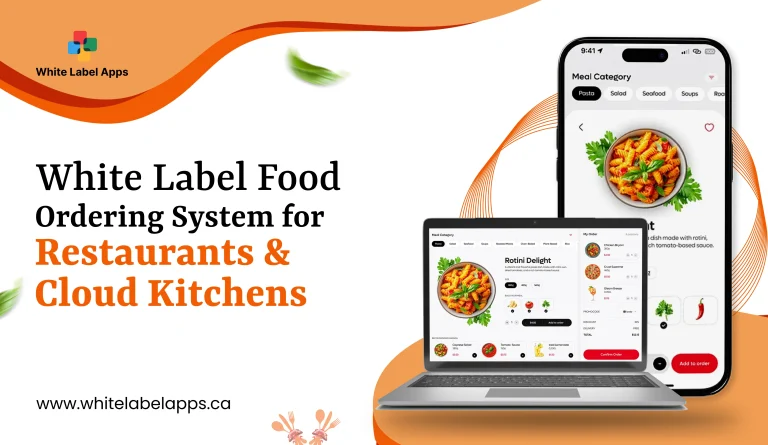
The food service industry has been completely transformed in the past decade. Customers are now expecting easy access to quick and digitally first experiences in food purchases. No matter if it’s a local restaurant or a delivery-only cloud kitchen, online ordering has turned into the main sales channel.
Nevertheless, third-party delivery platforms, on the whole, have been a blessing for restaurants in reaching customers rapidly; however, they still result in problems like high commissions, lack of customer ownership, and reduced brand visibility that restaurants have to deal with in the long run. To break through these restrictions, a lot of food businesses have resorted to a White Label Food Ordering System, which is a solution that allows restaurants and cloud kitchens to handle online orders directly via their own branded platforms.
This blog clarifies the concept of a white label food ordering system, the operation of such a system, the importance of this system to restaurants and cloud kitchens, and how it is the future of food ordering.
TL;DR
- White label systems help restaurants reduce commissions and regain profit control.
- Restaurants and cloud kitchens own branding, pricing, and customer data.
- Direct ordering improves margins, loyalty, and long-term business sustainability.
- Cloud kitchens benefit from multi-brand management and scalable digital infrastructure.
- White label platforms future-proof food businesses in competitive digital markets.
Key Points
- A White Label Food Ordering System enables restaurants to accept direct orders through branded platforms, reducing reliance on high-commission third-party delivery marketplaces.
- Restaurants gain full control over pricing, promotions, customer data, and brand experience, leading to stronger customer relationships and higher repeat orders.
- Cloud kitchens benefit from centralized multi-brand management, better demand forecasting, and scalable operations built for delivery-first business models.
- Integrated features like POS connectivity, real-time menus, secure payments, and analytics streamline operations and improve efficiency across ordering workflows.
- Investing in a white label system builds predictable growth, stronger branding, and long-term independence in an increasingly competitive digital food ecosystem.
What Is a White Label Food Ordering System?
A white label food ordering System is essentially a cloud-based digital ordering platform that restaurants and cloud kitchens are free to brand completely as their own. Rather than committing time and money to creating a feature-packed app or software from scratch, enterprises take a tested solution that a tech provider has already developed and then make it their own by adding their logo, brand colors, menu, pricing, and content.
The main concept of a white label food ordering system is one of ownership. Even though the backend technology is overseen by the provider, the whole customer-facing experience is that of the restaurant. Users get to submit their orders via a website or mobile app that has been branded, and thus, it looks, feels, and operates like a part of the restaurant itself, not a third-party marketplace.
With this arrangement, food businesses can still have absolute authority over their brand image, pricing tactics, and relationships with customers. Simultaneously, they have at their disposal a dependable, safe, and constantly upgraded ordering system. Therefore, restaurants and cloud kitchens are in the position to concentrate on what is of greatest value: providing delicious food, streamlined operations, and outstanding customer experiences without the technical issue of complicated development.
Also Read: White Label Ordering App for Restaurants
Why Restaurants Need a White Label Food Ordering System
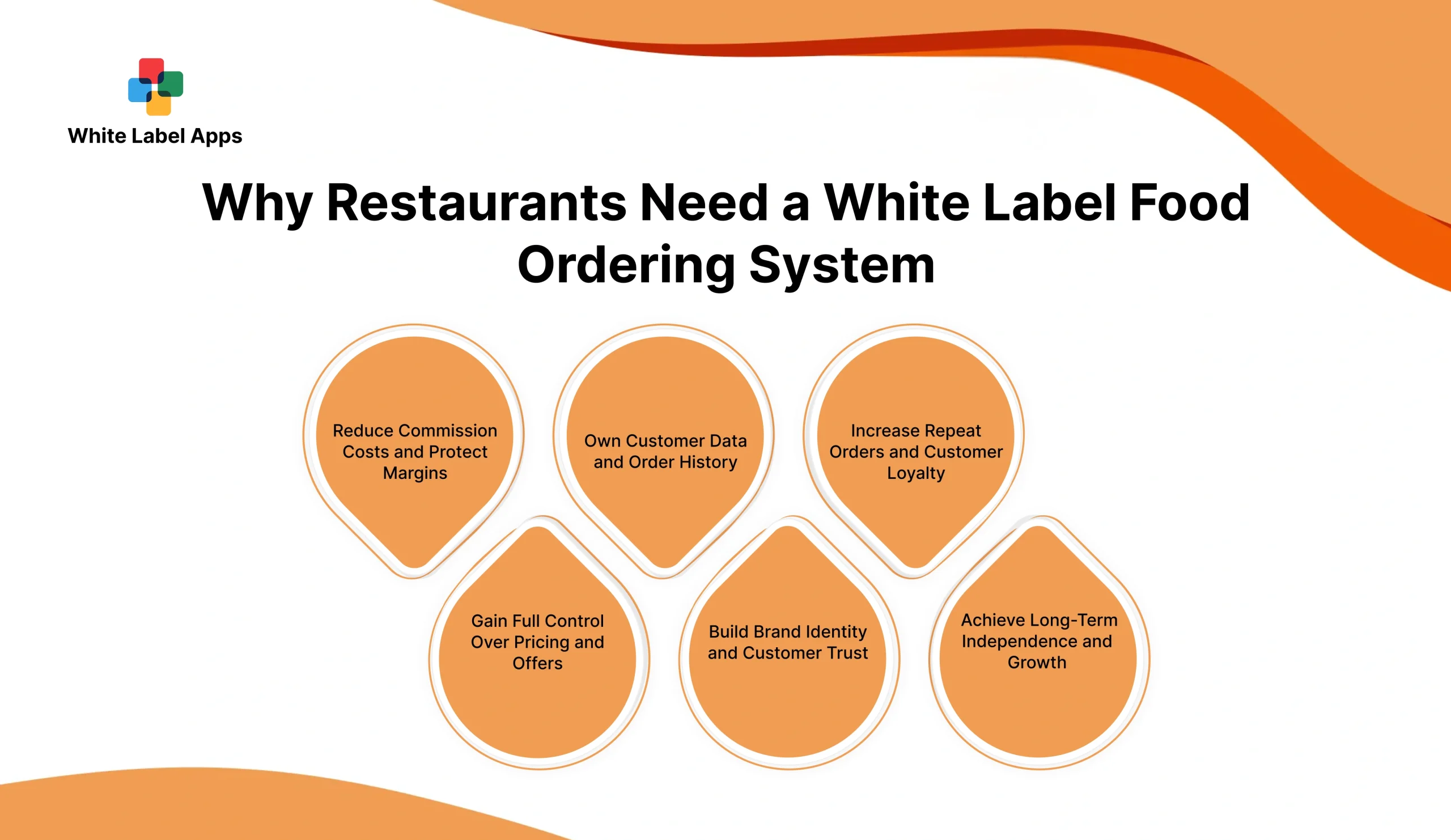
For traditional restaurants, profit margins are already under constant pressure. Third-party delivery platforms take high commission fees, but with the increasing costs of ingredients, labor, rent, and utilities, there is very little room left for these fees. Restaurants gain control, security, and sustainable expansion through a white label food ordering system as the online orders are redirected to their own branded channels.
Below are six key reasons why restaurants need a white label food ordering system, explained clearly and strategically.
1. Reduce Commission Costs and Protect Margins
Third-party platforms often charge 20–30% per order, which directly impacts profitability. A white label food ordering system allows restaurants to accept direct orders without heavy commission deductions, making online sales as profitable as dine-in orders.
- No or minimal commission fees
- Higher profit per order
- Predictable operating costs
- Better control over online revenue
- Long-term financial sustainability
2. Gain Full Control Over Pricing and Offers
Marketplaces often restrict pricing flexibility and promotions. With a white label food ordering system, restaurants can set their own prices, run exclusive deals, and experiment with offers without platform approval.
- Freedom to set menu pricing
- Custom discounts and combos
- Exclusive website/app-only offers
- Flexible seasonal promotions
- Better upselling opportunities
3. Own Customer Data and Order History
On platforms that are not owned by the restaurant, the customer data is the property of the platform and not the restaurant. A white label food ordering system gives restaurants complete ownership of customer data, order history, and preferences.
- Access to customer contact details
- Visibility into ordering behavior
- Better customer segmentation
- Personalized marketing campaigns
- Stronger customer relationships
4. Build Brand Identity and Customer Trust
When customers order through marketplaces, the platform brand dominates. A white label food ordering system keeps the restaurant brand front and center throughout the entire ordering experience.
- Fully branded website or app
- No competitor visibility
- Stronger brand recall
- Increased customer trust
- Consistent brand experience
5. Increase Repeat Orders and Customer Loyalty
Repeat customers are more profitable than new ones. A white label food ordering system enables restaurants to build loyalty programs and communicate directly with customers, driving repeat business.
- Loyalty points and rewards
- Personalized offers and coupons
- Push notifications and emails
- Higher repeat order frequency
- Improved customer lifetime value
6. Achieve Long-Term Independence and Growth
Relying solely on aggregators creates dependency and risk. A white label food ordering system helps restaurants build an independent digital channel that grows with their business.
- Reduced dependency on third parties
- Scalable for future growth
- Better operational insights
- Control over customer journey
- Sustainable online ordering strategy
A white label food ordering system goes beyond being a mere cost-saving instrument; it is a valuable strategic resource. With this, restaurants can maintain their profit margins, have direct control over the customer relationships, enhance their brand identity, and build a dependable base for sustainable growth in a highly digital food industry.
Read Also: Top White Label Restaurant App Solutions for Food Businesses
Why Cloud Kitchens Need a White Label Food Ordering System
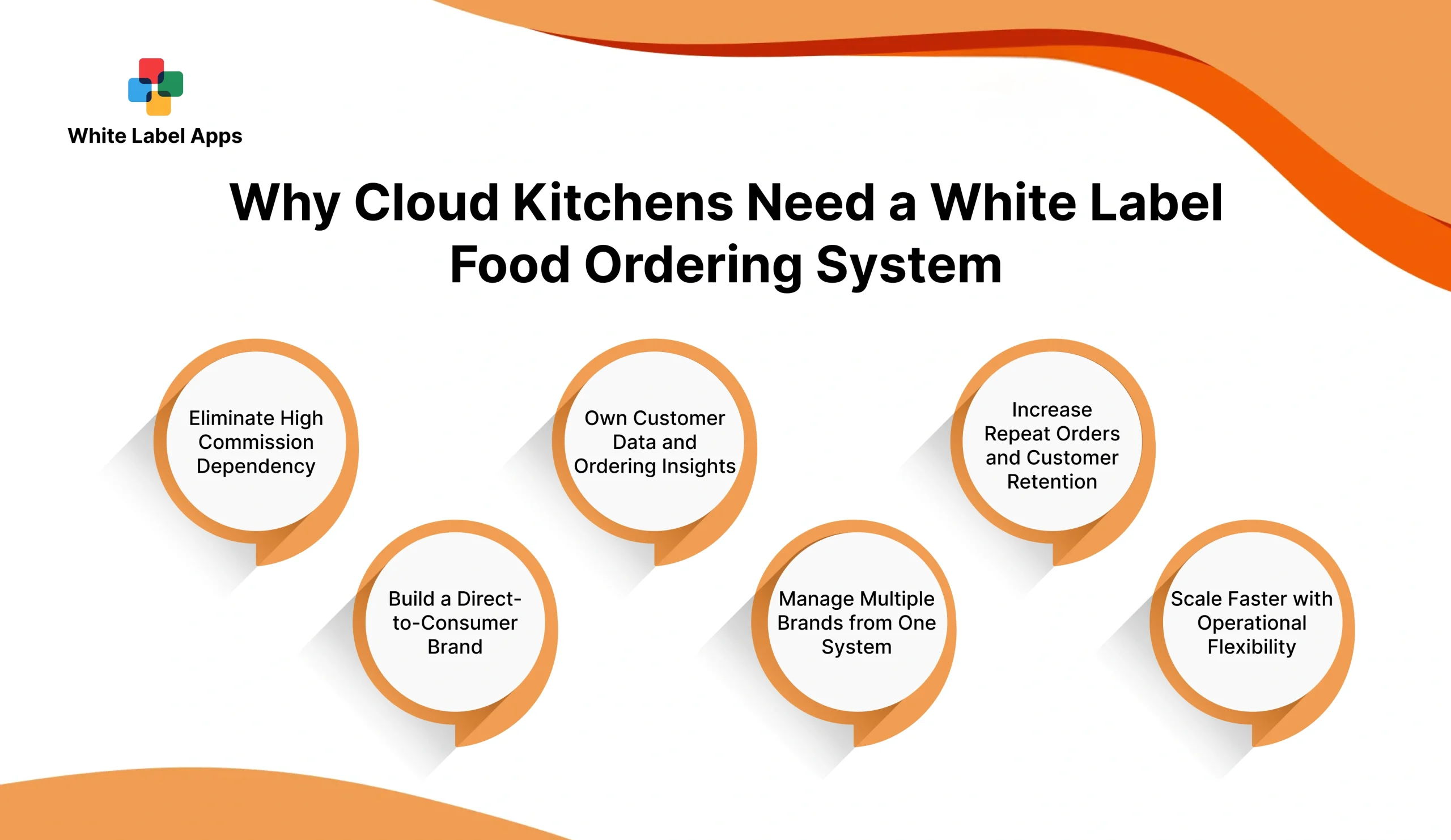
Cloud kitchens operate entirely on online orders, making digital efficiency and cost control critical for success. High platform commissions, limited customer ownership, and intense competition can quickly reduce profitability. A white label food ordering system gives cloud kitchens direct control over orders, branding, and customer relationships, enabling sustainable and scalable growth.
Below are six key reasons why cloud kitchens need a white label food ordering system.
1. Eliminate High Commission Dependency
Cloud kitchens are typically very dependent on third-party platforms, through which commissions can drastically affect margins. A white label food ordering system can be a way to get orders directly and thus cloud kitchens can keep more of the revenue generated per order and have their operational costs stabilized.
- Reduced or zero commission fees
- Higher profit margins per order
- Better control over pricing strategy
- Predictable monthly expenses
- Improved long-term profitability
2. Build a Direct-to-Consumer Brand
Unlike traditional restaurants, cloud kitchens lack a physical presence. A white label food ordering system becomes the primary brand touchpoint, helping cloud kitchens establish a strong, recognizable digital identity.
- Fully branded website or mobile app
- No marketplace brand dominance
- Clear brand positioning
- Better customer recall
- Stronger digital presence
3. Own Customer Data and Ordering Insights
Third-party platforms do not share complete customer data. A white label food ordering system ensures cloud kitchens own customer details, order history, and behavioral insights, which are essential for growth.
- Access to customer contact information
- Visibility into ordering patterns
- Better demand forecasting
- Targeted marketing campaigns
- Data-driven decision-making
4. Manage Multiple Brands from One System
Many cloud kitchens operate multiple virtual brands from a single kitchen. A white label food ordering system allows centralized management of menus, orders, and operations across multiple brands.
- Single dashboard for all brands
- Independent menus and pricing
- Faster brand launches
- Simplified operations
- Reduced management complexity
5. Increase Repeat Orders and Customer Retention
Cloud kitchens depend heavily on repeat customers. A white label food ordering system enables loyalty programs, personalized offers, and direct communication to keep customers coming back.
- Loyalty rewards and points
- Personalized discounts
- Push notifications and emails
- Higher customer lifetime value
- Improved retention rates
6. Scale Faster with Operational Flexibility
Growth for cloud kitchens requires scalable technology. A white label food ordering system supports expansion across locations, brands, and delivery zones without operational disruption.
- Easy multi-location expansion
- Flexible delivery zone management
- Real-time performance analytics
- Seamless system scalability
- Future-ready digital infrastructure
A white label food ordering system is a must-have for cloud kitchens that want to lower their dependence on platforms, create powerful digital brands, and grow their business in a profitable way. Cloud kitchens, by having the ordering channel as their property, get the control, insights, and flexibility required to be able to survive and expand in a market that is highly digital and delivery-driven.
Also Read: White Label Delivery App for Food Businesses: A Brief Guide
How a White Label Food Ordering System Works
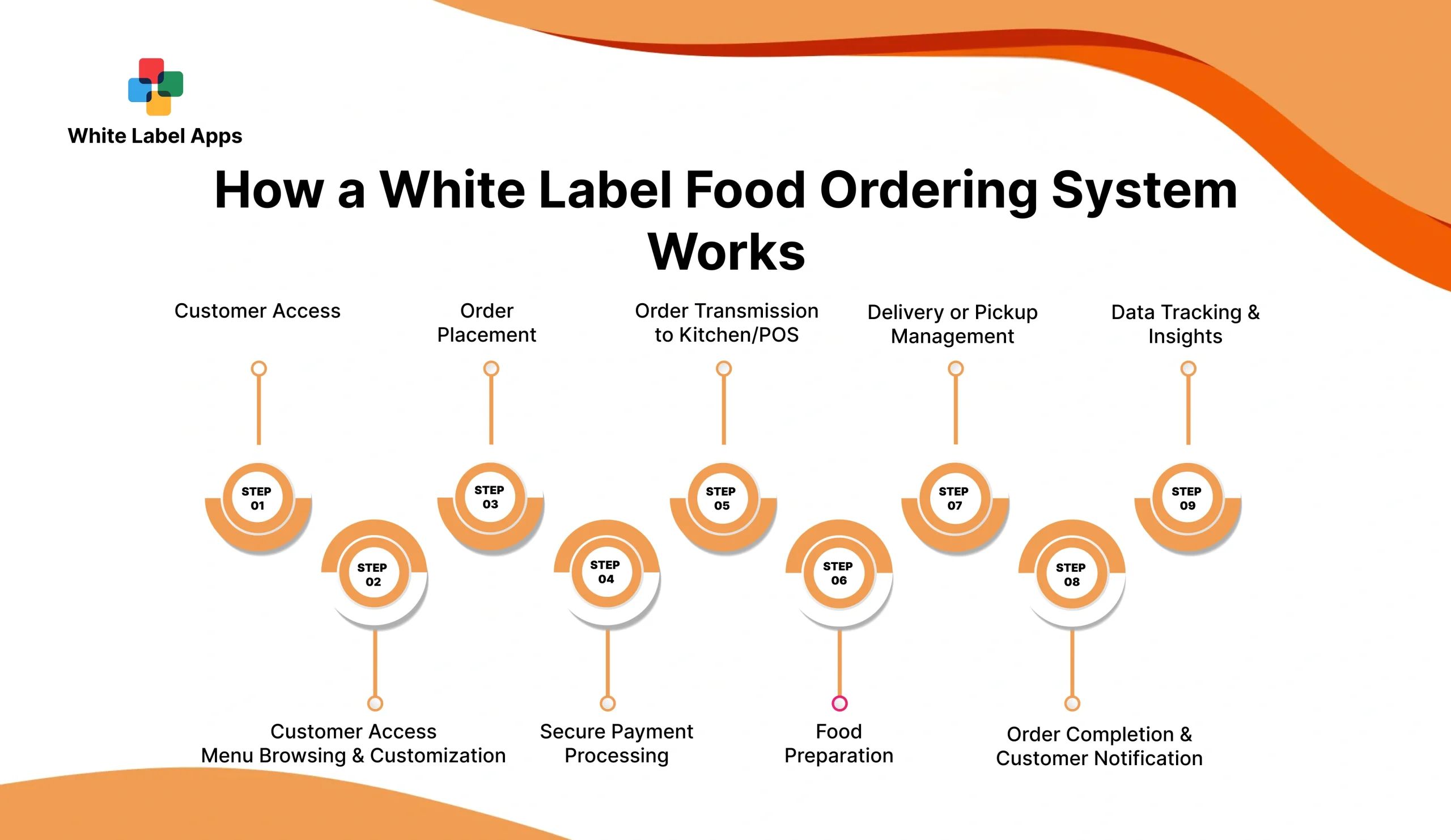
A white label food ordering system allows a restaurant or a cloud kitchen to have full control over the ordering journey of their customers, ranging from the discovery of their needs to the delivery of their requests. This system interrelates customers, kitchens, and fulfillment into one seamless digital flow. Furthermore, it automates, centralizes, and gives full control to the restaurant or cloud kitchen over the whole ordering journey that includes browsing menus, placing orders, payment processing, kitchen coordination, and delivery tracking.
Step 1: Customer Access
The customers are provided with direct access to the local platform, which is the restaurant’s branded website or mobile app with its logo, colors, and identity, and they can browse through the listings and order food online. Unlike other platforms, there are no adverts and searching results of other companies. With this direct access, brand recall is strengthened, customer trust is built, and users get to interact only with the restaurant’s own ordering channel.
Step 2: Menu Browsing & Customization
Real-time digital menus with pricing, availability, and descriptions that are up to date attract the customers. They have the option to customize food, add extra instructions, choose a serving size, and look through a list of the suggested add-ons. The given flexibility improves the correctness of the order, lowers the problems caused by misunderstanding, and elevates the overall customer ordering experience.
Step 3: Order Placement
Once customers have decided what they want, they choose whether to have the food delivered to them or to pick it up at the restaurant. They also check the order details for correctness, like address, time, and instructions. Customers place their orders straight to the restaurant, which is a guarantee that the payment method is without the intervention of third parties, thereby making the entire procedure more trustworthy for the customers.
Step 4: Secure Payment Processing
The payments are done through the integrated, and in the case of cards, the payment gateways are secure and support cards, UPI, wallets, or cash on delivery if enabled. These transactions occur only between customers and restaurants, which means that there are no platform commissions. Therefore, the settlements are faster, and the whole money exchange is safe and reliable.
Step 5: Order Transmission to Kitchen/POS
As soon as the payment is made, the action is available in the kitchen or POS software. There is an immediate and clear understanding of what the customer ordered, and this system cancellation of hand inputs drastically improves the work in the kitchen. Foremost, kitchens now know that their orders are up to date and have fewer mistakes; also, the time they need to prepare food is shortened, and thus the staff can meet the high demand quickly and efficiently.
Step 6: Food Preparation
The kitchen workers cook the foods requested accurately by following the real-time instructions given via the system. The statuses of the orders submitted, for instance, “accepted,” “preparing,” and “ready,” are digitally tracked. The well-planned flow of work makes the staff communicate better, have more coordination and take less time to serve the customers.
Step 7: Delivery or Pickup Management
An in-house driver is usually assigned to take care of the delivery if it is a local order. However, if it is a long-distance delivery, then the order is assigned to third-party logistics partners. Also, pickup orders generate alerts when the food is ready. Customers can track order progress in real-time and this helps them to be well-informed, be at ease, and have an overall positive experience with the service.
Step 8: Order Completion & Customer Notification
The delivery of the food is either through a handover at the customer’s place, or it can also be a self-pickup. Both of which will be marked done or completed by means of being tracked in the system. The customers are then sent confirmation messages and prompted if they wish to leave their feedback. Clear post-order communication builds customer trust further and excites customers more to transact with the business again.
Step 9: Data Tracking & Insights
Such white label food ordering system also acts as a data collection tool that gathers information about the ordering volume, daylight hours, best-selling products, and loyal customers during the whole procedure. The data help restaurant owners to redesign their menus, set prices, implement promotions and improve the overall business operations while keeping control over their performance metrics.
Read Also: What is White Label Delivery Software & Why It’s Popular
Key Features of a White Label Food Ordering System
A fully comprehensive white-label food ordering system incorporates the fundamental tools that facilitate business operations, elevate customer experience, and ensure business growth over time through a single, integrated ordering platform.
- Website and mobile app with full branding: Letting restaurants consistently reflect their brand identity to the customers while providing them with a smooth and distraction-free ordering experience without the branding of a third-party marketplace.
- Management of menu and inventory in real-time: It allows for instantaneous changes in menu items, pricing, and availability in all channels, thus avoiding the cases of placing orders for items that are out of stock and enhancing the accuracy of operations.
- Integration of POS and kitchen display system: The orders that are automatically routed to the kitchen or POS help the staff to lessen the number of manual errors, hasten the preparation, and have better coordination with each other even during the rush hours.
- Management of delivery and order tracking: It allows in-house delivery or third-party integrated logistics to provide customers with real-time order status and flexible delivery choices.
- Customer profiles and order history: Keeps customer information and previous orders so as to allow customers to receive offers that are tailor-made for them, they can have faster reordering, and there will be more customer loyalty over time.
- Coupons, discounts, and loyalty programs: Facilitates the process of getting repeat customers through targeted promotions, rewards, and incentives aimed at increasing customer retention and frequency of orders.
- Analytics and reporting on performances: Platforms to measure sales trends, customer behavior, peak hours, and menu performance to make well-informed business decisions that are data-driven.
The features are interlinked with one another to form a seamless ordering ecosystem that is supportive of the business both at the level of daily operations and long-term strategy.
White Label Food Ordering System vs Third-Party Delivery Platforms
With a white label food ordering system, restaurants can gain more control over their operations, increase their profits, and have direct relationships with their customers. On the other hand, third-party delivery platforms are mainly concerned with gaining visibility and reaching more customers. The majority of businesses that perform well use marketplaces as a tool for getting discovered, and they have their own ordering systems in place for sustained growth.
| Aspect | White Label Food Ordering System | Third-Party Delivery Platforms |
| Branding | Fully branded website or app | Platform-dominated branding |
| Commission Fees | Low or zero commissions | High commissions (20–30%) |
| Customer Data | Owned by restaurant | Owned by platform |
| Pricing Control | Full pricing flexibility | Limited pricing control |
| Customer Relationship | Direct communication | Platform-controlled interaction |
| Competition | No competing brands shown | Multiple competitors listed |
| Profit Margins | Higher and predictable | Reduced due to fees |
| Long-Term Growth | Sustainable and independent | Platform-dependent growth |
How to Choose the Right White Label Food Ordering System
Selecting an appropriate white label food ordering system is essentially a strategic move that will have a considerable influence on the way the business functions, its profits, and the customer experience. An ideal configuration should be able to meet the requirements of today and also support the development of tomorrow in such a way that restaurants and cloud kitchens could still be competitive and free.
When evaluating options, businesses should focus on the following key factors:
- Ease of Use: The system should be simple for customers, staff, and kitchen teams to use without extensive training.
- Customization & Branding: Full control over branding, menu layout, pricing, and customer communication is essential.
- Integration Capabilities: Seamless integration with POS systems, payment gateways, delivery partners, and CRM tools.
- Scalability: The platform should support multi-location expansion, new brands, and higher order volumes.
- Customer Support & Reliability: Responsive support, regular updates, and system stability are critical for daily operations.
A strong provider acts as a long-term technology partner, not just a software vendor, helping businesses reduce dependency on third-party platforms while delivering smooth, reliable ordering experiences.
Also Read: White Label Online Ordering App: Boost Sales & Launch Fast
Future Trends in White Label Food Ordering Systems
Technology that is more intelligent, automation, and personalization are some of the elements that are defining the future of white label food ordering systems. To cater to the rising trend of online ordering, which is becoming the main growth channel for restaurants and cloud kitchens, these systems are evolving to be more than mere order management tools to become smart, experience-driven platforms.
White Label Food Ordering Systems will be focusing on upgrading the productivity, getting more revenue per order, and creating highly personalized customer journeys by deep use of technology in the next 2-3 years. Their main goal will be to make these systems more efficient and attractive to both users and business owners.
Some of the main trends that will influence the future of these systems are
- AI-driven recommendations and upselling: One of the main ideas is the use of intelligent and automatic suggestions based on the order history and behavior of the customer, which will result in the increase of average order value in a natural way.
- Predictive ordering and demand forecasting: Using data to get very accurate insights to optimize the inventory, the staff, and peak-hour planning.
- Voice ordering and WhatsApp integration: A Quicker and more natural way of ordering for the most loyal customers and mobile-first users.
- Hyper-local delivery optimization: Deliveries are becoming faster and cheaper due to smarter routing and better management of delivery zones.
- Advanced loyalty and personalization features: Some of the examples are the personalized offers, the dynamic rewards, and the targeted re-engagement, which will contribute to the increase of repeat orders and customer lifetime value.
As consumer demands are continuously increasing, the implementation of white label food ordering systems would be essential in, on the one hand traditional restaurants and on the other hand cloud kitchens; these two types of food businesses will be able to offer via these systems quick, easy and individual ordering experiences while maintaining their competitiveness in a rapidly changing digital food ecosystem.
Conclusion
A white label food ordering system is an excellent tool for restaurants and cloud kitchens to digitize their presence, be less dependent on third-party platforms that take a large share of the revenue, and have direct, loyal relationships with customers. Instead of losing 20–30% of revenue on marketplace fees, businesses can keep more profit, have customer data, and become stronger brand identities by encouraging customers to order via their own channels.
Decision-making food businesses that are dependent solely on third-party delivery platforms choose to go forward by building their own ordering infrastructure, which will lead them to higher profitability, more customer insights, and long-term growth that they can predict. With a proper system in place, restaurants and cloud kitchens become not only customer-friendly but also secured against any future changes in the market and competitive pressures.
White Label Apps is one of the platforms that provide ready-to-launch White Label Food Ordering and delivery apps which can be completely customized with your branding, menu, and features without needing to build it all from zero. Whether you are a single outlet, a multi-location restaurant, or a cloud kitchen, WhitelabelApps.ca offers scalable, commission-free solutions that allow you to go live fast, be in control of your ordering channel, and grow your business as you wish.
FAQ’s
1. What is a White Label Food Ordering System?
A white label food ordering system is a branded online platform that makes it possible for restaurants to accept orders directly through their own website or app. It is without the third-party marketplace branding or the dependency on the commission.
2. Is a White Label Food Ordering System suitable for small restaurants?
Yes, most white label food ordering systems are feature-rich, easy to use, and made for small and medium-sized restaurants that are willing to raise their income and have the command of online orders.
3. Can cloud kitchens manage multiple brands with one system?
Most of the white label food ordering systems are configured to manage various brands as well as locations. Consequently, cloud kitchens have the opportunity to operate several virtual brands effectively through one single consolidated dashboard.
4. Does a White Label Food Ordering System replace delivery apps?
Not entirely. Delivery apps still work as a channel to reach new customers, whereas the White Label system is for direct orders. Therefore, third-party platforms continue to be valuable for customer acquisition and extending the reach to new audiences.
5. How long does implementation take?
The time for implementation varies from a few days to a few weeks depending on factors such as branding needs, menu setup, integrations, and the level of customization required for the restaurant or cloud kitchen.