
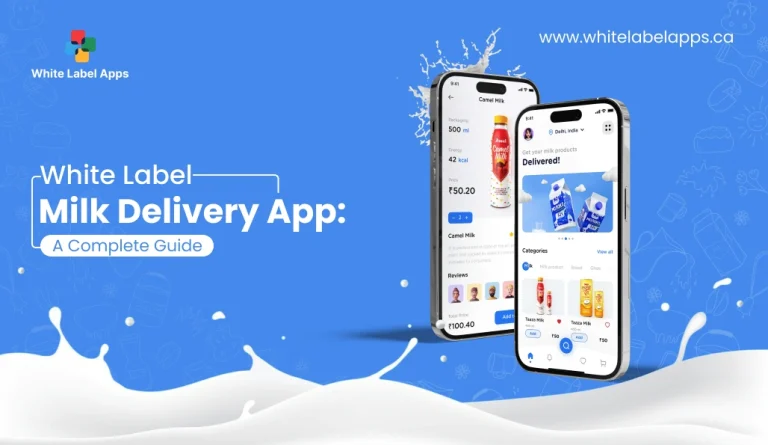
Milk delivery looks simple, until the morning rush hits. One missed packet, one wrong address, and your phone keeps ringing. A white label milk delivery app helps you lock the daily flow, subscriptions, payments, and delivery routes, so the business runs even when you are not on calls.
The demand is also growing. Statista’s milk market outlook estimates the global milk market will grow 12.89% from 2024 to 2029, and reach US$40.26 billion in 2029. That tells you one thing. More brands will fight for the same customers, and speed will matter.
We have built milk delivery apps through white label app development for businesses that run early morning routes, handle subscriptions, and manage cash and online payments. Our team also did focused research for this blog, so you get practical answers, not theory.
In this guide, you will learn what this model means, how online delivery compares to the traditional way, what app types work best, and the key modules you should not skip. You will also see how to shape a White Label Milk Delivery App to match your business, without overbuilding it.
TL;DR
- A White Label Milk Delivery App helps you run daily milk delivery with less chaos.
- It supports subscriptions, payments, routes, and delivery proof in one system.
- You can choose the right app type, then launch fast with your branding.
- Cost depends on platform fees, custom work, and the level of control you need.
Key Points
- A white label milk delivery app is a ready-made app you launch under your own brand with your own rules.
- Online milk delivery improves control because customers can pause, change quantity, and pay without daily phone calls.
- The most common app types are subscription-based, on-demand, farm-to-door, hyperlocal, and all-in-one models with add-ons.
- Milk delivery service models usually fall into direct-to-consumer, wholesale supply, or subscription-based delivery, and each one needs different billing and routing rules.
- A White Label Milk Delivery App works best when three modules stay connected, the merchant dashboard, the customer app, and the delivery agent app.
- Proof of delivery, clear delivery instructions, and route planning reduce disputes and missed drops in daily operations.
- The cost is usually structured as a one-time setup plus a monthly platform fee, and it increases with custom workflows, integrations, and advanced subscription rules.
- Strong branding, clean colours, and a branded domain improve trust and reduce confusion during sign-up and payments.
What is White Label Milk Delivery App?
A white label milk delivery app is a ready-made mobile app that you can launch under your own brand. Your logo, your colours, your business name. Customers feel it is “your” app, not a third-party marketplace. You control the pricing, the delivery areas, the subscription rules, and the customer communication.
In simple words, it is like buying a clean, unbranded delivery system and putting your shop label on it. The core tech is already built and tested. You skip the long build cycle and start faster. This is useful for daily milk routes where timing matters, and mistakes cost you repeat customers.
A White Label Milk Delivery App usually comes in three parts. A customer app to subscribe and pay. A merchant dashboard to manage orders, routes, inventory, and reports. And a delivery agent app to track drops, collect cash, and update delivery status. The main benefit is speed with control. You get a working base, then tailor it to how your milk business runs every morning.
Also Read: White-Label vs Custom-Built Food Delivery Apps: Which Is Best for Startups?
Online Milk Delivery Vs. Traditional Milk Delivery
Online milk delivery and the traditional milkman model both solve the same need. Fresh milk at your door. The difference shows up in scale and control. In the traditional setup, orders are mostly fixed, changes happen on calls, and tracking depends on the delivery person. In online delivery, customers can pause, add, or reschedule from the app. Payments become easier to track, and routes can be planned with fewer mistakes. You also get data, like which areas reorder more and which days see complaints. Traditional can feel personal. Online can feel more predictable and easier to grow.
| Point | Online Milk Delivery | Traditional Milk Delivery |
| Ordering | App-based, customer edits anytime. | Mostly fixed or on-call changes. |
| Subscriptions | Pause, resume, add items in seconds. | Manual updates, easy to miss. |
| Payments | Online, wallet, card, UPI, cash options. | Mostly cash, manual records. |
| Delivery tracking | Status updates, proof of delivery possible. | Depends on trust and memory. |
| Route planning | Optimised routes, fewer missed stops. | Route depends on person’s routine. |
| Customer communication | SMS, WhatsApp, in-app alerts. | Calls and word-of-mouth. |
| Reports | Sales, churn, refunds, area-wise demand. | Limited insights, mostly guesswork. |
| Scaling | Easier to add areas and agents. | Harder to scale without confusion. |
| Customer experience | Self-serve and predictable. | Personal touch but less control. |
What Are the Different Types of Milk Delivery Apps
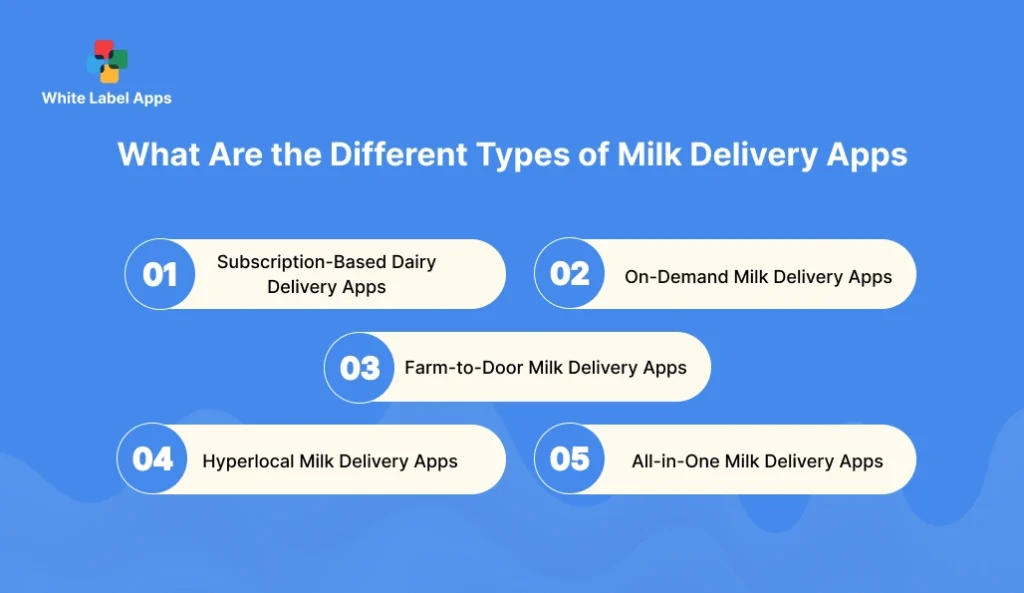
Milk delivery is not one fixed model. Some customers want a daily subscription that just runs. Some order only when they remember at night. Some pay extra for farm-source trust. And many local dairies win because they deliver fast in a small area. The right type depends on your route style, how often orders change, and what customers expect from you. Pick the model that matches how your orders come in today, not how you “hope” they will come later. It saves you time, reduces complaints, and keeps delivery teams sane during peak mornings.
1. Subscription-Based Dairy Delivery Apps
A subscription-based dairy delivery app is built for routine. Customers choose quantity, schedule, and delivery time, and the system repeats orders automatically. This is perfect for morning milk routes where most homes want the same pack every day. Customers can pause deliveries during travel, restart later, and increase quantity on weekends. For the business, it reduces daily order calls and last-minute confusion. It also makes planning easier because you can predict demand and stock. This model works best when consistency matters more than speed.
- Best for daily households and societies with repeat demand.
- Key flow is subscribe, pause, resume, and change quantity anytime.
- Main win is predictable orders and smoother morning routes.
2. On-Demand Milk Delivery Apps
An on-demand milk delivery app is for quick, one-time orders. It works when customers do not want a fixed plan and prefer ordering only when needed. This model is common in cities where people forget to recharge balance, guests arrive suddenly, or milk finishes earlier than expected. The customer places an order, pays online or chooses cash, and expects a fast drop. For businesses, it can bring extra evening sales, but it also needs tighter delivery control. You must manage stock availability and delivery time promises carefully to avoid refunds.
- Best for one-time orders and quick top-ups.
- Key flow is browse, pay, and get delivery fast.
- Main win is flexibility for customers and higher impulse orders.
3. Farm-to-Door Milk Delivery Apps
A farm-to-door milk delivery app focuses on trust and source. Customers want to know where the milk comes from, how it is handled, and why it is different. This model suits premium dairy brands that sell organic milk, A2 milk, or small-batch products. The app usually highlights farm details, quality checks, packaging, and sometimes batch or date info. Deliveries may be scheduled rather than instant, because freshness and handling matter more than speed. For businesses, this model supports higher pricing, but it also needs clear communication and consistent quality to keep loyalty.
- Best for premium, organic, A2, and farm-branded milk businesses.
- Key flow is source-led shopping with quality info and scheduled delivery.
- Main win is trust, story-driven selling, and better pricing power.
4. Hyperlocal Milk Delivery Apps
A hyperlocal milk delivery app works within a small radius, like a few neighbourhoods or a set group of societies. The main promise is speed and reliability. Orders are fulfilled from a nearby dairy, distributor, or mini hub, and delivery routes stay tight. This model is useful when you want to reduce delivery cost per drop and avoid long travel time between homes. It also helps in handling early morning rush, because agents can cover more stops quickly. The challenge is capacity planning. If too many orders hit at once, delays happen fast.
- Best for local dairies that serve a small radius.
- Key flow is nearby fulfilment with tight route planning.
- Main win is faster drops and lower delivery cost per order.
5. All-in-One Milk Delivery Apps
An all-in-one milk delivery app goes beyond milk. It supports subscriptions for milk, plus on-demand add-ons like curd, paneer, ghee, bread, and other daily items. This is a smart model when you want to increase the average basket without pushing customers too hard. A family might subscribe to milk daily, then add paneer for dinner or curd for weekends. For businesses, it improves margins because add-on items usually carry better profit than plain milk. The key is a clean catalog and simple reorder flow, so customers do not feel lost in too many options.
- Best for dairy brands selling milk plus daily essentials like curd and paneer.
- Key flow is milk subscription plus add-to-cart for extras.
- Main win is bigger basket size and better margins per customer.
Also Read: What is White Label App Builder: What They Are & How To Use Them
Why Invest In White Label Milk Delivery App Development?
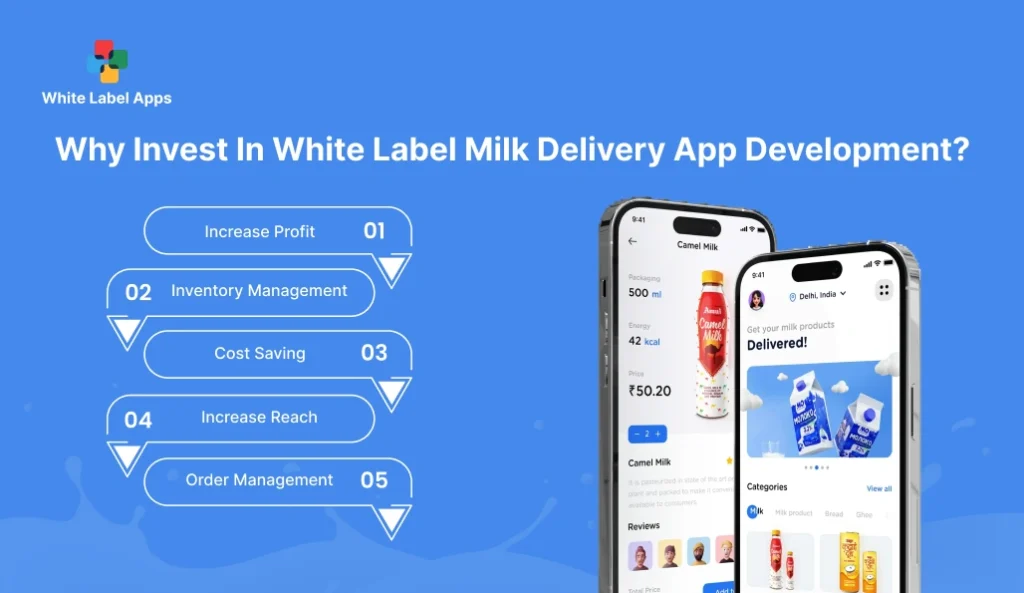
Milk delivery is a repeat business. Small issues repeat too. Late drops, missed houses, wrong quantities, unpaid dues. Over a month, that becomes real money leaking out. A white label app fixes the daily workflow in one place. Orders come in clean, routes get planned, payments get tracked, and customers stop calling for every small change. You also get data, which helps you take smarter decisions, not guesses. For Canada, it also helps you serve families who add dairy for breakfast, lunchboxes, and weekend baking.
1. Increase Profit
Profit grows when you reduce waste and increase repeat orders. Subscriptions bring stable revenue because customers stay on autopilot. Add-ons lift the basket value without extra marketing spend. Think yogurt cups, cheese slices, butter, cream, and cottage cheese. These are common weekly buys for Canadian homes. You also cut losses from missed deliveries and wrong quantities. Small fixes, bigger impact.
2. Inventory Management
Milk is perishable. One wrong estimate and you throw stock, or lose sales. An app helps track daily demand by area and by product. It shows what is needed for tomorrow morning. You can also manage vendor supply and stock alerts, so the team does not run blind at 5 a.m. This matters even more when you stock skim, 2%, whole milk, lactose-free, and plant-based options in the same route.
3. Cost Saving
Manual operations cost more than they look. Staff time goes into calls, paper notes, and chasing payments. A white label app reduces this load with self-serve subscriptions, digital ledgers, and automated alerts. Route planning also cuts fuel cost and delivery time because agents stop wasting rounds. That is important in spread-out suburbs where one extra loop burns time and gas.
4. Increase Reach
With a branded app, you are not limited to word-of-mouth in one street. You can promote the app in condos, townhome communities, and local stores. New customers can sign up without calling you. A simple referral reward can also bring steady new users, especially in apartment buildings. This works well in cities where people prefer quick sign-ups and clear delivery windows.
5. Order Management
Order management becomes predictable when it is inside one system. Customers can pause, resume, or change quantity, and you see it instantly. The dashboard shows today’s route list, pending payments, and failed deliveries. You can also handle special instructions like “leave in cooler box” or “do not ring bell.” Fewer surprises. Faster mornings. Less stress for the team.
Understanding Milk Delivery Service Business Models
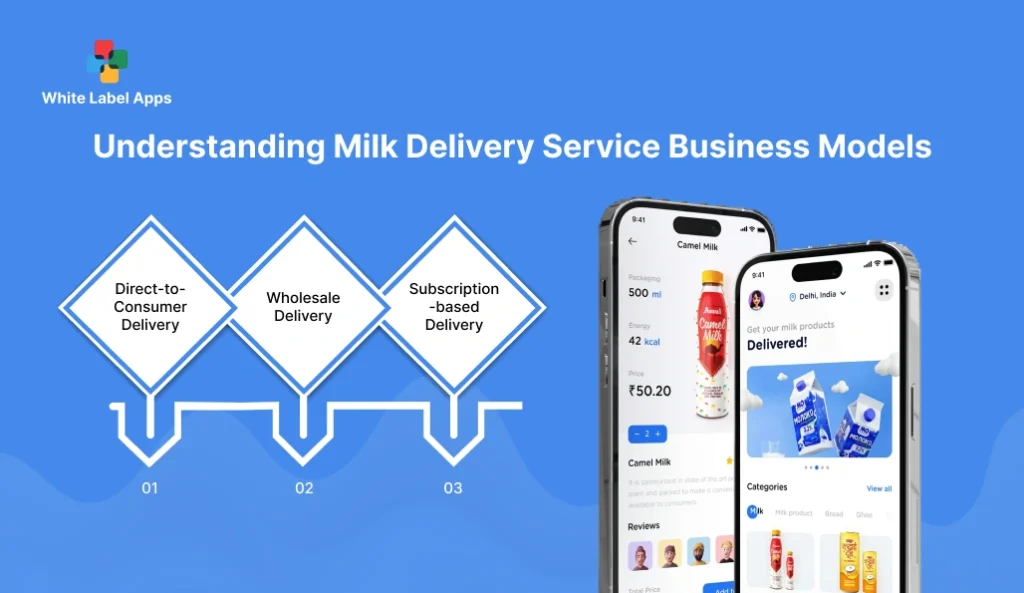
Most milk delivery businesses in Canada run on one of three models. Some deliver straight to homes. Some supply cafes, restaurants, and small grocery stores. And many use subscriptions to lock daily demand. The model you choose decides everything, pricing, delivery routes, driver workload, and even what features your app needs. If you pick the wrong model, you will feel it fast. Orders look messy, inventory goes off, and drivers waste time. Below is a simple breakdown of the three common models and where each one fits best.
1. Direct-to-Consumer Delivery
This model delivers milk and dairy items directly to households. You sell to the end customer, collect payment, and manage last-mile delivery. It works well for condos, family neighbourhoods, and areas where people want doorstep convenience. The challenge is volume and timing. Early morning routes must be tight, and failed deliveries can lead to complaints. In an app, you need clear delivery windows, address notes like “leave in cooler box,” easy pause or reschedule options, and quick support for missing items.
2. Wholesale Delivery
Wholesale means you supply other businesses instead of individual homes. Think cafés, bakeries, small restaurants, and independent stores. Order sizes are larger, but customer count is lower. Routes are fewer and more planned. Payment terms often include weekly or monthly invoicing instead of instant payments. In an app or dashboard, you need bulk ordering, invoice management, tax-ready billing, and account-wise credit tracking. The biggest risk here is late payments and stock planning. If a café runs out of milk, they will blame you, even if the order was last-minute.
3. Subscription-based Delivery
This model is built around repeat orders that run on autopilot. Customers subscribe for daily or alternate-day milk, and payments can be weekly or monthly. It gives stable demand and makes inventory forecasting easier. It also reduces the “today order, tomorrow cancel” chaos. The key is flexibility. Customers must be able to pause during travel, change quantity for weekends, and add extras like yogurt, butter, or cheese without breaking the plan. In the app, subscription controls, wallet balances, reminders, and route syncing become the core features.
Core Features in White Label Milk Delivery App Modules
A milk delivery business runs on routine. Same homes, same time window, same expectations. So your app modules should focus on daily control, not fancy screens. The goal is simple. Zero missed deliveries, clean payments, and a route that drivers can follow without calling you every five minutes. A White Label Milk Delivery App usually has three parts, the merchant dashboard, the customer app, and the delivery agent app. Each one solves a different daily problem.
The merchant side keeps the business in order. It helps you manage orders, assign routes, track inventory, and see what went wrong yesterday. The customer side reduces calls. People can subscribe, pause, pay, and add delivery notes on their own. The delivery agent side keeps the last mile tight. Drivers can see stops in sequence, update delivery status, and record cash collection if needed. When these three modules work together, mornings feel smoother and growth becomes easier to handle.
1. Merchant Dashboard
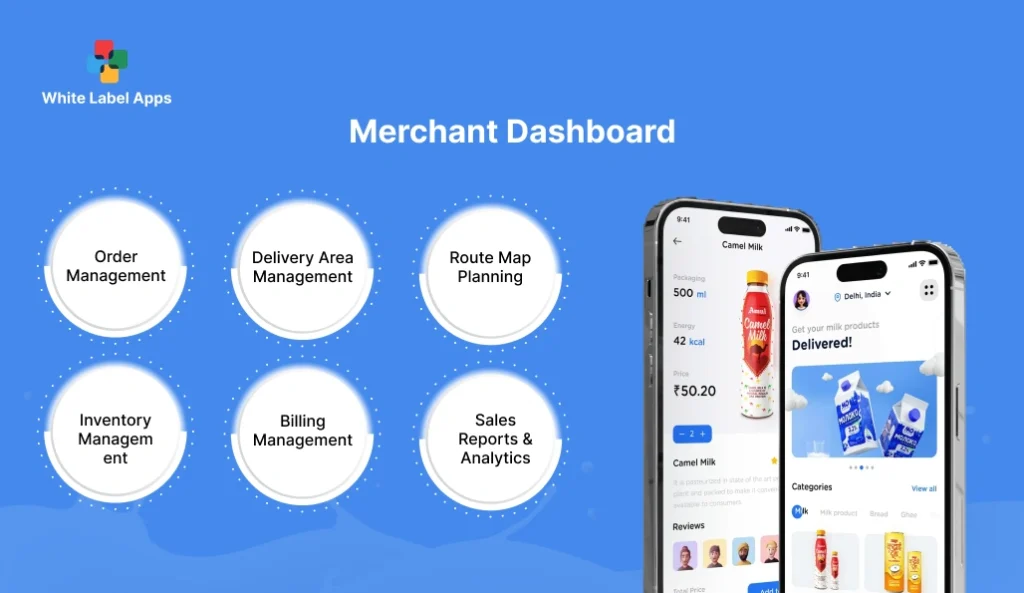
The merchant dashboard is the control room. This is where you see today’s orders, tomorrow’s demand, and what went wrong yesterday. For milk delivery, small gaps create big complaints. One missed bottle or wrong quantity becomes a daily headache. A good dashboard keeps everything in one place, so your team does not juggle spreadsheets, WhatsApp messages, and paper slips. It also helps you plan routes, track inventory, and close billing cleanly. In Canada, where routes can be spread across suburbs and weather can change plans, having a clear dashboard view saves time and avoids rework. In a White Label Milk Delivery App, this dashboard is where the business stays under control.
Order Management
This section shows new orders, subscription changes, missed drops, and cancellations. You can filter by date, route, driver, or delivery status. It helps you catch last-minute quantity changes before the van leaves. You can also mark partial deliveries, handle refunds, and track pending actions. The biggest win is fewer “I told your driver yesterday” calls, because everything is logged.
- View all orders by date, route, and status.
- Track subscription edits, skips, and cancellations.
- Manage failed deliveries, refunds, and re-attempts.
- Keep every change logged for quick dispute checks.
Delivery Area Management
Here you define where you deliver and where you do not. You can set zones by postal code, neighbourhood, or radius. This prevents orders from coming in from areas that are too far or not profitable. You can also set different delivery rules for condos vs houses, like gate codes or lobby drop rules. When zones are clear, routes stay shorter and service stays reliable.
- Create delivery zones by postal code or radius.
- Block areas that raise cost or delays.
- Add location rules for condos, lobbies, and gated homes.
- Keep service reliable by limiting overreach.
Route Map Planning
Route planning is what keeps mornings calm. The dashboard lets you group stops, assign drivers, and arrange delivery order in a logical sequence. It reduces fuel use and avoids missed buildings. If a driver is absent, you can reassign the route quickly. This is especially useful during winter months when traffic and road conditions can change the plan fast.
- Auto-group stops and build logical routes.
- Assign routes to drivers in one click.
- Reassign routes quickly when a driver is absent.
- Reduce missed stops and extra loops.
Inventory Management
Inventory tracking helps you stock the right quantity for each day. You can see total demand by product, like 2% milk, skim, lactose-free, or cream. It also supports add-ons like yogurt, butter, and cheese. You can set low-stock alerts and track wastage. This reduces spoilage and prevents stock-outs that lead to refunds and angry customers.
- Forecast daily demand from active orders.
- Track variants like 2%, skim, lactose-free, and cream.
- Set low-stock alerts to avoid last-minute gaps.
- Monitor wastage to reduce spoilage loss.
Billing Management
Billing ties orders to money. You can manage one-time payments, subscription cycles, wallet balances, and cash collection records. It also helps with invoices for bulk buyers if you supply cafés or small stores. Clear billing reduces payment follow-ups and avoids “I already paid” confusion. It also makes end-of-week closing much faster.
- Manage subscriptions, wallets, and payment status.
- Track cash collection and pending dues clearly.
- Generate invoices for bulk and business buyers.
- Reduce payment disputes with clean records.
Sales Reports & Analytics
Reports show what is actually happening, not what you feel is happening. You can track active subscribers, churn, top-selling items, refunds, and delivery failures. You can also compare performance by area and by route. This helps you decide where to expand and where to stop delivering. Even simple reports can show patterns, like higher weekend demand or frequent issues in one building.
- Track subscribers, churn, and repeat order patterns.
- Identify top items and refund reasons fast.
- Compare performance by area, route, and driver.
- Use trends to plan expansion with less risk.
Also Read: What is White Label Delivery Software? A Complete Guide
2. Customer App
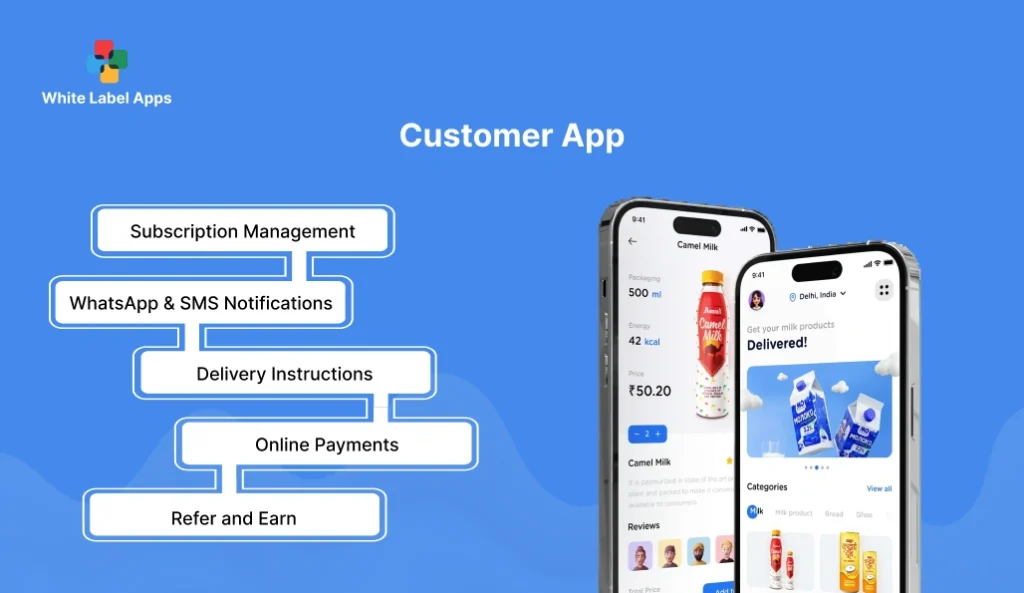
The customer app is where trust is built. If it feels confusing, customers will call, complain, or simply stop ordering. A smooth app lets people manage daily milk without talking to anyone. They can start a plan, pause it, change quantity, and add notes for the driver. This matters a lot in Canada, where many homes prefer contactless drops and clear delivery windows. In a White Label Milk Delivery App, the customer app reduces support load because customers self-serve most actions. It also helps you keep orders stable, since changes are logged and easy to track.
Subscription Management
This is the heart of the customer experience. Users can choose quantity, frequency, and delivery time. They can pause during travel, resume later, or increase milk for weekends. It also supports add-ons like cream, butter, and yogurt, so customers do not need a second order. Clear subscription controls reduce daily calls and last-minute confusion.
- Start, pause, resume, and edit subscriptions anytime.
- Change quantity for weekends or guests in seconds.
- Add dairy extras without breaking the subscription flow.
- View upcoming deliveries in a simple calendar view.
WhatsApp & SMS Notifications
Notifications keep customers calm and reduce “Where is my milk?” messages. They get alerts for order confirmation, subscription changes, out-for-delivery, and delivery completed. WhatsApp is useful for quick updates, while SMS works as a reliable backup. This also helps when customers do not open the app daily.
- Send order and delivery updates on WhatsApp and SMS.
- Confirm subscription changes instantly to avoid confusion.
- Alert customers for delays or failed drops quickly.
- Reduce inbound calls with clear status messages.
Delivery Instructions
Milk delivery often needs small, specific instructions. Leave it in a cooler box. Drop at the back door. Do not ring the bell. The app lets customers add these notes once and reuse them daily. This reduces missed deliveries and avoids awkward back-and-forth with drivers.
- Save delivery notes like “leave at side door.”
- Add building details like buzz codes and unit numbers.
- Support contactless drop preferences clearly.
- Reduce failed deliveries caused by unclear directions.
Online Payments
Online payments make operations cleaner. Customers can pay by card or other supported methods, and you can track everything in one place. It also supports prepaid balance or wallet-style payments, which work well for subscriptions. When payments are smooth, churn reduces because customers do not feel the friction every week.
- Pay securely online without cash follow-ups.
- Support prepaid balance for subscription convenience.
- View payment history and receipts inside the app.
- Reduce missed payments with reminders and auto-renew options.
Refer and Earn
Referrals work well in condos and family neighbourhoods. Customers trust neighbours more than ads. A simple refer-and-earn feature gives users a reason to share the app and bring new sign-ups. Rewards can be set as credits or discounts, and tracking stays automatic.
- Share a referral code in one tap.
- Earn credits or discounts for successful sign-ups.
- Track referrals and rewards inside the app.
- Grow faster in buildings and local communities.
3. Delivery Agent App
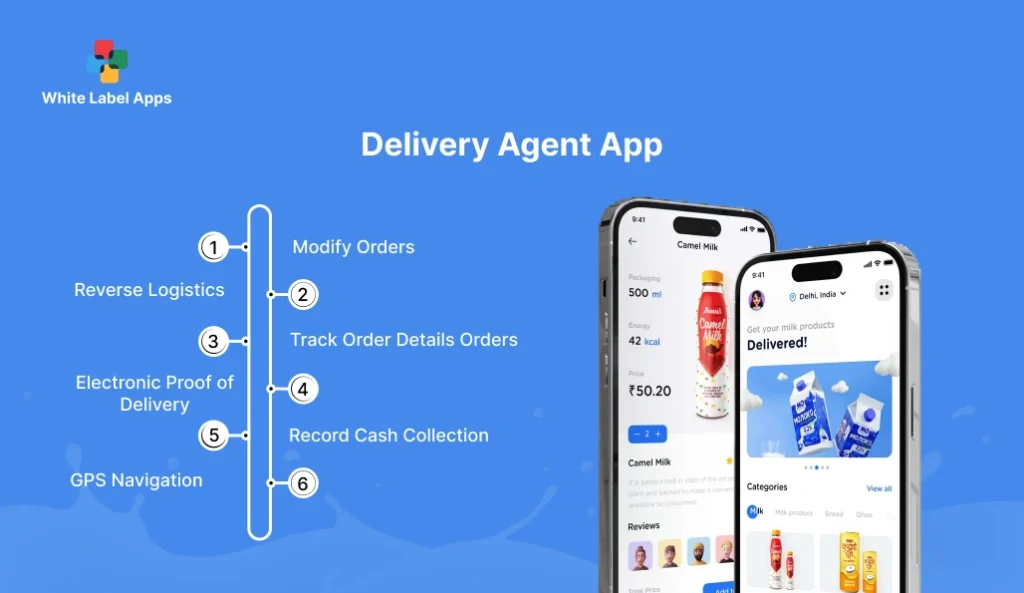
The delivery agent app decides whether your day goes smooth or messy. Drivers work in tight time windows, often before customers wake up. So the app must be fast, clear, and easy to use with one hand. It should show the stop list, what to drop, and what to do if something changes on the way. In Canada, weather and road conditions can also shift routes quickly, so drivers need live updates and simple navigation. In a White Label Milk Delivery App, this module reduces delivery mistakes, improves proof, and keeps cash records clean.
Modify Orders
Sometimes a customer changes quantity late, or asks to skip for a day. The driver needs to see these updates quickly, without calling the office. Limited, controlled edits help handle real-life cases, while keeping records safe.
- View last-minute order changes in real time.
- Mark items as delivered, partial, or missed with reasons.
- Handle skip requests with proper logging.
- Reduce calls between drivers and the back office.
Reverse Logistics
Reverse logistics covers returns and pickup tasks. This could be empty bottle returns, undelivered items, or wrong drops that need correction. The driver app should log these cases clearly, so inventory and billing stay accurate.
- Mark items for return pickup or reverse delivery.
- Log reasons like “customer not available” or “wrong address.”
- Track returned items against the original order.
- Keep inventory and billing aligned after adjustments.
Track Order Details
Drivers need full clarity at each stop. Address, unit number, delivery notes, product list, and quantity. When details are clear, mistakes drop fast. It also helps new drivers cover routes without relying on memory.
- Show full order list and quantities per stop.
- Display customer notes like “leave in cooler box.”
- Highlight special items like cream or lactose-free milk.
- Reduce wrong drops with clear, readable order screens.
Electronic Proof of Delivery
Proof of delivery protects both you and the customer. It can be a photo, a quick confirmation, or a timestamped status update. This is useful when customers claim missing milk, especially in condos or shared entry areas.
- Capture delivery proof with timestamp and status.
- Support photo proof where needed for high-complaint areas.
- Reduce disputes with clear delivery records.
- Keep logs linked to the exact stop and order.
Record Cash Collection
Some routes still use cash. The agent app should record cash collected, pending dues, and any mismatch instantly. This avoids end-of-day confusion and reduces leakage.
- Record cash collected per order in seconds.
- Track pending dues and partial payments clearly.
- Reduce “cash mismatch” disputes with logged entries.
- Sync collections with the merchant dashboard automatically.
GPS Navigation
Navigation should guide drivers stop-by-stop, in the best sequence. It saves fuel, cuts delays, and helps drivers handle new areas confidently. In winter or heavy traffic, quick reroutes make a big difference.
- Navigate to each stop with built-in map support.
- Follow the planned route order to save time.
- Reroute quickly when roads or conditions change.
- Reduce late deliveries with smarter pathing.
Also Read: What Is a White-Label Restaurant Ordering System and Why Restaurants Are Switching
Benefits of Using White Label Milk Delivery App for Your Business
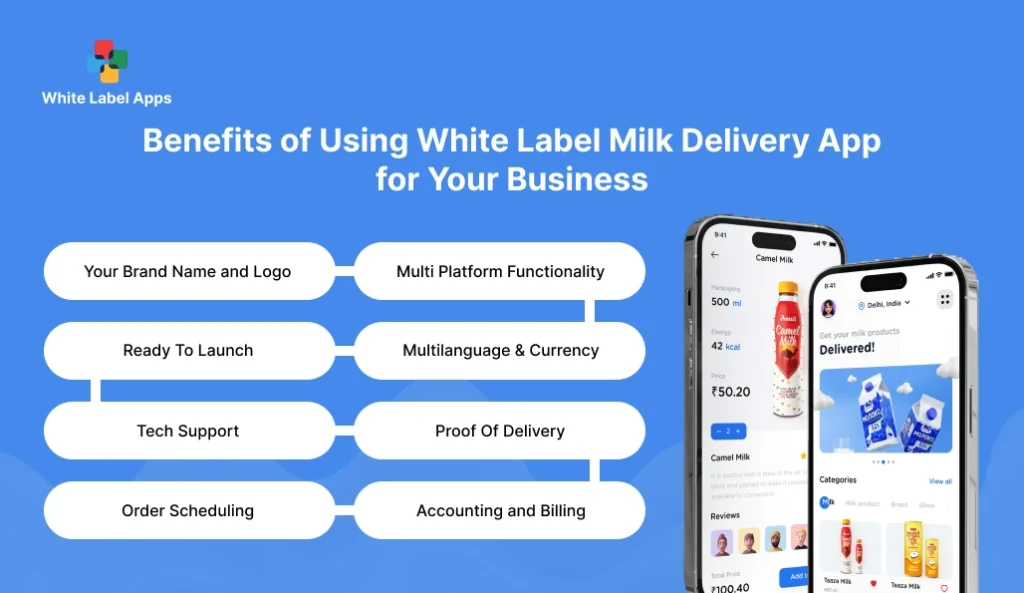
Milk delivery is all about consistency. Same drop, same time, and no excuses. When you run operations on calls and paper, small issues keep repeating. A White Label Milk Delivery App helps you run the business like a system, not like a daily firefight. You get a branded app, smoother subscriptions, cleaner billing, and stronger delivery control. It also helps you grow into more neighbourhoods without losing grip on routes and service quality.
1. Your Brand Name and Logo
A marketplace app makes your brand invisible. A white label app keeps your name front and center. Customers see your icon on their phone, your colours, and your notifications. This builds recall. Over time, it also reduces price comparison because people stick to a brand they trust for daily essentials.
2. Multi Platform Functionality
Customers use both iPhones and Android phones. Some even order from tablets. Multi-platform support makes sure you do not lose customers due to device limitations. It also helps your delivery team and admin staff use whichever device is practical, without breaking the workflow.
3. Ready To Launch
Building from scratch takes time, budget, and constant decisions. A ready-to-launch base app saves months of effort. You can start with core features, launch fast, and improve later based on real customer behaviour. That speed matters in a competitive market where people switch services quickly.
4. Multilanguage & Currency
Canada is diverse. Many areas have customers who prefer different languages. Multi-language support reduces confusion during sign-up and subscription changes. Currency support also helps if you expand later or serve customers who use different payment preferences. Clear language also reduces support calls.
5. Tech Support
Apps need updates, bug fixes, and help when things go wrong. Tech support is what keeps the system stable after launch. It also saves your team from firefighting every small issue. Strong support means faster fixes and fewer angry customers when something breaks at the worst time.
6. Proof Of Delivery
Missing milk complaints are common, especially in condos, shared lobbies, and during bad weather days. Proof of delivery helps you handle disputes calmly. A photo, timestamp, or status log protects your business and also keeps drivers more careful with drops.
7. Order Scheduling
Milk is not like pizza. People want it early, and they want it on repeat. Scheduling lets customers choose delivery time windows, skip days, and change quantity for weekends. For you, scheduling makes routes predictable and reduces last-minute order chaos.
8. Accounting and Billing
Billing becomes messy when cash and subscriptions mix. A proper billing flow tracks payments, pending dues, refunds, and invoices in one place. It makes weekly closing easier and reduces leakage. It also helps if you supply bulk buyers like cafés or small stores, where invoicing and payment terms matter.
How to Tailor White Label Milk Delivery App As Per Your Business Needs?
A ready app is a great start, but it should still feel like your business. Customers should open the app and instantly know it belongs to your brand. Tailoring is not only about looks. It also reduces confusion. When the app name, colours, and domain match your brand, people trust it more and support calls drop. A few clean branding changes can make a White Label Milk Delivery App feel owned and professional from day one.
1. Logo and brand
Start with the basics. Update the app name, logo, splash screen, and store listing details. Use the same brand name customers see on your milk packs and delivery vehicles. Keep the icon clear and readable, even on small screens. Add your brand tone in key places like order confirmation text and delivery status messages. This makes the experience consistent and builds recall. When customers search their phone, they should find your app easily and not confuse it with another dairy service.
2. Custom Brand Colors
Colours set the mood in seconds. Use your primary and secondary brand colours across buttons, headers, icons, and key screens like subscription setup and checkout. Keep contrast strong so text stays easy to read in bright light. Avoid using too many colours, because it starts looking messy and cheap. A clean colour system also helps your support team. They can guide customers faster by saying things like “tap the Pay button,” and customers understand instantly.
3. Personalized Domain
A branded domain makes your business look legit. Use a simple domain for your admin panel and any customer web pages, like order tracking or receipts. It also helps with trust when you send links on SMS or WhatsApp. Customers are more likely to click a link that matches your brand name than a random vendor URL. A personalised domain also keeps branding consistent across emails, invoices, and support pages, which matters when you scale.
Also Read: How White Label Online Ordering App Can Boost Sales Of Restaurants
Cost To Develop White Label Milk Delivery App
A basic White Label Milk Delivery App often starts around USD 1,999 one-time setup plus USD 199 per month on some ready platforms, before taxes and any custom work. The final cost moves up when you add more users, deeper branding, extra modules, or new integrations.
Here is a practical cost view in USD.
| Cost part | What it usually includes | Typical cost idea |
| One-time setup | Branding, initial configuration, basic training, go-live support | From $1,999 on some platforms, higher if scope is bigger. |
| Monthly platform fee | Hosting, core updates, standard support, access to modules | From $199/month on some platforms, can rise with usage rules. |
| Usage-based charges | Per active customer, per order, or per extra user | Example: $1 per 5 active customers on one plan. |
| Customization | New screens, special subscription rules, extra workflows | Usually quoted case-by-case by vendors. |
| Integrations | SMS/WhatsApp, payment gateways, accounting tools, route tools | Varies by tool and complexity. |
| Fully custom build | If you skip white-label and build from scratch | Many projects sit in $10,000–$49,999 range on Clutch, but it depends on scope. |
Cost goes up fastest when you want complex subscriptions (pause windows, cutoff times, proration), proof-of-delivery photos, multi-zone routing, and detailed analytics.
Conclusion
Milk delivery is a habit business. When the habit breaks, people switch fast. A White Label Milk Delivery App helps you keep the routine steady with subscriptions, clean billing, route control, and fewer daily calls. It also brings structure to things that usually stay messy, like skipped deliveries, partial drops, cash collection, and missed payment follow-ups.
The best way to approach it is to start simple and stay honest. Launch with the three core modules, customer app, merchant dashboard, and delivery agent app. Set clear delivery windows. Add delivery notes and proof of delivery early, because these two features reduce most disputes. Then focus on reporting. Even basic reports on churn, refunds, and failed drops can show where money is leaking.
Once the daily flow becomes smooth, you can grow without panic. Add more areas, more agents, and more dairy items, without losing control. This is the real win. You stop running the business on memory and calls. You start running it on a system that stays consistent every morning.
As a leading white label app development company in USA & Canada, our team builds white label apps that keep this daily flow smooth, stable, and ready to scale. Contact us if you want to build a milk delivery app.
FAQs
How Do I Create A White Label Milk Delivery App?
Start by choosing a white label platform that already has the three modules, customer app, merchant dashboard, and delivery agent app. Then add your branding, set delivery zones, upload products, and define subscription rules like daily, alternate days, and cut-off time. Do a small pilot with 20–50 homes, so you catch real issues like wrong addresses, missed drops, and payment confusion. After that, expand route by route, not all at once.
How Do Milk White Label Delivery Apps Work?
A White Label Milk Delivery App works like a ready delivery system that runs under your brand. Customers subscribe or place orders, and the system creates a delivery list for the next run. The merchant dashboard manages inventory, routes, and billing. The delivery agent app confirms each drop and updates status, so you have a clean record.
Do White Label Milk Delivery Apps Only Offer Milk?
No. Most businesses also sell dairy add-ons and daily essentials. Common options are curd, paneer, yogurt, butter, cheese, cream, and sometimes bread and eggs. The app can support subscriptions for milk and on-demand add-ons in the same cart. This helps increase basket size without extra effort.
Is It Safe To Order Milk Online?
It can be safe when the service follows basic hygiene and cold-chain rules. The app helps with safety indirectly by improving traceability, like delivery timestamps, batch notes, and customer complaints tracking. The real safety depends on how milk is stored, packed, and delivered. So the app is the system, but your operations are the backbone.
Are Milk Delivery Apps Reliable?
They are reliable when routes, inventory, and support are managed tightly. Reliability usually breaks due to simple things, stock mismatch, poor route planning, or unclear delivery instructions. A good app reduces these issues with scheduling, delivery notes, and proof of delivery. Still, regular testing and clear driver processes are what keep the experience consistent.

whitelabelapp
Related Articles
White Label Personal Training App Development: Launch Your Branded Fitness App Faster
Your day is full of small fitness tasks. A client asks for the plan again. Another forgets to pay. Someone says the video link is not opening. It all happens on WhatsApp, notes, and screenshots, and it gets messy fast. A white label personal training app helps you put workouts, check-ins, payments, and progress in […]
Read More
Top 15 White Label Reseller Programs That Deliver Big Profits in 2026
If you have ever tried reselling services, you know the truth. The pitch is easy. Delivery is where most resellers bleed time and profit. That is why this list is not based on “popular names” or random directories. We did deep research before writing this blog. We reviewed reseller program pages, service menus, white label […]
Read More