
Most restaurants today lose customers in seconds. A slow page, a confusing menu, or a long checkout is enough for people to close the tab. The food delivery market is also changing fast. Global online food delivery revenue is projected to reach $1.4 trillion in 2025, according to Statista (source). With so many orders happening online, restaurants need a setup they control, not a rented space on an aggregator. This is where a white label online ordering system becomes important.
A white label model lets you run your own branded ordering website or app. You keep your logo, your menu, your colours, and your customer data. Unlike marketplace apps, no one else appears beside your food. You pay zero commission, which helps protect your margins. Many restaurants now choose this path because it combines the freedom of white label apps with the speed and reliability of modern software.
If you want a simple overview of how these systems work, you can explore our guide on direct ordering here: overview of online ordering software.
This shift is happening across the world. Nearly 3 billion people are expected to use online delivery services, with Asia alone reaching 1.84 billion users (source). With so much demand, restaurants that build their own platforms get a real advantage. They keep customer relationships, run loyalty programs, and offer better pricing because they save on marketplace fees.
A white label restaurant setup also helps smaller brands stand out. You get the same tech power as big chains without building everything from scratch. Whether you run a café, a bakery, or a cloud kitchen, the system fits your menu and daily flow.
If you want to see how menus and branding come together, here’s a helpful breakdown: white label restaurant app features.
One more reason this space is growing fast is the rise of SaaS. The SaaS industry that powers most white label app development is forecast to reach $232 billion in 2025 (source). This means restaurant software is becoming more stable, more secure, and easier to use every year.
In this blog, you will learn what a white label online ordering system actually does, how it builds loyalty, how much it costs, what features matter, and how restaurants launch it without stress. Each section gives you a clear path, from setup to real returns.
Ready to start? Let’s break it down step by step.
TL;DR
- Customers drop fast when menus load slow or checkout feels confusing.
- A white label system gives restaurants their own branded space with no commissions.
- Better margins, better control, and stronger repeat orders when customers order direct.
- Setup follows a simple path: audit, branding, menu build, delivery rules, testing, and soft launch.
- Costs stay between $1,200 and $6,000 USD, depending on features you add.
Key Points
- Restaurants lose a lot of orders on marketplaces because of high fees and crowded listings, so owning a direct ordering channel gives a clear advantage.
- A white label setup carries the restaurant’s colours, menu layout, and touchpoints, which helps customers feel connected to the brand.
- Direct systems protect customer data, making it easier to see buying patterns and plan better offers.
- The rollout becomes easier when the team follows small steps like menu prep, payment setup, delivery zones, and quick test orders.
- Features like POS syncing, mobile-friendly pages, loyalty points, and branch management help daily operations run smoother.
- Even small cafés and cloud kitchens benefit because the system removes commission cuts and builds long-term customer habits.
- A branded platform scales well when restaurants add new branches or change menus during busy weeks.
- The total cost stays lower than custom development while giving the same branded experience big chains use.
- Better ordering flow and clear branding make customers return more often, which raises lifetime value without extra spending.
- A white label system becomes the restaurant’s own digital home, not a rented spot on an aggregator.
What a White Label Online Ordering System Means?
A white label online ordering system is a ready-made platform that restaurants can brand as their own. You get a full website or app built for ordering, but it carries your colours, your menu, and your customer touchpoints. Customers feel like they are ordering straight from your kitchen, not from a crowded marketplace. This helps you control pricing, manage offers, and build long-term loyalty without paying extra fees on every order.
The system is designed for real restaurant workflows. Orders flow from the customer’s screen to your POS or kitchen display. You can update items, change prices, or adjust delivery zones in minutes. This makes it easier to keep operations smooth even during lunch peaks.
Many restaurants now choose white label apps because they bring brand control and long-term savings. You avoid marketplace commission cuts and keep direct access to customer data. This helps you understand buying habits, repeat patterns, and best-selling items.
If you want to explore how first-party systems create value, here’s another helpful reference: white label restaurant app for food businesses.
Industry trends also support this shift. As digital ordering rises, the demand for white label app development is increasing across cafés, cloud kitchens, grocery delivery setups, and multi-branch restaurants. A branded system gives you the freedom to scale without relying on external gateways.
Up next, we will look at the business case and real value behind this shift.
The Business Case: Dollars, Data, and Brand Equity
Restaurants choose a white label online ordering system because it improves margins, strengthens branding, and builds long-term customer relationships. Marketplace apps look helpful at first, but their commissions cut into profit fast. A direct system keeps more money in your business. Even a small restaurant can save thousands every year by shifting regular customers to its own ordering channel.
A branded setup also protects data. Marketplaces keep customer details for themselves. With your own white label restaurant app, you see real buying patterns, favourite dishes, peak hours, and repeat behaviour. This helps you plan better offers and improve menu flow.
If you want to understand how ownership impacts growth, here’s a simple breakdown: how to make money with white label apps.
Brand value grows too. People feel a stronger connection when they order from your own site or app instead of scrolling through a long list of competitors. Your colours, your food photos, and your rewards stay in front.
Direct ordering helps you capture more of this growth without sharing 20 to 30 percent commission. This is why many restaurants now rely on white label apps and white label app development to stay profitable and visible.
Next, we’ll map out the full implementation blueprint from decision to first order.
Implementation Blueprint: From Decision to First Order
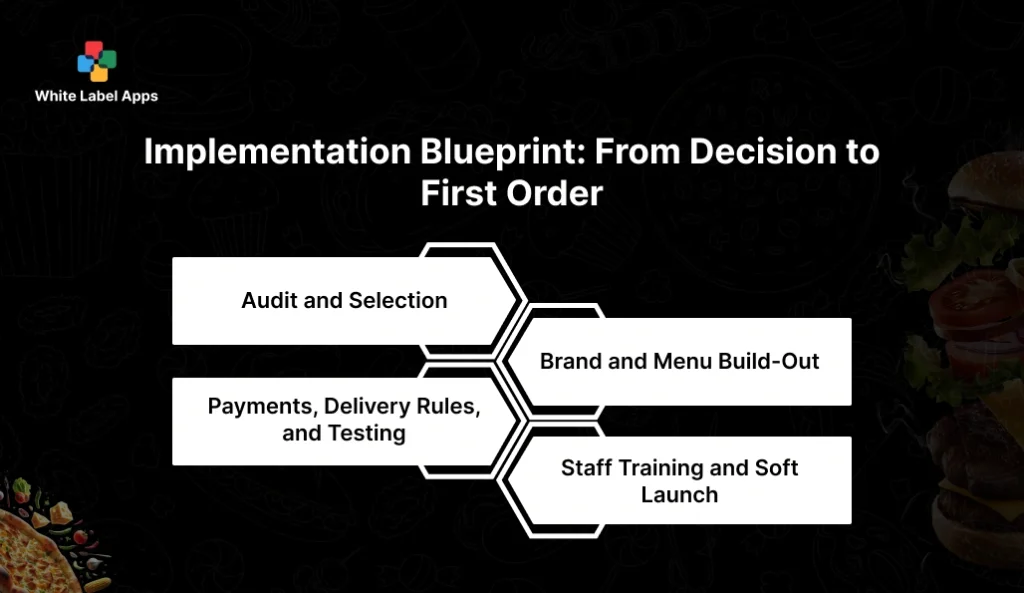
Setting up a white label online ordering system becomes easier when you break it into clear steps. Most restaurants worry this process will feel technical, but the workflow is simple when you follow a structured path. Each phase helps you move from idea to a fully branded ordering experience that customers trust.
If you need a quick reference on how restaurants launch their first digital system, this guide is useful: white label online ordering for restaurants.
A good rollout keeps things smooth for your team. You check your current setup, pick the right features, prepare the menu, test delivery flows, train staff, and go live with confidence. This process helps you avoid last-minute surprises and makes your white label restaurant system feel ready from day one.
Phase 1: Audit and Selection
Start by checking what your restaurant uses today. Look at your POS, menu size, delivery zones, and order volume. This helps you choose the right provider. Ask whether the platform supports mobile ordering, menu updates, and loyalty tools. Clear answers at this stage save you time later.
Phase 2: Brand and Menu Build-Out
This is where the system starts feeling like your business. Add your colours, logo, and dish photos. Set menu sections, combos, and modifiers. A strong brand layout helps customers recognise your restaurant instantly.
Phase 3: Payments, Delivery Rules, and Testing
Set up your payment options and delivery logic. Define zones, charges, prep time, and pickup instructions. Then test everything. Run small orders with your team to check timings, notifications, and kitchen flow. This stage reduces customer complaints after launch.
Phase 4: Staff Training and Soft Launch
Train your staff on accepting orders, marking items sold out, and handling rush hours. Then start a soft launch with a small group of customers. Their feedback helps you adjust menu flow, order timing, and delivery rules before going public.
This blueprint helps restaurants launch faster with fewer issues. It also makes white label technology feel simpler, even for first-time users.
Next, we’ll look at the potential pitfalls and pro tips that save you headaches during setup.
Potential Pitfalls and Pro Tips
Even the best white label online ordering system can hit a few bumps if the setup is rushed. Most restaurants face the same early issues, and they usually come from skipped steps, unclear workflows, or limited training. The good news is that each challenge is easy to avoid when you know what to watch for. These points help you launch smoothly and get the full value from your white label restaurant app.
1. Tech Paralysis
Some teams overthink every small detail before starting. They compare too many systems, delay decisions, and lose momentum. A simple checklist based on your menu size, delivery flow, and budget works better than endless reviews. Choose the system that covers your essentials and supports future growth.
If you need clarity, this internal guide helps outline features: white label ordering app for restaurants.
2. “Set It and Forget It” Marketing
Many restaurants launch the app but forget to promote it. Customers need clear reminders through QR cards, packaging, table tents, and social media. Add simple copy like “Order Direct, Save More.” Promote loyalty points and app-only deals. A white label app works best when you build habits around it.
3. Delivery Staffing Myopia
Your system may run well, but orders slow down if the kitchen or delivery team is not ready. Check prep times, driver availability, and peak-hour limits. A fast app with slow fulfilment frustrates customers. Small optimisations inside your POS or kitchen display can fix this quickly.
4. Why White Label > Marketplace Apps
Marketplaces charge high commissions and put your menu beside competitors. A white label setup gives you direct orders, branding control, and data ownership. It keeps your profit and brings customers back faster.
For a deep dive on why restaurants shift away from aggregators, see this guide: white label restaurant ordering app.
Pro Tip: Run a weekly 10-minute system check. Review your bestseller list, slow-moving items, coupons, and delivery times. These tiny adjustments keep your platform fresh and improve customer satisfaction.
Next, we’ll look at the core features you must check when choosing a white label platform.
Key Features to Look for in a White Label Platform
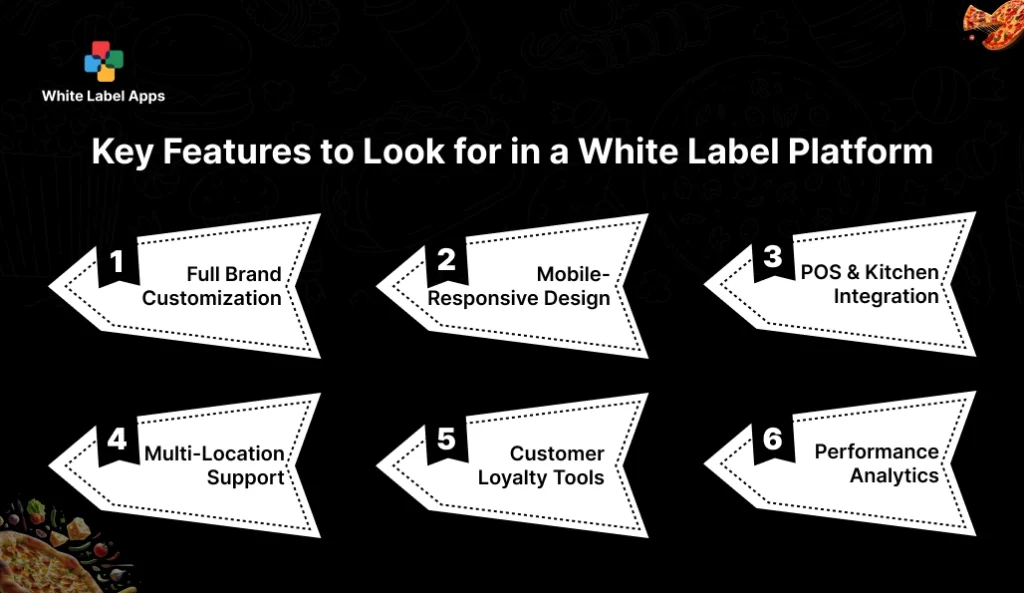
A good white label online ordering system should feel simple for customers and smooth for your team. The right features help you grow repeat orders, reduce mistakes, and run the whole flow from menu to delivery without breaking your rhythm. The goal is not to pick the platform with the most features. It is to pick the one that fits your kitchen, your pace, and your long-term plans as a white label restaurant brand.
1. Full Brand Customization
Your app should look like your restaurant, not a template. Colours, menu layout, logo, and photos should match your identity so customers feel at home the moment they land. This helps build recall and keeps your brand front and centre.
2. Mobile-Responsive Design
More than 70 percent of direct orders now come from phones. Your system should adjust to every screen without zooming, pinching, or confusion. Clear buttons, clean spacing, and fast loading help users order in seconds. A mobile-friendly experience increases conversions automatically.
3. POS & Kitchen Integration
Your white label apps should sync orders straight to your POS or kitchen screen. This cuts manual entry, reduces errors, and keeps staff focused on food instead of toggling tabs. Smooth integration also keeps inventory and order history accurate.
4. Multi-Location Support
If you run two or twenty branches, your platform should handle different menus, store hours, and delivery zones. A central dashboard makes it easier to manage everything without switching accounts or calling each outlet.
5. Customer Loyalty Tools
Loyalty points, coupons, and app-only rewards encourage customers to order directly instead of choosing a marketplace. These small rewards build long-term habits, especially for weekly buyers. A strong loyalty setup turns casual visitors into regulars.
6. Performance Analytics
You should be able to see what items sell fastest, when peak hours hit, and which coupons work best. This helps you adjust pricing, remove slow items, and run smarter promotions. Data is what turns your white label app development choice into a revenue driver.
Next, we’ll show how our team delivers a complete white label solution that supports real restaurant workflows.
How We Offer a White Label Solution for Growing Restaurants?
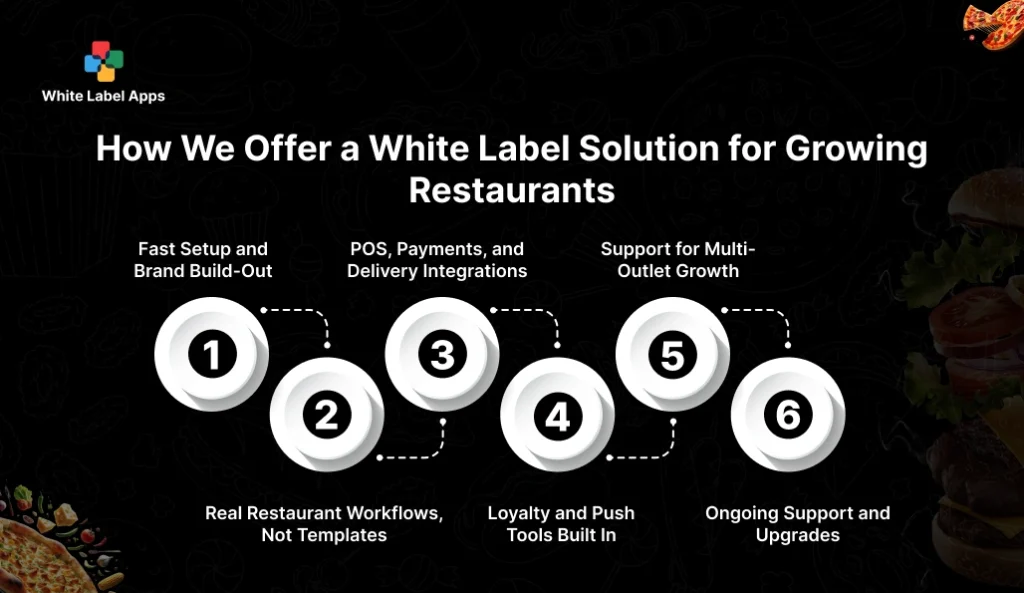
A strong white label online ordering system should feel like your own space, not a borrowed tool. Our approach is simple. We shape the platform around your brand, your menu, and the way your kitchen works every day. You get ready technology without losing identity or control. This matters for any white label restaurant that wants direct orders, repeat customers, and cleaner workflows. Everything is built to scale, whether you run a single café or a chain.
1. Fast Setup and Brand Build-Out
You don’t start from scratch. We prepare layouts, match your colours, upload your dishes, and help design a menu that feels natural on mobile. Most restaurants go live in days, not weeks.
2. Real Restaurant Workflows, Not Templates
Your white label restaurant app must support the real rush. Menu edits, order tracking, kitchen screens, delivery zones, and payment flow are all included. No clunky steps. No broken screens.
3. POS, Payments, and Delivery Integrations
Your orders sync to the systems you already use. If you prefer your own riders, the app supports that. If you want third-party delivery, we help connect it. Payments stay smooth with reliable gateways.
4. Loyalty and Push Tools Built In
We set up points, deals, welcome-back offers, and app-only rewards that bring customers back. This is part of our full white label app development setup, designed to increase repeat orders.
5. Support for Multi-Outlet Growth
If you manage more than one branch, you can run it all from one clean dashboard. Different menus, timings, and delivery rules stay organised without extra work.
6. Ongoing Support and Upgrades
Once your system is live, you’re not alone. We help with menu updates, seasonal offers, new features, and app-store submissions. This keeps your platform ready as your white label apps grow.
Cost to Build a White Label Online Ordering System
Most restaurants spend between $1,200 and $6,000 USD to set up a complete white label online ordering system. This range covers branding, menu setup, payment integration, and the core ordering flow. Costs stay low because you don’t build the tech from zero. Add-ons like loyalty tools, multi-outlet control, or delivery integrations increase the price slightly. The goal is simple. You get a branded system that feels like your own white label restaurant app without long development cycles or large budgets.
| Cost Item | Typical Range (USD) | What It Covers |
| Setup Fee | $300–$1,000 | Branding, menu build, colours, app submission |
| Monthly Platform Fee | $49–$199 | Hosting, updates, support, uptime monitoring |
| Loyalty & Rewards Add-On | $50–$300 | Points, coupons, return-user offers |
| Multi-Location Module | $299–$799 | Branch menus, store hours, delivery zones |
| Delivery Integration | $100–$400 | Rider assignment, map tools, order tracking |
| Custom Add-Ons | Varies | Features beyond the standard flow |
Conclusion
A strong food brand grows when customers choose you directly, not a marketplace filled with competitors. That’s why a white label online ordering system matters today. It gives you a clean digital space with your colours, your menu, and your journey. Each order builds a stronger connection because people interact with your white label restaurant app, not a third-party screen that takes commissions.
You save money by avoiding high platform fees. You own the customer relationship because data stays with you. You run smoother workflows because updates, pricing, and delivery rules stay in your control. And with the right partner in white label app development, you launch fast without handling complex tech.
Most restaurants now want a long-term digital setup that supports takeout, delivery, and repeat orders. A white label system becomes that dependable engine. It scales when you open new branches, adds loyalty when you want rewards, and keeps your brand in front every time someone orders.
If you want a setup that matches your menu and works for your team, explore our guides on White Label Online Ordering Software and White Label Restaurant Apps.
Your brand. Your customers. Your growth. That’s the real power of white label apps.
FAQs
1. What is a white label online ordering system?
It is a ready platform that restaurants can brand as their own. You get your name, your colours, and your menu on a clean ordering flow. Customers order directly from you instead of going through a marketplace. This helps you keep the profit and build loyalty over time.
2. How is this different from using a food delivery marketplace?
Marketplaces charge high commissions and show your menu beside many others. A white label system keeps the customer with your brand only. You own the data, set your prices, and control the full ordering experience. This makes every repeat order more valuable.
3. How much does it cost to set up a white label ordering system?
Most restaurants spend between $1,200 and $6,000 USD. The cost depends on branding, menu setup, payment flow, loyalty tools, and delivery modules. You pay once for setup and a small monthly fee for hosting and support. This is cheaper than losing 20 to 30 percent on every marketplace order.
4. Do small restaurants really need their own ordering system?
Yes. Even a small café or cloud kitchen gets value from direct orders. You save on commissions and build a stronger brand. Customers remember your name better when they order straight from your site or app. It also helps you run simple loyalty offers that bring people back.
5. How long does it take to launch a white label restaurant app?
Most restaurants go live in a few days. You choose your layout, upload menu items, set delivery rules, test a few orders, and start a soft launch. Once your staff knows the flow, you can open it to all customers. This makes the setup quick even if you are new to digital ordering.

whitelabelapp
Related Articles
White Label Personal Training App Development: Launch Your Branded Fitness App Faster
Your day is full of small fitness tasks. A client asks for the plan again. Another forgets to pay. Someone says the video link is not opening. It all happens on WhatsApp, notes, and screenshots, and it gets messy fast. A white label personal training app helps you put workouts, check-ins, payments, and progress in […]
Read More
Top 15 White Label Reseller Programs That Deliver Big Profits in 2026
If you have ever tried reselling services, you know the truth. The pitch is easy. Delivery is where most resellers bleed time and profit. That is why this list is not based on “popular names” or random directories. We did deep research before writing this blog. We reviewed reseller program pages, service menus, white label […]
Read More