

Wealth tech looks simple on a demo day. Real life is different. Clients forget passwords, KYC gets stuck, and advisors need answers in minutes.
AI is now entering daily wealth workflows too. In Charles Schwab’s Independent Advisor Outlook Study, 57% of firms said they are already using AI, and 29% said they are exploring it.
That is why many firms are looking for faster, safer ways to launch. This is where white label app development fits. A strong build team knows the hard parts, like access controls, audit logs, secure integrations, and AI guardrails that do not break compliance.
It is written after focused research, not assumptions. We reviewed real platform workflows, common compliance checkpoints, AI risk areas, and the build items that usually increase cost later, like integrations, audit logs, testing, and post launch support.
In this blog, you will learn the market basics, the step by step build process, technical considerations, AI powered features, cost ranges, common challenges, and how to choose the right partner.
TL;DR
- A white label wealth management platform lets you launch faster with your own branding.
- AI is being adopted inside advisor workflows, not just as a buzzword.
- The real build work sits in compliance, security, integrations, and testing.
- The guide breaks down build steps, tech essentials, AI features, costs, and partner selection.
Key Points
- A white label wealth management platform is ready made software that you rebrand with your logo, colours, and client flow.
- White label app development is chosen when speed to market matters but brand ownership must stay with you.
- An AI white label wealth management platform works best when AI is limited to clear use cases and kept explainable with logs and review flows.
- Role-based access, encryption, and audit trails are all security controls that must be in place. They are not optional extras.
- Market data, identity checks, CRM, and custodians are examples of integrations that often determine the timeline, cost, and quality of the user experience.
- The main things that affect cost are the project’s size, how deep it needs to comply, and how many integrations it needs. A phased rollout keeps costs and risks low.
What is White Label Wealth Management Platform?
A white label wealth management platform is a ready made software you can rebrand as your own. Your logo, your colours, your domain, and your client flow stay on top. The core system under it is already built, tested, and set up for everyday wealth tasks.
In simple words, it is like renting a fully fitted office and putting your nameplate outside. You get the client app, advisor dashboard, admin controls, and reports without building everything from zero. A white label wealth management platform usually covers onboarding, KYC steps, risk profiling, portfolio tracking, goal planning, and client messages. Many platforms also support integrations like market data, CRM, payment rails, and custodians, based on your setup.
The big reason teams choose it is speed and control. You launch faster, keep your brand visible, and avoid long build cycles. Still, you must check limits early, like custom rules, data ownership, security controls, and how upgrades are handled.
Also Read : How Much Does a White Label Crypto Exchange Cost in 2026?
Steps To Build An AI White Label Wealth Management Platform
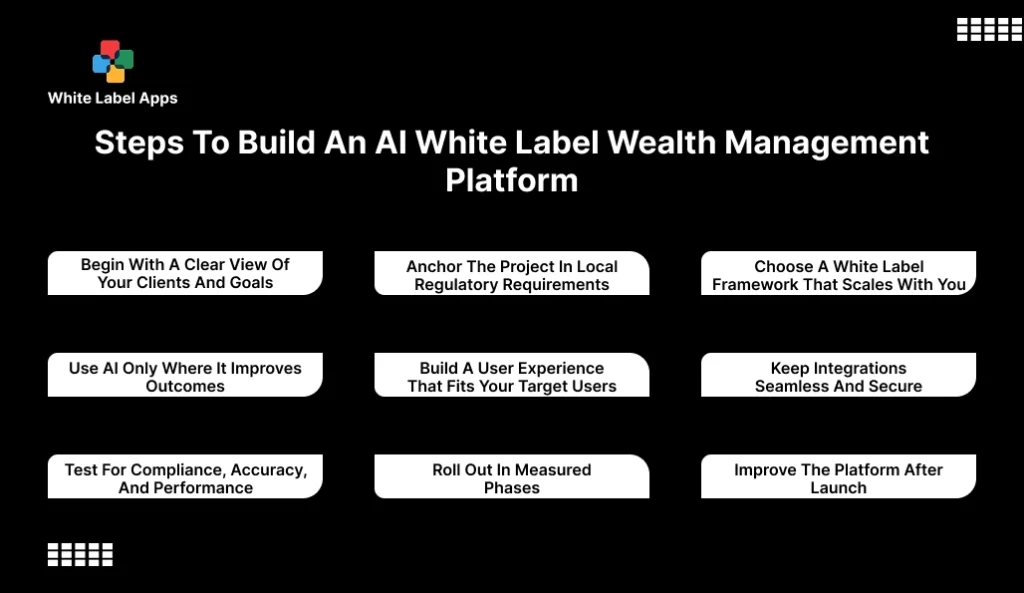
Building an AI white label wealth management platform starts with one simple goal. You want a branded product that helps customers make better choices without putting them at risk. First, lock down your user journeys, data sources, and compliance checks. Then, only add AI where it cuts down on manual work, makes insights better, and stays easy to check.
1. Begin With A Clear View Of Your Clients And Goals
Before you build anything, get clear on who the platform is for. Are you serving high net worth clients, mass affluent users, family offices, or advisor led teams. Then define goals in plain words, like faster onboarding, fewer support calls, or cleaner portfolio visibility. Add 3 to 5 success metrics, like time to onboard, drop off rate, and monthly active users. This keeps your AI white label wealth management platform focused, not feature heavy and confusing. When goals are sharp, the roadmap becomes easier to defend.
2. Anchor The Project In Local Regulatory Requirements
Compliance cannot be a last week task. It has to live inside the product flow from day one. Make a list of what you need to collect during onboarding, what users need to agree to, and what audit trails you need to keep. Explain how suitability checks will work, how risk profiling records will be stored, and how long data will be kept. When these rules are designed early, you avoid rework and delays. It also lowers the risk of missing records when audits happen.
3. Choose A White Label Framework That Scales With You
Pick a framework that fits today, and still fits when you grow. It should support role based access, admin settings, and different user types like clients, advisors, and compliance teams. Check what you can customise, such as workflows, reports, and approval rules. Also ask how upgrades are delivered, because many teams get stuck on old versions and pay for it later. If the setup is too rigid, you end up adding patches and workarounds. A flexible base saves time, cost, and a lot of headache.
4. Use AI Only Where It Improves Outcomes
AI should earn its place in the product. Not just sit there as a shiny feature. Use it for real jobs like drafting review reports, summarising client notes, spotting odd account activity, or helping support teams reply faster. If it cannot save time or reduce mistakes, skip it. Make sure the system doesn’t make up facts, prices, or advice by putting up guardrails. For high impact actions, keep a human review step, especially around recommendations and risk changes. Log AI inputs and outputs for audits. This keeps quality steady and reduces trust issues.
5. Build A User Experience That Fits Your Target Users
Wealth users want calm screens and clear next steps. Keep onboarding short, tell users why you need each piece of information, and show them how far they’ve come so they don’t give up halfway through. Use easy-to-understand names for risk, goals, and time frame. Advisors need speed, so give them quick views, filters, and clean client history. Clients need confidence, so avoid clutter and too many prompts. A smooth UX makes your platform feel reliable, even before results show.
6. Keep Integrations Seamless And Secure
Wealth platforms depend on integrations to feel complete. You may need market data, identity checks, CRM, reporting tools, custodians, and messaging. Plan API security, encryption, access control, and rate limits before wiring things together. Also plan failure handling, like what happens when a data feed is down or an identity check times out. Good retry logic and clear error messages matter more than people think. If integrations are messy, support tickets rise fast and confidence falls.
7. Test For Compliance, Accuracy, And Performance
Testing is not only about bugs. Validate calculations, portfolio values, fee logic, and edge cases like partial data or delayed feeds. Test role based access, approvals, disclosures, and full audit logs end to end. For AI features, test unsafe outputs, confusing prompts, and wrong summaries. Run performance tests for peak load so pages do not lag during busy hours. Also test backup and recovery so you can restore quickly if something breaks. This is how you avoid costly mistakes in production.
8. Roll Out In Measured Phases
A big bang launch seems quick, but it’s dangerous. Start with a small group, like one client group or one advisor team. Watch how people use it, get their feedback, and fix the top five problems right away. Then grow in waves, based on region, user type, or feature set. This keeps compliance risk lower and training simpler. It also protects your support team from getting flooded. A phased rollout often leads to a cleaner long term product.
9. Improve The Platform After Launch
Launch is not the end; it’s the beginning. Keep track of drop-offs, how often users use features, support tickets, and questions that come up a lot. Don’t just check security events and compliance alerts when something goes wrong; do it all the time. Instead of waiting for one big release, send out small updates often. You should only add new AI features after you have stable data, clear rules, and a way to measure how they work. This is how an AI white label wealth management platform stays useful year after year.
Technical Considerations For White Label Wealth Management Platform
Technical choices decide if your platform stays stable when real users log in, place requests, and expect instant updates. In this section, we cover the building blocks of an AI white label wealth management platform, like secure architecture, role based access, encryption, audit logs, and data storage rules. We also look at performance needs, uptime targets, backups, and disaster recovery, so the system does not fail during peak hours. The focus is simple. Keep it safe, fast, and easy to scale without breaking compliance.
1. Architecture And Hosting Model
Your architecture determines how safe and stable the platform feels in real life. Choose a hosting model that works with your data rules, risk level, and growth goals. Many teams use a cloud-first setup with different environments for development, staging, and production. Keep important services like authentication, portfolio services, and reporting separate so that one problem doesn’t bring everything down. Add monitoring and alerts from day one. A clean base makes your AI white label wealth management platform easier to update and safer to run.
2. Identity, Access, And Role Based Controls
Wealth platforms handle sensitive data, so access must be strict. Use strong login, support multi factor authentication, and set secure session timeouts. Define roles clearly, like client, advisor, admin, and compliance reviewer. Each role should see only what it needs. Add approvals for high risk actions, like changing risk profiles or exporting client reports. Log every permission change so you can trace who did what. This control layer is a core trust pillar in an AI white label wealth management platform.
3. Data Encryption And Key Management
Encryption isn’t just a formality; it’s what keeps you safe. When data is being sent and when it is not being used, it should always be encrypted. Use the right key management, like changing keys and limiting who can use them. Keep your secrets in a safe vault, not in code or shared folders. If you use AI workflows, you should also treat prompts and outputs as sensitive because they may have client information in them. If you can, add masking or redaction to personal data. If something leaks, these steps make the blast radius smaller.
4. Audit Trails And Activity Logs
The platform’s memory is its audit trails. Record important events like logins, changes to profiles, approvals, portfolio actions, and data exports. Make it hard to change logs and easy to find them. Store timestamps, user IDs, device or IP context, and the action taken. Set clear retention rules so logs remain available for the required period. For AI features, log what inputs were used and what output was shown to the user. This helps compliance teams review decisions without guesswork.
5. Scalability, Latency, And Uptime Targets
Even if the numbers are right, a wealth app that takes a long time to load seems untrustworthy. Set goals for how long it will take to respond, how much load it can handle, and how long it will be up, and then plan for them. Use caching for common reads, optimize APIs, and don’t make heavy calls on every screen. Plan for auto scaling during busy times, like days when the market is volatile or when reports are due. Add health checks and alerts so you can find problems early. Strong performance makes users more confident and less likely to leave.
6. Backup, Disaster Recovery, And Business Continuity
Backups are only helpful if you can quickly restore them. Set a schedule for testing restores, and decide how often backups should be made, where they should be stored, and how they should be encrypted. Make a plan for recovering from a disaster that has clear RPO and RTO goals. This way, teams will know how much data they can lose and how long they can be down. Have failover options ready for important services like authentication and core databases. Document roles during incidents and run drills. This keeps the business running even when systems fail.
Also Read : White Label Restaurant Software: Features, Integrations, And Reseller Tips
AI Powered Features In White Label Wealth Management Platform
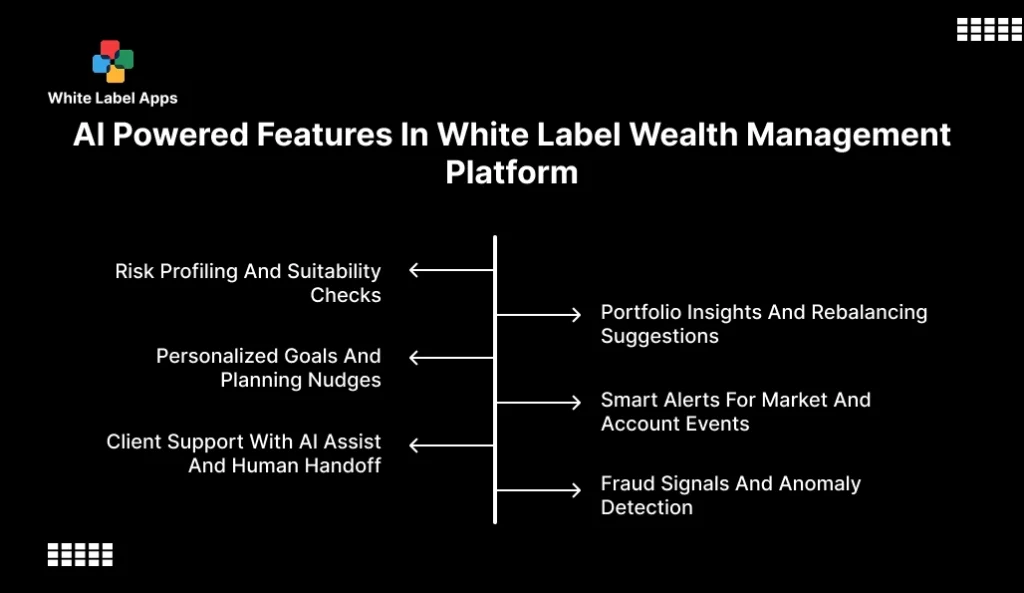
AI powered features make a wealth platform feel smarter, but only when they are controlled and explainable. In an AI white label wealth management platform, these features can help with faster onboarding checks, cleaner risk profiling, portfolio insights, and timely alerts that clients actually act on. They can also help advisors by doing things like writing reports, summarizing client conversations, and finding strange account activity early on. The most important thing is to make sure that AI suggestions are clear, logged, and easy to look at. This way, you can go fast without losing trust.
1. Risk Profiling And Suitability Checks
This feature helps you match each client to the right risk level based on their answers and basic behaviour signals. It can flag mismatches, like a user picking “high risk” but choosing a very short time horizon. In an AI white label wealth management platform, it can also prompt for missing details early, so advisors do not chase data later. The best setups show a simple reason for the suggested risk level. They also store a clean trail for audits and reviews.
2. Portfolio Insights And Rebalancing Suggestions
AI can scan a portfolio and spot patterns that are easy to miss. For example, over exposure to one sector, too many overlapping holdings, or a drift away from the target allocation. It can suggest rebalancing steps and show possible impact in simple terms. The key is to show the “why,” not only the recommendation. Advisors should be able to accept, edit, or reject suggestions. This keeps decisions human owned while AI handles heavy analysis inside the platform.
3. Personalized Goals And Planning Nudges
Goals based planning works better when it feels personal. AI can help turn broad goals like “retire early” into smaller steps, timelines, and simple monthly targets. It can send nudges that fit the client, like reminding them when they fall behind or when a goal date is nearing. In an AI white label wealth management platform, these nudges should stay calm and limited, not frequent and pushy. Give users control to mute or adjust reminders. Done well, it improves engagement and long term stickiness.
4. Smart Alerts For Market And Account Events
Smart alerts help clients and advisors react at the right time. This can include market moves, allocation shifts, dividend events, or a sudden cash balance change. It can also include account events like failed payments, login from a new device, or document expiry. The best alerts are action based, not noisy. They tell the user what happened and what to do next. Filtering and priority rules matter a lot, because too many alerts create panic or fatigue.
5. Client Support With AI Assist And Human Handoff
AI support can answer common questions fast, like how to reset a password, where to download statements, or how fees work. It can also guide users through simple tasks inside the app. But wealth queries can get sensitive, so a smooth handoff to a human is important. The system should share context, like the last screens visited and a short issue summary, so clients do not repeat themselves. This mix saves support time and improves the client experience.
6. Fraud Signals And Anomaly Detection
Fraud checks mean you catch weird activity early, before money is lost. For example, too many wrong password tries, a new phone suddenly logging in, or a login from a far away place. A big withdrawal out of nowhere is another red flag. When these signs show up, you pause and verify. Better safe than sorry.
It can also watch for account takeover signals and odd transaction timing. Alerts should trigger safe actions like step up authentication, temporary holds, or manual review. Keep false alarms low, because too many blocks frustrate genuine users. A tuned detection layer protects money and trust at scale.
Cost To Build An AI Powered White Label Wealth Management Platform
Basic cost for setup is $25,000–$60,000. Cost is not one fixed number. It moves based on what you launch first and how tight your compliance rules are. The budget usually goes up when you add deeper onboarding and KYC, advisor dashboards, portfolio calculations, and integrations like market data or custodians. The level of AI you add also changes the scope.
Do not plan only for the first release. The cost is not only for building the app once. You also pay for security, audit logs, testing, hosting, and support after launch. These are not “extra.” They are the basics that keep the platform safe and running.
This section explains what pushes the budget up or down. It also shows rough cost ranges for small, medium, and large builds. And it lists the monthly or yearly costs you will still have after the launch.
| Platform Scope | Average Cost | Typical Timeline |
| Starter White Label Setup | $25,000–$60,000 | 6–10 weeks |
| Core Wealth Platform | $60,000–$140,000 | 10–18 weeks |
| AI Enabled Platform | $140,000–$280,000 | 4–7 months |
| Enterprise Grade Platform | $280,000–$600,000+ | 6–12+ months |
Also Read : White Label Apps: What They Are and How to Resell Them
How AI Is Improving Wealth Management ?
AI is improving wealth management by making advice and service faster, more personal, and easier to scale. It helps advisors spend less time on routine work, like drafting reports, sorting client notes, and tracking follow ups. It also helps clients understand their portfolio with simple insights, timely alerts, and goal based nudges. In an AI white label wealth management platform, AI can spot risk patterns early, highlight portfolio drift, and support better suitability checks. The real win is not “more automation.” The win is better decisions with clearer explanations, plus strong human control when it matters.
1. Faster Research And Better Client Summaries
AI speeds up the prep work that usually eats an advisor’s day. It can pull key points from meeting notes, emails, and portfolio activity, then turn them into a clean client summary. Instead of scanning ten tabs, the advisor sees one page with goals, recent changes, and pending actions. In an AI white label wealth management platform, this also helps draft review notes in simple language that can be edited before sending. This saves time and reduces missed details. Clients feel the difference because conversations become sharper and more focused.
2. More Consistent Advice Support
Different advisors can explain the same plan in different ways. AI helps bring consistency by using the same rules, disclosures, and explanation style each time. It can suggest next steps based on agreed frameworks, like rebalancing triggers or suitability checks. In an AI white label wealth management platform, it also helps advisors follow internal playbooks, so advice does not change with mood or memory. The key is control. Humans still make the final call, but AI keeps the process steady and less error prone.
3. Better Engagement With Personalization
Clients stay longer when the app feels made for them. No one likes the same copy paste messages. So goals, reminders, and alerts should match the person’s time plan, comfort with risk, and daily habits. Example. If someone is falling behind a goal, the app can remind them to add a little more. If markets move fast, the app can explain it in simple, calm words, so the client does not panic. It also cuts the noise, because people see fewer useless alerts that do not matter to them. Done right, it feels helpful, not pushy. That often leads to better retention and more regular check ins.
4. Operational Efficiency For Teams
This helps your team save time on boring repeat work. It can sort support tickets, draft simple replies, and send the issue to the right person faster. It can also help check documents, point out missing details, and prepare quick draft reports. That way, your team spends more time on real client problems, not copy paste tasks. This does not remove people, it removes busywork. Teams get more time for high value actions like complex client cases and escalations. It also helps new staff ramp up faster because they get guided workflows. Over time, these small savings add up and improve service speed.
5. Stronger Monitoring For Risk And Compliance
Wealth platforms need regular monitoring, not once in a while checks. You should watch for things like unusual logins, strange timing of transactions, or sudden portfolio moves that do not match the user’s profile. You also need alerts for missing disclosures, incomplete KYC, or risky changes that should go for review.
Monitoring should be clear and traceable. Your team must know why something was flagged. You should keep adjusting it over time. Otherwise, you will get too many false alarms. That wastes your team’s time and irritates users. With the right setup, it works like an early warning bell. It helps you catch issues early, protect trust, and avoid compliance slips.
How To Overcome Common Challenges In Building An AI Powered White Label Wealth Management Platform ?
Building an AI white label wealth management platform comes with real challenges, not only technical ones. You need to move fast, but you cannot cut corners on compliance. You also need automation, but final control must stay with people. Most problems show up in data privacy, output quality, clear reasoning, and tricky integrations. Testing matters a lot too, because wrong outputs can confuse users and break suitability rules.
In this section, we share practical ways to lower risk, add safety checks, and keep the platform stable as you grow.
1. Managing Regulatory And Compliance Risk
Regulatory risk becomes real when your product makes suggestions that look like advice. First, list every step where you must show a disclosure, take approval, or save a record. Then make sure the system keeps a clear history for key actions like onboarding, risk profiling, recommendations, and report downloads. Also set role based access, so only the right people can approve sensitive changes. Add version control for policies and prompt templates so changes are traceable. In an AI white label wealth management platform, compliance is not a document, it is a product feature that must work every day.
2. Reducing AI Hallucinations And Bad Suggestions
Sometimes AI speaks like it is 100% sure, even when it is wrong. So you should keep its job limited. Tell it what it can answer and what it must not touch. Also control where it gets the data from, so it does not guess or pick random info. Use trusted internal data sources, add validation checks, and block unsupported claims. Keep explanations simple and show sources when possible. Add thresholds, like “suggest only, never auto apply.” When data is missing, the system should say “I do not have enough info,” not make a guess. Keep a safe fallback message ready for such cases. Also test it often with tricky questions, the kind real users will ask. This helps you spot weak areas early, before they create a bigger problem.
3. Keeping Client Data Safe In AI Workflows
Client data safety is a non negotiable in wealth products. Treat prompts, outputs, and logs like private client files. They can contain names, account details, and money info. Keep them encrypted. Hide sensitive parts where possible. Also lock access tightly, so only approved people can see or use this data. Avoid sending raw identifiers to external systems unless required and approved. Set retention rules so AI logs are not stored forever. In an AI white label wealth management platform, privacy should be designed into the workflow, not added later as a patch.
4. Avoiding Vendor Lock In And Hidden Limits
Lock in happens when your platform depends on one vendor’s formats, models, or custom APIs. To avoid getting stuck with one vendor, keep things simple and movable. Use common formats and clean data setup, so you can shift later if needed. Also make sure your contract is clear. You should own your data. You should be able to export it. Prices and support terms should be written, not “we will see later.”
Ask direct questions before you sign. What if you want to change the AI tool. What if you want to move hosting. What if you want to replace a big integration. If they cannot answer clearly, that is a risk. Plan your exit path early, so you stay in control and costs do not jump later.
5. Balancing Automation With Human Oversight
Automation helps, but wealth decisions need a person to take responsibility. So decide what can run on its own, and what must be checked by a human. For example, the system can draft summaries and suggestions. But approvals should stay with advisors or the compliance team.
Keep the steps clear. Review first, approve next. Also give an easy override option when something looks wrong. Track what was approved and what happened after. Over time, this helps you tighten the rules and reduce mistakes.This balance keeps clients safe and keeps trust strong.
Also Read : Why Becoming a White Label Restaurant Ordering Software Reseller Makes Sense
How To Choose The Right Partner For Your AI Powered White Label Wealth Management Platform ?
Choosing the right partner is not about who promises the fastest build. It is about who can ship a secure product and support it when real users start depending on it. For your AI white label wealth management platform, look for a team that understands wealth workflows, compliance needs, and AI guardrails, not only app screens. Ask how they handle data privacy, audit logs, model testing, and integrations with your existing systems. Also check ownership terms, upgrade support, and clear pricing for change requests. A good partner will show proof, not only pitches.
1. Proof Of Experience In Wealth And Finance Workflows
Do not judge a partner only by a nice UI portfolio. Ask for examples that match real wealth workflows, like onboarding with KYC, risk profiling, portfolio views, advisor dashboards, and client reporting. A good partner should talk comfortably about edge cases, like incomplete documents, joint accounts, and approval chains. Ask what went wrong in past builds and how they fixed it. That answer shows real experience. If they cannot explain the workflow clearly, they may struggle once complexity shows up.
2. Security And Compliance Maturity
Security is not a “later” item in wealth products. Check if the partner follows secure coding practices, uses encryption properly, and has clear access control patterns. Ask about audit logs, penetration testing, vulnerability scanning, and incident response. Also check how they handle data retention and deletion rules. A mature team will have written processes, not only verbal assurance. This matters because one leak or one missing log can damage trust fast. Strong security habits reduce long term risk.
3. Clear AI Approach And Model Governance
AI needs rules, not only demos. Ask what data the model uses, how outputs are validated, and how hallucinations are reduced. Check if they have a plan for explainability, logging, and human review flows for high impact actions. Ask how they update models and prompts without breaking compliance. Also confirm who owns the prompts, fine tuning work, and evaluation reports. A partner with governance thinking will protect you from messy AI surprises later.
4. Integration Capability With Your Current Stack
Most wealth platforms are built around integrations. Ask if the partner has handled market data feeds, identity checks, CRM, reporting tools, custodians, and secure messaging. Request a clear integration plan with API standards, error handling, retries, and monitoring. Also ask how they manage credentials, keys, and secrets. A strong integration team will talk about failures and fallbacks, not only “we can connect it.” This is where many projects slip on timeline and quality.
5. Delivery Plan, Support, And Ownership Clarity
A good partner gives you a clear plan, not only a timeline. Ask for sprint structure, testing stages, and what “done” means for each milestone. Confirm who owns the code, the cloud setup, the data, and the documentation after launch. Ask about post launch support, bug SLAs, and how updates are handled. Also check if you get admin access and full handover. Ownership clarity prevents headaches when you want to grow or switch vendors later.
6. Transparent Pricing And Change Control
Wealth platforms evolve fast, so change requests will happen. A reliable partner shares pricing assumptions, what is included, and what triggers extra cost. Ask how they scope changes, estimate effort, and document approvals before work starts. Check if they provide a simple change control process, so scope does not creep quietly. Also ask about ongoing costs like maintenance, monitoring, and security updates. Clear pricing reduces conflict and keeps your budget predictable.
Also Read : White Label Food Ordering System for Restaurants & Cloud Kitchens
How We Can Help You Build An AI Powered White Label Wealth Platform ?
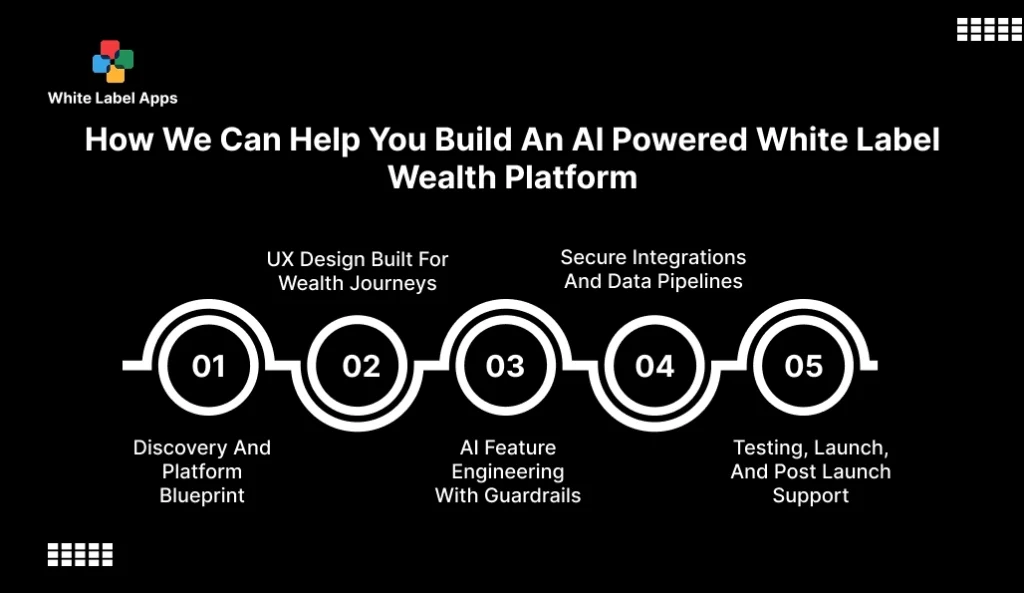
We help you build an AI white label wealth management platform that is secure, compliant, and easy for clients and advisors to use. We start by mapping your workflows, goals, and data sources, so the platform fits your business, not a generic template. Then we design the client and advisor journeys, set up integrations, and add AI features with clear guardrails and audit logs. We also test for accuracy, performance, and compliance before launch. After launch, we support updates, monitoring, and steady improvements so the platform keeps getting better.
1. Discovery And Platform Blueprint
We start by understanding what you are building and why. We map your users, workflows, data sources, and compliance needs in simple steps. Then we turn that into a clear blueprint with screens, roles, approvals, and integration points. You also get a feature priority list so the first release stays focused. For an AI white label wealth management platform, this phase is where we decide what AI should do, and what it should never do. It saves time later because the team builds with clarity, not guesses.
2. UX Design Built For Wealth Journeys
We design the flow so it feels steady and easy to trust. Onboarding stays short. Explanations stay simple. Important actions are easy to spot, not hidden. We also design separate flows for clients and advisors. Clients want clarity and comfort. Advisors want speed and quick access to details. We also plan accessibility, mobile behaviour, and clear error handling so users do not feel stuck. In an AI white label wealth management platform, UX also includes how AI suggestions are shown, explained, and reviewed. Good design reduces drop offs and builds confidence early.
3. AI Feature Engineering With Guardrails
We build AI features with boundaries. We define approved data sources, safe output formats, and rules for when the system should stay silent. We add validation checks, confidence thresholds, and human review steps for sensitive actions. We also log AI inputs and outputs so results are traceable. This keeps the platform useful without turning it into a risk. The goal is simple. AI supports decisions, but humans remain accountable.
4. Secure Integrations And Data Pipelines
We connect the platform with the systems you already use, like identity checks, CRM, market data, reporting tools, and custodians. We design APIs with strong authentication, encryption, and access control. We also add retries, fallbacks, and monitoring so one failed connection does not break the user experience. Data pipelines are built with clean mapping and version control so updates do not create surprises. Security is built into the integration layer, not added after things go live.
5. Testing, Launch, And Post Launch Support
We test more than UI. We test calculations, edge cases, role permissions, audit logs, and AI outputs under real scenarios. We also run performance and reliability checks so the platform stays stable during busy hours. Launch is done in phases, with monitoring and quick fixes ready. After launch, we support updates, security patches, and feature improvements based on real usage and feedback. This keeps the platform stable and helps it grow with your business.
Conclusion
Building an AI white label wealth management platform is not only about shipping screens fast. It is about trust. Clients share sensitive details and they expect calm, clear answers. Advisors expect speed, clean data, and fewer surprises. If your platform gets these basics right, you earn long term usage, not just downloads.
The smart path is simple. Start with clear goals, strong compliance, and a scalable white label base. Add AI only where it improves outcomes, and keep guardrails so it stays explainable and reviewable. Test hard before launch, then roll out in phases and keep improving with real usage feedback.
If you want a team that can plan, build, secure, and support this end to end, WhiteLabelApps can help you launch with clarity and control.
FAQs
1. What Is An AI White Label Wealth Management Platform?
An AI white label wealth management platform is ready made wealth software you can rebrand as your own. It can include client onboarding, risk profiling, portfolio views, advisor dashboards, and reports. AI features can add insights, summaries, alerts, and support assist. You get a faster launch compared to building from zero, while still keeping your brand on top.
2. Is AI Advice Allowed In Wealth Platforms?
AI can support advisors, but it must be controlled. Most teams use AI for research, summaries, and suggestions, not for auto advice. You should keep disclosures, audit logs, and human review for high impact actions. This keeps decisions accountable and reduces compliance risk.
3. What AI Features Matter Most For Wealth Management?
The most useful features are risk profiling support, portfolio insights, goal nudges, smart alerts, and AI assisted customer support with human handoff. Fraud and anomaly detection is also important for protection. The best features are explainable and easy to review. Fancy features without clear value usually add risk and cost.
4. How Much Does It Cost To Build One?
Cost depends on scope, integrations, and compliance depth. A starter white label setup may start around $25,000, while an enterprise grade platform can go $280,000 to $600,000 plus. Ongoing costs also matter, like hosting, monitoring, security updates, and support. The safest way is to launch a focused phase one, then expand.
5. How Long Does It Take To Launch?
A basic version can launch in 6 to 10 weeks if the scope is tight and integrations are limited. A core platform with strong compliance and more workflows may take 10 to 18 weeks. AI heavy and enterprise builds often take 4 to 12 months. A phased rollout helps you launch sooner without taking big risks.