

App budgets are not the only thing that can spiral. Crypto exchange budgets do it too. One extra trading module here, one stricter KYC rule there, then your “simple” plan starts looking like a full build. And in 2026, you cannot treat risk as a side note. As per reports crypto money laundering rose to over $82 billion in 2025, up from about $10 billion in 2020. That is why security and compliance choices now sit right inside the cost conversation.
This guide explains the cost of launching a white label crypto exchange in 2026, in plain terms and real ranges. It is written after focused research, not assumptions. We reviewed vendor pricing pages, feature bundles, and the “extra” items that usually show up later, like audits, liquidity, compliance updates, and support.
If you come from a white label app development background, the pattern will feel familiar. The base product is ready, but the real cost sits in setup, risk controls, and long-term maintenance. By the end, you will know what you pay upfront, what you pay monthly, and how to plan v1 without cutting corners that matter.
TL;DR
- A white label exchange feels “ready,” but costs rise when you add real trading and real risk controls.
- 2026 pricing usually sits across three tiers, from MVP to enterprise scale.
- Security, KYC and AML, liquidity, and admin depth move the budget the most.
- Many costs show up after launch, not inside the first quote.
- The fastest way to save money is to ship an MVP, then add modules in phases.
Key Points
- Crypto risk is now a cost driver, because reported crypto money laundering rose to over $82B in 2025 from about $10B in 2020, which pushes teams to spend more on compliance and security.
- A white label crypto exchange typically ranges from $8,000–$250,000+ in 2026, depending on tier, modules, and compliance readiness.
- The three common platform choices, centralized, decentralized, and hybrid, change custody, UX complexity, and ongoing maintenance effort.
- White labels are usually faster and cheaper than custom builds, but custom builds give deeper flexibility and long-term control.
- Add-ons often change the final bill, and some providers note key factors can add $10,000–$50,000 on top of base pricing, mainly around security, compliance, and integrations.
- The biggest budget levers are trading modules (spot, margin, futures, OTC), wallet depth (hot and cold), and risk controls like withdrawal rules and fraud checks.
- Hidden costs usually include licensing and legal setup, liquidity provider fees, ongoing compliance updates, audits and pen testing, market-making or spread costs, and marketing.
- Team size and timeline depend on scope, because advanced modules and multi-chain wallets increase testing, support load, and security work.
What Is a White Label Crypto Exchange?
A white label crypto exchange is a ready-made exchange platform you can launch under your own brand name. Think of it like renting a fully fitted shop. The counter, billing, and back room are already there. You change the logo, colors, domain, and the user flow to match your business.
Most white label setups come with the main exchange blocks. You get a trading interface, an admin panel, user management, basic wallet setup, and reporting. Some also include KYC and AML connections, security layers, and API hooks for liquidity. But one thing is important. “White label” does not mean “zero work.” You still need decisions on compliance, hosting, liquidity, support, and the exact features you will turn on.
White Label Crypto Exchange Types of Platforms
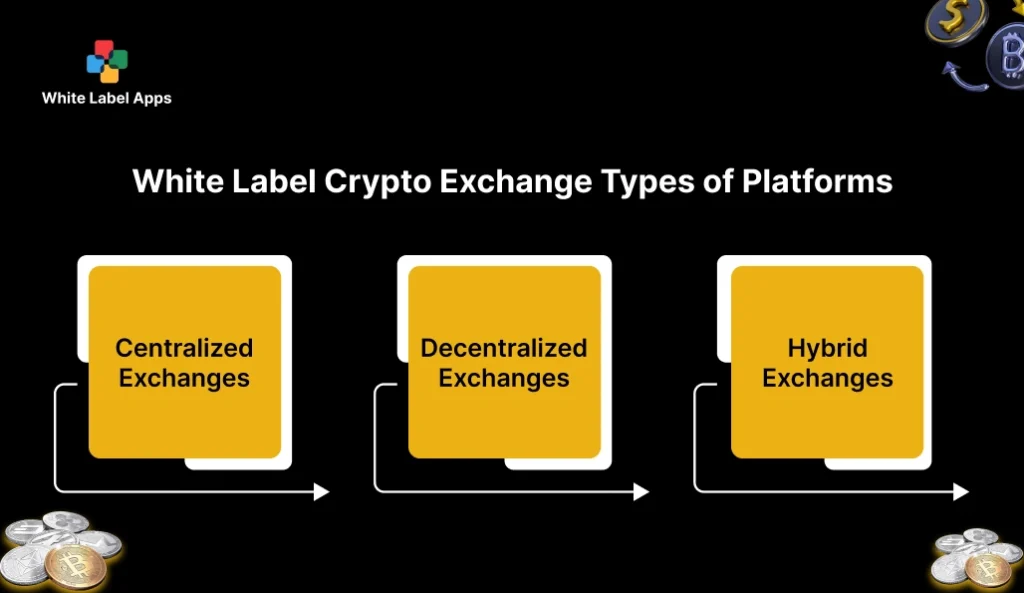
A white label crypto exchange can be built in three common ways. The type you choose changes your cost, timeline, and risk. Some teams want full control, fast support, and a clean KYC flow. Others want self-custody and fewer middle layers. There is no “best” choice for everyone. It depends on your users, your region, and how strict your compliance plan is.
1. Centralized Exchanges
This is the most common model. A company runs the exchange, holds custody of user funds, and manages trades on a central system. It feels simple for users because login, deposits, and trading happen in one place. But it also brings more responsibility. You need strong security, clear KYC and AML steps, and fast support when something goes wrong.
2. Decentralized Exchanges
A decentralized exchange runs through smart contracts and lets users trade from their own wallets. This can reduce custody risk because users keep control of funds. But it adds other challenges. User experience can feel confusing for beginners, gas fees can surprise people, and smart contracts need careful audits. Also, many DEX builds still need add-ons like a frontend, analytics, and monitoring.
3. Hybrid Exchanges
Hybrid platforms try to mix both worlds. You may offer a centralized-style trading experience, while keeping some self-custody or on-chain settlement. It can help with speed and user comfort, while lowering a few custody concerns. But hybrid systems are not “half simple.” They can be more complex to build and maintain, so costs and testing effort usually go up.
Also Read : White Label Sports Betting App: Features, Cost, Security, & Setup Guide
White Label Crypto Exchange vs Custom Exchange Development Cost
If you want to launch fast, a white label crypto exchange is usually the cheaper starting point. Industry breakdowns put white label pricing anywhere from $8,000 to $250,000+, based on tier and add-ons.
The simple trade-off is control vs speed. White label gets you to market quickly, but you work within a framework. Custom gives deep flexibility, but you pay for every screen, workflow, and edge case.
| Factor | White Label Exchange | Custom Exchange Build |
| Upfront Build Cost | ~$8,000–$250,000+ | ~$40,000+ to ~$420,000+ |
| Time To Launch | Days to weeks | Months to 12+ months |
| Customization | Limited to what the product allows | Full flexibility |
| Code Ownership | Varies by vendor | You typically own what you build |
| Security Work | Shared baseline, plus your hardening | Fully your responsibility |
| Compliance Fit | Often comes with KYC/AML hooks | You design compliance end-to-end |
| Integrations | Common APIs are easier | Any integration is possible |
| Scaling Costs | Depends on vendor limits | You design for scale |
| Best For | MVP, quick launch, tight budget | Large roadmap, unique features, long-term control |
How Much Does a White Label Crypto Exchange Cost in 2026?
The price range is wide because “white label” can mean very different bundles. A basic setup may start around $8,000–$14,000, but add-ons can push the bill up fast. B2Broker notes that key factors can add $10,000 to $50,000 on top of the base, mainly due to security, compliance, and integrations.
| Tier | Typical Cost Range | Best For |
| Basic Tier | $8,000–$14,000 | MVP launch, small team |
| Advanced Tier | $20,000–$60,000 | Growth stage, more features |
| Enterprise Tier | $100,000–$250,000+ | High volume, multi-region plans |
Key Factors That Influence White Label Crypto Exchange Cost
This is where most budgets shift. A white label crypto exchange cost looks fixed on day one, but it changes once you pick your real stack. A white label cryptocurrency exchange is still a full product, with security, support, and compliance work behind it. So treat it like a business system, not just a quick install.
1. Security Standards And Hardening
Security is not one feature. There are many small locks inside your crypto exchange software. Things like 2FA, withdrawal limits, device checks, rate limits, and alert rules take time. If your white label crypto exchange software also needs audits and regular patch cycles, your budget goes up.
2. KYC And AML Workflows
KYC and AML is not just a form. It is a workflow with retries, failures, and review queues. Many cryptocurrency exchange solutions plug in third-party vendors, and each vendor has fees plus setup effort. The stricter your rules, the more “edge cases” your cryptocurrency exchange software development team must handle.
3. UI, Branding, And User Journeys
Branding is not only a logo swap. It is the full journey, sign-up, deposit, trade, withdraw, and support. If you want custom onboarding, local language, and better trade screens on your white label crypto exchange platform, it adds design and QA hours. Even small UI changes can create big testing work.
4. Admin Panel Depth And Controls
Basic admin tools are cheap. Deep controls are not. If you want role-based access, audit logs, withdrawal approvals, risk flags, and user throttling, the white label exchange software needs more build and testing. Admin is where most “real-world” problems get solved, so teams keep adding to it.
5. Liquidity Setup And Market Depth
Liquidity is what makes the exchange feel alive. Without it, prices slip, spreads widen, and users complain. A crypto exchange solution may offer a basic setup, but deeper market depth often needs extra providers and routing rules. This also adds monthly fees, not just a one-time build cost.
6. Trading Modules (Spot, Margin, Futures, OTC)
Spot is the simplest launch path. Margin and futures add leverage rules, liquidation logic, and stronger risk controls. OTC adds pricing, approvals, and settlement steps. This is where “turnkey crypto” promises can break, because each module behaves like a separate product.
7. Coin And Network Support
More coins sounds like a quick add. In reality, each coin and network brings wallet handling, confirmations, fee rules, and monitoring. If you need a white label cryptocurrency wallet with multi-chain support, plan for extra cost and extra support load. Even a simple white label bitcoin exchange platform setup needs careful withdrawal controls.
8. API Integrations (Wallets, Payments, Pricing, Alerts)
Integrations are never plug-and-play. Wallet APIs time out, payment gateways fail, and price feeds spike. These crypto exchange software solutions need fallback logic, retries, and clean error messages. Every integration also needs updates when vendors change versions.
9. Hosting, Scalability, And Infrastructure
A small MVP can run on a modest setup. A high-traffic exchange needs load balancing, autoscaling, database tuning, and uptime monitoring. If you want near-zero downtime deployments, your infra cost rises. Scaling is part of white label blockchain solutions too, not only servers.
10. Jurisdiction, Licensing, And Compliance Readiness
This part changes by region and business model. Some jurisdictions need stricter record keeping, reporting, and user checks. If you are also exploring white label decentralized exchange software, the compliance story can look different, and so can the build work. Either way, legal and compliance costs often sit outside the core build quote.
11. Support, Maintenance, And SLA Costs
Launch is not the finish line. You still need bug fixes, security updates, monitoring, and vendor coordination. If you want 24/7 support with strict response times, budget for it. This is also why choosing the right white label crypto exchange development company matters, post-launch support can decide your ROI.
Also Read : White Label Milk Delivery App: A Complete Guide 2026
White Label Crypto Exchange Features That Change Pricing the Most
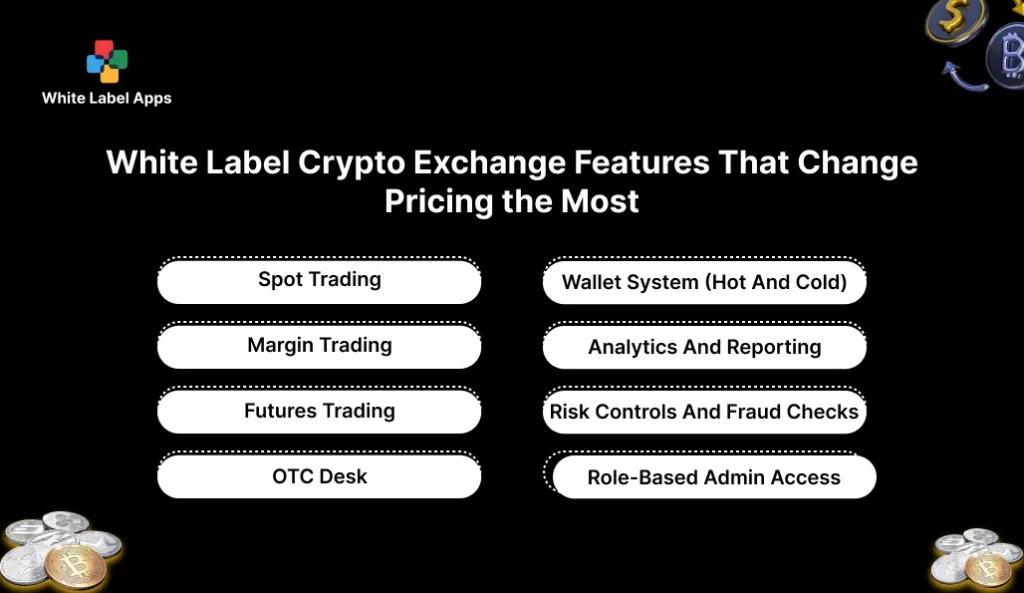
A white label crypto exchange may feel affordable at first. Once you add “real trading” features, the cost can climb quickly. Each module brings more screens, deeper backend rules, and heavier QA. So even if the base package looks small, pricing can still jump. Treat these features like cost levers, because they decide how complex the build becomes.
1. Spot Trading
Spot is the most common starting point in crypto exchange software. It looks simple, but you still need order types, balances, fees, trade history, and clean charts. If your white label crypto exchange platform includes a matching engine and basic liquidity hookups, spot stays manageable. If not, the spot itself can become a bigger build.
2. Margin Trading
Margin trading increases risk and complexity fast. You need leverage rules, interest logic, collateral checks, and liquidation triggers. For most providers, this pushes the cost of white label crypto exchange into a higher tier because the system must handle edge cases under stress. This is also where strong cryptocurrency exchange solutions start to matter.
3. Futures Trading
Futures is not just “margin with a different label.” It needs funding rate logic, mark price rules, liquidation engines, and deeper risk controls. Many crypto exchange software solutions treat futures as a premium module because it needs serious testing. If futures is in your plan, your white label cryptocurrency exchange cost will rarely stay in the basic range.
4. OTC Desk
An OTC desk is a separate flow. Quotes, approvals, manual checks, settlement steps, and reporting. It is often built as an add-on inside white label crypto exchange software, but it still needs admin workflows and audit trails. OTC can also require deeper compliance steps, depending on the region.
5. Wallet System (Hot And Cold)
Wallets are where real money sits, so cost rises quickly here. A white label cryptocurrency wallet setup usually includes hot wallet operations plus cold storage policies. Multi-chain wallets, withdrawal queues, fee rules, and confirmations add more build and more monitoring. Even a white label bitcoin exchange platform needs strong wallet controls to avoid losses.
6. Analytics And Reporting
Basic reports are included in many exchange scripts. But growth teams want more. Cohort reports, volume by pair, revenue by fee type, user funnel drops, and suspicious activity views. Advanced analytics increases the white label crypto exchange cost because it needs clean data pipelines and dashboard work in the admin.
7. Risk Controls And Fraud Checks
This is the “boring” part that saves you later. Rate limiting, device fingerprinting, IP checks, withdrawal holds, velocity rules, and fraud alerts. These controls add time in cryptocurrency exchange software development because every rule needs testing and audit logs. When vendors say “turnkey crypto,” this is often the part that is thin.
8. Role-Based Admin Access
A simple admin login is cheap. Real ops need roles, permissions, approvals, and audit trails. This feature raises the price because mistakes here are costly. It also matters when you work with a white label crypto exchange development company, since support teams and compliance teams need controlled access.
White Label Crypto Exchange Tech Stack Cost Breakdown
A white label crypto exchange is not priced only by screens and features. The tech stack behind it shapes your build hours, hosting bill, and long-term maintenance. This is why two vendors can quote very different numbers for the same looking exchange.
In most projects, the big cost buckets are backend services, APIs, database, cloud setup, and security layers. If your crypto exchange software uses third-party tools for KYC, wallets, price feeds, and alerts, those also add recurring fees. And if you want deeper automation or risk checks, your cryptocurrency exchange software development effort goes up because testing becomes heavier.
| Tech Stack Component | Cost Range (USD) |
| Programming Languages | $2,000–$7,000 |
| APIs | $2,000–$5,000 |
| Frameworks | $2,000–$4,000 |
| Artificial Intelligence | $2,000–$5,000 |
| Operating System | $2,000–$6,000 |
| Cloud Storage | $2,000–$4,000 |
| Database | $2,000–$5,000 |
White Label Crypto Exchange Hidden Costs And ROI Considerations
A white label crypto exchange cost is not only the build quote. The real spend shows up after launch, when you start dealing with compliance, liquidity, security, and growth. This is also where ROI becomes real. If your fees, spreads, and volume are not planned, the exchange can look busy but still lose money.
1. License, Registration, And Legal Setup
Legal setup can be a big swing factor. It depends on your region, your product type, and whether you handle custody. Even if your white label crypto exchange software is ready, legal work can take time and money. This cost is often outside the vendor invoice.
2. Liquidity Provider Fees And Minimums
Liquidity is rarely “free.” Many crypto exchange software solutions need a liquidity partner, and those deals can have setup fees, minimum monthly commitments, or volume-based pricing. If liquidity is thin, users see slippage and leave. If liquidity is strong, costs can rise, but trading feels smooth.
3. Ongoing Compliance Updates
Rules change. KYC and AML vendors also change their checks. That means recurring work, not a one-time setup. For any white label cryptocurrency exchange, this is a steady monthly or quarterly cost, especially if you operate in multiple regions.
4. Security Audits And Pen-Testing
Security is not “done” at launch. You need audits, pen tests, patching, and monitoring. If you add futures, margin, or a complex wallet setup, testing needs go up again. This is a common reason the white label crypto exchange price increases after the first release.
5. Market-Making Or Spread Costs
If you rely on spreads or maker-taker fees, you still need healthy order books. Some teams hire market makers or use liquidity programs. That can reduce dead zones in trading pairs, but it has a cost. So your “revenue” and your “market stability” are linked.
6. Marketing And User Acquisition
Even the best exchange does not sell itself. You need onboarding funnels, content, referral loops, and support. In many cases, marketing spend becomes bigger than cryptocurrency exchange software development spend after a few months. It is a normal pattern, and you should plan for it.
7. Token Listing Fees And Due Diligence
Listing new tokens can involve business fees, legal checks, technical integration, and risk review. Some tokens need deeper due diligence. If you rush listings, you increase fraud and support load. If you do it right, it costs more, but it protects the platform and the brand.
Also Read : White Label Mobile Apps Benefits
White Label Exchange Cost Based on Geographical Location
A white label crypto exchange can cost very differently by region, even with the same feature list. The price shifts due to compliance effort, security expectations, hosting choices, and the level of documentation and support you need. In stricter markets, the base build may start higher, and ongoing maintenance can also cost more. Use the ranges below as a planning shortcut, then narrow it down based on your exact jurisdiction and launch scope.
1. United States ($80,000–$250,000+)
The US range is higher because security and compliance expectations are strict. Many builds need deeper KYC and AML workflows, audit logs, and monitoring. If you want enterprise uptime and 24/7 support, the price often moves to the top end.
2. United Kingdom ($70,000–$200,000+)
UK projects usually include stronger reporting, risk controls, and verification flows. That adds build and QA time. If you add futures, margin, or OTC modules, pricing can quickly move closer to the upper bracket.
3. Australia ($60,000–$180,000+)
Australia sits in a mid-to-high band because teams often plan for strong security, stability, and support. Multi-coin and multi-network support can raise the quote. Advanced admin controls also add to the final price.
4. Singapore ($50,000–$150,000+)
Singapore can start lower for development, but the final price still depends on compliance scope and integrations. Many exchanges here focus on speed and clean workflows. Deeper liquidity setup and high availability hosting usually push the budget upward.
5. Dubai, UAE ($40,000–$130,000+)
Dubai is often the most cost-friendly for MVP launches. But the range moves up when you add licensing help, heavy security hardening, and premium liquidity. If you plan a fast pilot with limited modules, the price tends to stay near the lower end.
6. Canada ($60,000–$180,000+)
Canada is typically mid-to-high because teams often need solid security, reliable support, and clean operations. If you add bilingual UX, deeper reporting, or stricter compliance workflows, the price can rise. Multi-region scaling also pushes the cost toward the higher bracket.
White Label Crypto Exchange Team Size Needed To Launch
A launch can look simple because the base product is ready. But you still need people to set it up, make it safe, and test it end to end. The team size depends on how much you plan to customize, which trading modules you add, and how strict your compliance path is. For a basic MVP, a lean team can work. For margin, futures, or multi-chain wallets, you will need more hands.
1. Front-End Designers
Front-end is where trust is won or lost. You need clean sign-up, KYC screens, wallet views, and trading screens. If you want heavy UI changes, design and testing time increases. If you stick to the vendor template, this role can stay light.
2. Back-End Developers
Back-end handles orders, balances, fees, wallets, and admin rules. They also connect third-party services like KYC, payment, alerts, and pricing feeds. This role grows fast when you add advanced trading or complex withdrawal rules. Most cost surprises come from backend edge cases.
3. Blockchain Engineer (If Needed)
Not every build needs this role. You need a blockchain engineer when you have custom wallet logic, multi-chain withdrawals, token listing work, or on-chain monitoring. They also help troubleshoot stuck deposits and chain congestion issues. For a simple start with limited coins, you may skip this.
4. Cybersecurity Specialist
Security needs focused attention, not guesswork. A specialist reviews login flows, withdrawal protections, admin access, and API exposure. They also support audits and pen testing planning. This role reduces real-world risk, even if it adds time upfront.
5. QA Engineer
QA is where you catch issues before users do. They test deposits, trades, withdrawals, and admin actions on real devices and weak networks. They also check error states, retries, and timeouts. If you want fewer support tickets after launch, do not cut QA.
6. Product Or Agile Project Manager
This person protects the plan. They lock scope, manage priorities, and keep vendor timelines tight. Without a PM, teams keep changing requirements mid-build, and rework grows. A good PM saves money quietly.
7. Compliance Partner (External Or In-House)
Compliance decides how strict the user journey should be. This includes KYC steps, AML triggers, record keeping, and region rules. Vendors can offer integrations, but compliance choices are yours. If you skip this, you may rebuild flows later, which costs more.
White Label Crypto Exchange Timeline To Build And Launch
Timelines look fast in brochures. Real launches move based on scope, testing, and compliance steps. A basic build can go live quickly, but only if you keep features tight and use ready integrations. The moment you add more coins, complex wallets, or advanced trading, the timeline stretches. QA also takes time, especially for deposits, withdrawals, and edge cases.
1. Quick Launch (7–10 Days)
This is possible when you accept the default UI, run a limited coin list, and stick to basic spot trading. Setup usually covers branding, domain, basic configs, and basic admin access. It still needs smoke testing, but not deep customization. This is best for a pilot, not a full scale rollout.
2. Moderate Customization (2–4 Weeks)
This fits most MVP launches. You usually tweak the user flow, refine the admin panel settings, add a few integrations, and improve onboarding. QA becomes more serious here, with full deposit and withdrawal testing. If your KYC flow needs small changes, it can still stay in this window.
3. Advanced Modules (4–6 Weeks)
This is when things get heavier. Adding margin, futures, or OTC needs extra logic, risk controls, and more admin controls. Multi-network wallet support also adds testing time. You will likely run security review and more detailed performance checks in this phase.
4. Full Customization + Compliance (6+ Weeks)
This is the realistic range for bigger plans. It covers deeper UI work, custom workflows, stricter KYC and AML rules, regional compliance readiness, and stronger infrastructure planning. You may also add audit logs, approvals, and multi-role admin access. Expect multiple test cycles and a longer pre-launch checklist here.
Also Read : White Label Food Ordering System for Restaurants & Cloud Kitchens
White Label Crypto Exchange Cost Optimization Tips for Startups
You can cut costs without cutting trust. The trick is to control scope, reduce moving parts, and avoid “nice to have” features in v1. Most of the times cost overruns happen when teams add advanced modules too early, or underestimate compliance, liquidity, and security work. Use these tips to keep the cost of white label crypto exchange stable while you test real demand.
1. Start With An MVP Feature Set
Launch with spot trading, a small coin list, and simple deposit and withdrawal rules. Keep onboarding clean, then improve it later. A smaller MVP reduces QA time and keeps the white label crypto exchange price closer to the lower tier.
2. Pick Modular Add-Ons
Choose a platform that lets you add features like margin, futures, or OTC later, as separate modules. This helps you avoid paying for everything upfront. Many crypto exchange software solutions offer modular add-ons, so you can grow only when volume supports it.
3. Use Cloud Hosting First, Then Scale
Cloud hosting helps you start without heavy infrastructure bills. You can upgrade as traffic grows. This also keeps early ops simpler, especially if your white label crypto exchange software comes with a recommended cloud setup and monitoring plan.
4. Avoid Too Many Coins On Day 1
Every extra coin adds wallet handling, confirmations, fee rules, and support work. Start with a short list of reliable coins and networks. If you want a smoother launch, treat multi-chain expansion as phase two, not day one.
5. Negotiate Liquidity Packages Early
Liquidity is often a monthly cost, not a one-time cost. Talk to liquidity providers early and ask about minimums, spreads, and pricing models. A smart liquidity deal can lower ongoing spend and improve trade experience, which supports ROI for your white label cryptocurrency exchange.
6. Budget For Security Audits Upfront
Do not treat security as an optional add-on. Plan for audits, pen testing, and ongoing patching from day one. This protects user trust and reduces expensive incidents later. It also makes your white label crypto exchange platform easier to operate at scale.
White Label Crypto Exchange Apps to Study (For UX Benchmarks)
These apps are not “white label marketplaces.” But they are great UX references. Study how they reduce fear for a first-time user. Also note how they handle risky moments like deposits, price swings, and withdrawals. Copy patterns, not the brand.
1. Binance
Binance is a good example of “power without chaos.” It has a lot of tools, but the core trade flow stays clear. Watch how it keeps key actions visible even when charts and numbers are loud.
- Clear deposit and withdraw steps with status updates.
- Strong warnings for risky actions, like leverage.
- Quick access to pairs, watchlist, and recent trades.
2. Robinhood
Robinhood is a lesson in making finance feel less scary. The UI is clean, and the language is simple. It is useful if your audience is new and needs confidence first.
- Simple buy and sell screens with fewer distractions.
- Smooth onboarding and identity steps.
- Clean portfolio view that feels easy to understand.
3. Cash App
Cash App shows how to mix “money app” UX with crypto. It feels casual, not like a trading terminal. This is helpful if you want everyday users, not only traders.
- Simple navigation and fast actions.
- Easy funding flow, less friction.
- Clear activity history that builds trust.
4. Webull
Webull is good to study if your users want charts and detail. It is more “trader-first” than “beginner-first.” But it still tries to keep the main actions consistent.
- Dense charting, but stable trade buttons.
- Many data points, still grouped well.
- Useful alerts and watchlist patterns.
5. WazirX
WazirX is a solid reference for a mobile-first crypto flow in a familiar style. It is useful if you want a simpler exchange feel without too many pro tools upfront.
- Straightforward market list and search flow.
- Clear order screens for basic trading.
- Simple wallet and transaction history layout.
Conclusion
A crypto exchange can be launched fast today. But the cost is not just the base build. Your real spend comes from security, liquidity, compliance, and support after launch. If you plan these early, your budget stays steady. If you ignore them, the project keeps leaking money in fixes and add-ons.
The safest way to decide is to start with your first 90 days. How many coins will you list? Which trading modules will you turn on? What is your KYC and AML flow? Who handles incidents at 2 a.m. Once these answers are clear, your cost range becomes far more accurate.
Before you sign, lock these items in writing. Scope for v1. Code ownership and deployment rights. Security update policy and audit plan. Liquidity fees and minimums. Support hours and response time.
If you want a practical quote, not guesswork, talk to WhiteLabelApps about your white label crypto exchange project. We map your scope, compliance needs, and launch plan, then share a clear cost estimate in USD with a simple checklist for next steps.
FAQs
1. What Is a White Label Crypto Exchange?
It is a ready-made crypto exchange platform you can launch under your own brand. The core building blocks are already built, like trading, admin controls, and basic user management. You mainly customize the look, settings, integrations, and compliance flow.
2. How Much Does a White Label Crypto Exchange Cost?
In 2026, a typical range is $8,000 to $250,000+. The lower end is for a basic MVP with limited features. The higher end is for advanced modules, stronger security work, multi-region compliance readiness, and high-availability infrastructure.
3. How To Ensure The Best White Label Crypto Exchange Cost?
Keep v1 small and tight. Start with spot trading, limited coins, and only the integrations you truly need. Also lock scope and ownership in writing, and ask for a clear list of “included vs extra” items like liquidity, KYC vendor fees, audits, and support SLAs.
4. What Are the Popular White Label Crypto Exchange Marketplaces?
Most “popular names” people mention, like Binance, Robinhood, Cash App, Webull, and WazirX, are exchanges or trading apps, not white label marketplaces. Use them as UX benchmarks. For actual white label options, you usually compare providers by what they ship, like trading modules, liquidity setup, admin depth, code ownership, and post-launch support.
5. What’s the ROI Potential of a White Label Crypto Exchange?
Your volume, charge model, spread, and monthly expenditures all affect your return on investment (ROI). To get a rough idea, multiply the monthly trading volume by the fee rate to get the gross fee revenue. Then, take away the costs of hosting, compliance, liquidity, and support. For example, if you conduct $10 million in business each month and charge 0.10% in fees, you will make $10,000 in gross fees before expenses. When you keep churn low, prevent security problems, and raise volume without adding a lot of fixed expenditures too soon, your real ROI goes up.

whitelabelapp
Related Articles

White Label Personal Training App Development: Launch Your Branded Fitness App Faster
Your day is full of small fitness tasks. A client asks for the plan again. Another forgets to pay. Someone says the video link is not opening. It all happens on WhatsApp, notes, and screenshots, and it gets messy fast. A white label personal training app helps you put workouts, check-ins, payments, and progress in […]
Read More
Top 15 White Label Reseller Programs That Deliver Big Profits in 2026
If you have ever tried reselling services, you know the truth. The pitch is easy. Delivery is where most resellers bleed time and profit. That is why this list is not based on “popular names” or random directories. We did deep research before writing this blog. We reviewed reseller program pages, service menus, white label […]
Read More