
Your day is full of small fitness tasks. A client asks for the plan again. Another forgets to pay. Someone says the video link is not opening. It all happens on WhatsApp, notes, and screenshots, and it gets messy fast.
A white label personal training app helps you put workouts, check-ins, payments, and progress in one clean place. It is a faster way to launch, so you can start selling plans sooner and stop doing manual follow-ups all day.
The demand is real. Grand View Research says the global fitness apps market was USD 12.12 billion in 2025 and is projected to reach USD 33.58 billion by 2033.
Building a custom personal training app from scratch can take 20–40 weeks and the cost can swing from $30,000 for an MVP to $300,000 for an advanced build. Many coaching brands do not want to burn months on basics while competitors ship faster.
White label personal training apps give you a ready base app, then we brand it to your studio with your logo, colours, plans, and client journey. With white label app development, we set up the coach app, client app, and admin panel with workouts, check-ins, chat, subscriptions, reminders, plus testing and store launch.
This blog is for startup owners, gym founders, and new coaches who want a branded app without tech confusion. Inside, you will learn what white label means, how it works, must-have features, key benefits, white label vs custom, the launch steps, best use cases, how to choose the right provider, best practices, future trends, and simple FAQs.
TL;DR
- Coaching work gets messy with chats and screenshots.
- A ready app puts plans, payments, and progress in one place.
- Startups can launch faster and sell sooner.
- This guide shows what to check before picking a provider.
Key Points
- A white label personal training app pulls your coaching work out of WhatsApp and puts it in one place.
- Clients can find workouts, reminders, and progress without pinging you for the same thing again.
- Trainers can reuse workout plans and quickly see who is following, and who has gone quiet.
- Payments feel less random because renewals and reminders run on their own.
- The guide breaks down features that matter, the launch steps, and common use cases like gyms and solo coaches.
- It also covers how to choose a provider, including support, updates, branding limits, and data export rules.
What Is A White Label Personal Training App?
A white label personal training app is a ready fitness app that you can brand as your own. You put your name, logo, colours, and content inside it. Then you sell plans to clients using that app. You do not start from scratch like a custom build. The base system is already built and tested, so you can launch faster.
Think of it like buying a ready food truck. The kitchen is already there. You only add your menu, pricing, and branding. For a startup, this saves time and reduces the early cost risk. It also keeps your daily work simple, like onboarding clients, sharing workout plans, taking payments, and tracking progress from one place.
How Does White Label Personal Training App Works?
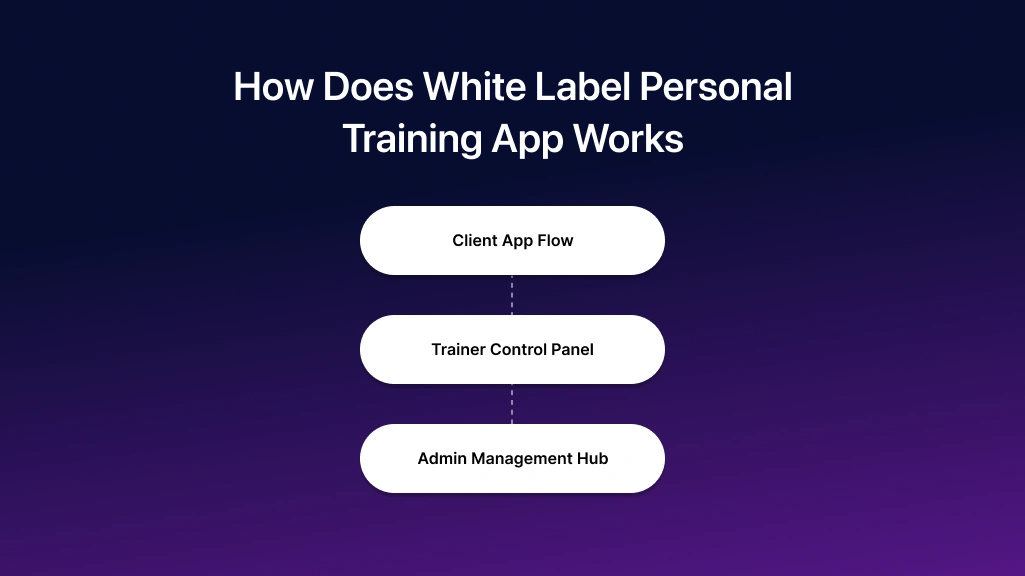
A white label app is like a ready gym setup. The basics are already in place. You get an app for clients, a space for trainers, and an admin panel to manage it all. Clients install the app, create an account, choose a plan, and begin. They can open workouts, mark sessions done, track progress, and get reminders, all in one place.
On the trainer side, you add programs, assign plans, and spot who is staying consistent and who is drifting. Many apps also include chat, video sharing, and session scheduling, so you do not keep switching tools. The provider usually takes care of hosting, updates, and fixes when something breaks. You spend your time on coaching and getting clients, not on building the system from scratch.
1. Client App Flow
In a white label personal training app, clients install the app, sign up, and choose a plan. Once they pay, their workouts open up right away. They can see the weekly schedule, watch exercise videos, and follow daily tasks without asking you to resend anything. After each session, they can mark it done and log basics like weight, steps, or progress photos. The app keeps these records in one place, so clients can look back and see change over time. Reminders also help, so workouts do not get missed on busy days. This flow matters because it reduces daily questions on WhatsApp. It also makes the client feel guided, even when they train alone at home.
2. Trainer Control Panel
Trainers work from a simple dashboard. It lets you create plans, assign them, and see what each client has actually done. You can set reps, rest time, and weekly goals once, then reuse the same plan for similar clients. No need to type the same instructions every week. You can also check logs and catch problems early. Like a client who has not trained for three days, or someone who keeps skipping legs. Many apps add chat, video notes, and habit tracking, but the big win is order. Everything stays in one place, not spread across WhatsApp, notes, and sheets. That is how a small team handles more clients without losing track.
3. Admin Management Hub
The admin area is where the business side stays clean. From the admin side, you set your prices, run discounts, and group clients the way you work. You can add trainers, decide who can edit plans, and keep your workout content in a neat library. Branding controls are usually here too, like your logo, colours, and a few key screens. You also get simple reports. Things like how many users are active, who renewed, and which payments are pending. That makes decisions easier because you are not guessing. As you grow, this panel helps you add new trainers or even new locations with proper access. No more sharing one login with the whole team.
Also Read : Top 15 White Label Reseller Programs That Deliver Big Profits in 2026
Must-Have Features of White Label Personal Training Apps
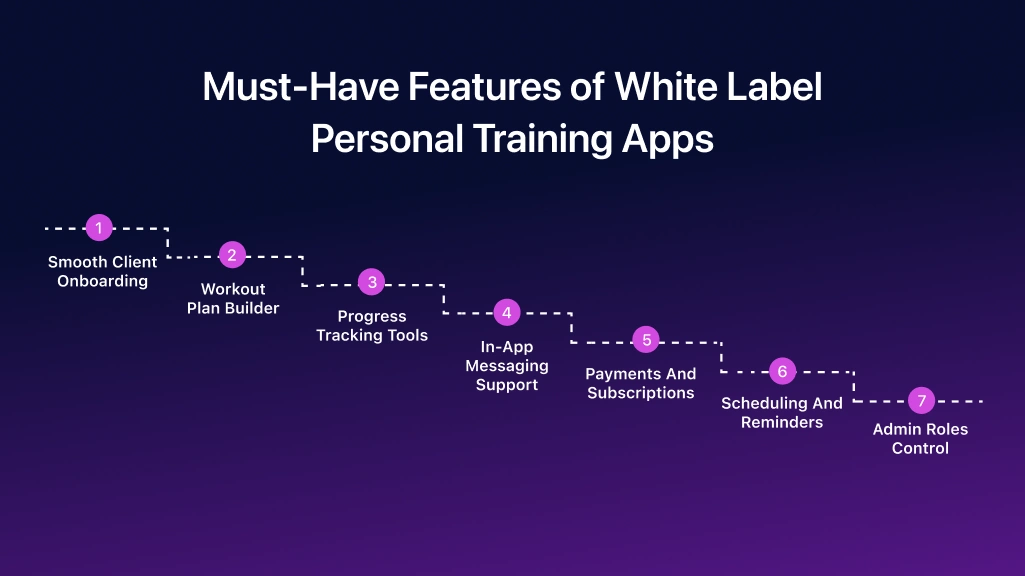
A white label personal training app should solve daily coaching problems, not just look good on a demo call. Startups usually lose time in three spots. Onboarding, follow-ups, and payments. So the must-have features are the ones that cut daily back-and-forth and keep clients training even when your schedule is packed. If a feature does not save time or help renewals, it is optional.
First, you need simple client onboarding. This means easy sign-up, goal questions, and a quick way to assign the right plan. Next, you need workout planning that is clear, with sets, reps, rest time, and video support. Progress tracking is also key, because clients stay longer when they can see small wins each week. Add in chat or messaging for quick guidance, but keep it clean and not noisy.
Payments can’t be a “manual reminder” job. You need subscriptions, plan renewals, and basic invoices, so money comes in on time. If you run live sessions, you need simple scheduling. A basic calendar plus reminders does the job. You also need admin controls, so you can manage trainers, roles, packages, and content on your own, without calling a developer for every small update.
1. Smooth Client Onboarding
The first week decides if a client stays or quits. So onboarding must feel easy and fast. The app should let clients sign up, answer a few goal questions, and get the right plan without long forms. A clean start also reduces messages like “Where do I begin?” In a white label personal training app, onboarding should also include simple profile setup, health notes, and plan access in one place. When the first session is clear, clients feel confident. That confidence is what keeps them active.
2. Workout Plan Builder
Your workouts should not live inside PDFs and screenshots. A good plan builder lets you add sets, reps, rest time, and small notes like “go slow on the last set.” Video demos are a big plus because they reduce form mistakes. The real value is speed, you can reuse templates and assign them to new clients in minutes. With a white label personal training app, you should be able to update a plan anytime and clients should see the change instantly. This saves time and avoids confusion.
3. Progress Tracking Tools
People renew when they can see results. So tracking tools are not a luxury, they are retention. The app should support basic logs like weight, body measurements, steps, and workout completion. Even a simple weekly check-in screen helps. You want clients to look back and feel proud, not lost. In a white label personal training app, progress should look simple at a glance. Skip the busy charts. Streaks, weekly summaries, and small milestones are enough, and they keep clients motivated without you doing extra work.
4. In-App Messaging Support
Clients will ask questions, that will not stop. The trick is to keep all messages in one place, so nothing gets lost. In-app chat saves you from jumping between WhatsApp, Instagram, and email. It also keeps the full history ready when you need to check what was said last week. A solid setup supports quick replies, voice notes, and file sharing. The chat should feel one-to-one, not noisy like a group thread. This way you can guide clients, send reminders, and fix small issues fast, without your whole day getting eaten by messages.
5. Payments And Subscriptions
If payments are manual, you will chase money every month. The app should support card payments, subscriptions, renewals, and simple invoices. It should also handle plan upgrades and add-ons without confusion. Many startups lose revenue because clients forget to renew. Auto-renew and reminder emails can fix that. In a white label personal training app, payment status should be visible in your admin panel, so you know who is active and who needs follow-up. This makes your cash flow more steady.
6. Scheduling And Reminders
If you run live sessions, booking should be easy. Clients pick a slot, get a reminder, and join, with no back-and-forth calls. Even for self-paced plans, reminders still help. People forget workouts on busy days. In a white label personal training app, reminders can cover workouts, water, steps, or weekly check-ins. Keep them light. The point is a small nudge at the right time, so clients stay on track.
7. Admin Roles Control
As you grow, you may add trainers, assistants, or sales staff. You cannot share one login forever. Admin role control lets you decide who can edit plans, who can view payments, and who can manage users. This prevents mistakes and protects client data. In a white label personal training app, the admin panel should let you add or remove staff in minutes. It should also keep a basic activity log, so you can track changes. This makes operations smoother when your team gets bigger.
Also Read : Top 15 AI Nutrition Apps for Better Personal Health
Key Benefits of Developing A White Label Personal Training App
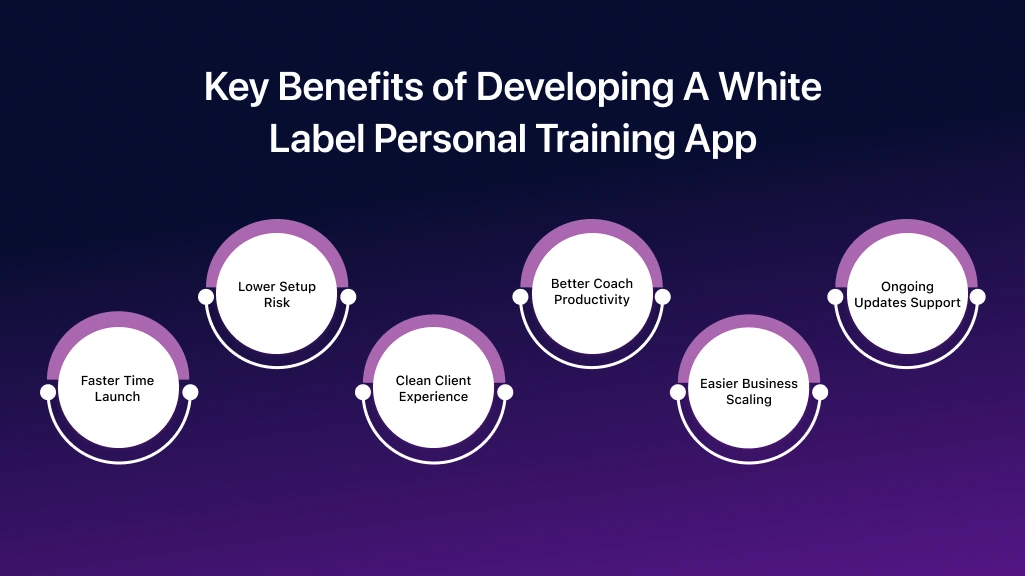
Speed is the biggest win. A white label personal training app lets you launch in weeks, not months. For a startup, that matters because you can start selling plans while you are still building your brand. It also cuts the “waiting time” where you spend money but earn nothing.
You also get fewer moving parts. Most ready apps already include logins, plans, payments, and basic tracking. So you are not juggling five tools and ten spreadsheets. Updates and bug fixes are usually handled by the provider too, which keeps things calm.
Another big benefit is consistency. Every client sees the same clean flow, the same reminders, and the same progress screens. That makes your service feel premium, even if you are a small team. It also helps retention, because clients know what to do next, without asking you daily.
Finally, it helps you test your business model faster. You can test one-month plans, group coaching, or corporate packages, then adjust pricing using real numbers. If an offer does not sell, you can switch it fast, without rebuilding the entire app.
1. Faster Time Launch
Speed is a real advantage for a startup. With a white label personal training app, you start from a working base, so you are not waiting months for a first version. That means you can begin selling plans sooner and learn what people actually pay for. Early launch also helps your marketing, because you can show a real app, not just promises. When you move fast, you also reduce the risk of spending too much before you find product fit.
2. Lower Setup Risk
Custom builds can surprise you. Extra screens, extra changes, extra time, and the bill keeps growing. A white label personal training app reduces this risk because most core features are already built and tested. You know what you are getting from day one. You also avoid many early tech decisions that startups get stuck on, like backend choices and long testing cycles. Your focus stays on programs, pricing, and client results, not on managing developers every week.
3. Clean Client Experience
Clients stay when things feel easy. A branded app gives them one place for workouts, reminders, and progress. No searching old messages. No lost PDFs. In a white label personal training app, the client journey usually stays smooth because the flow is already designed for fitness use. It makes your service look serious, even if you coach alone. When clients know what to do next, they follow the plan more often, and renewals do not feel like a chase.
4. Better Coach Productivity
When your day is full, small tasks become heavy. Sending links, resending plans, chasing check-ins, and tracking who is active takes time. A white label personal training app puts these tasks into a system. You can reuse workout templates, assign plans fast, and view progress without asking clients for updates every time. Even simple features like auto reminders and plan libraries save hours in a week. That time can go into sales calls or better coaching.
5. Easier Business Scaling
Growth is not just more clients. It is also more complexity, more trainers, more plan types, and more support needs. A white label personal training app often supports role access, client groups, and multiple packages, so scaling feels more controlled. You can add a new trainer, start a group program, or try a corporate plan without rebuilding everything. Growth then feels like a simple add-on, not a fresh restart every time.
6. Ongoing Updates Support
Apps need maintenance. Phone updates break things. Payment rules change. Bugs show up at the worst time. With a white label personal training app, the provider usually manages core updates and fixes, so you are not hunting developers for every issue. This helps startups because support becomes predictable. You can plan launches and campaigns without worrying that the app will crash after a system update. The business stays steady, and trust stays intact.
White Label Personal Training App vs. Custom App Development: Which Is Right For You?
This choice is not about “better tech.” It is about timing, budget, and how unique your idea is. Most startups need a working product first. They need real users, real payments, and real feedback. That is where a white label personal training app fits well. You launch faster, test your offers, and build a routine that you can repeat.
Custom app development makes sense when you have a very specific model that ready apps cannot handle. Maybe you need a special assessment flow, a unique coaching style, or deep hardware and wearable links. It also fits when you have steady budget and can wait longer for launch. The trade is simple. You get full control, but you also take full responsibility for time, cost, and future maintenance.
A good rule. If your goal is to start selling in the next few weeks, go white label. If your goal is to build a long-term product with unique workflows, and you can invest for months, custom can work.
| Factor | White Label App | Custom App Development |
| Best When | You want to launch fast and start selling plans. | You need a unique idea that ready apps cannot do. |
| Time To Launch | Usually weeks. | Usually months. |
| Upfront Cost | Lower to start. | Higher because everything is built new. |
| Control | Limited to what the provider allows. | Full control over every screen and rule. |
| Custom Changes | Branding and some feature switches, sometimes small layout changes. | Any feature is possible, but it adds time and cost. |
| Maintenance | Provider often handles core updates and fixes. | Your team handles updates, bugs, and new releases. |
| Risk Level | Lower early risk because the base is already tested. | Higher early risk because issues appear during build and launch. |
| Good For | Coaches, studios, and startups testing packages and pricing. | Funded startups building a product and planning long-term scale. |
| Long-Term Fit | Great if your needs stay close to standard fitness workflows. | Better if your workflows are very specific and must stay unique. |
Also Read : White Label Milk Delivery App: A Complete Guide
How Does White Label App Supports Different Business Needs?
A fitness startup rarely stays the same for long. You start with a few clients, then add more plans, maybe group batches, maybe a second coach. So this section is about fit. A white label personal training app should match how you sell, coach, and collect payments today. It should also give you room to change your model later without breaking everything.
The simple check is this. Write down your daily flow, like onboarding, plan delivery, check-ins, renewals, and support. Then see if the app can do that flow with its current settings. If it can, you will move faster and avoid daily workarounds. If it cannot, you may need deeper custom work or a different provider.
1. Addressing Specific Business Needs
Every fitness business runs a little different. A solo trainer sells 1:1 plans. A studio sells group classes. A corporate program needs team reports and fixed billing. So the real question is simple. Can the app bend to your daily workflow, or will you bend to the app.
With a white label personal training app, you usually get a strong base that covers the common needs. Plans, check-ins, payments, scheduling, and client progress. The smart move is to map your “must-do” tasks on paper first. Like onboarding, weekly check-ins, plan upgrades, and refunds. Then match those tasks to what the app can do today, without promises.
Also check what is truly editable. Some providers let you change branding only. Some allow plan types, coach roles, content layouts, and even custom forms. If your business needs are niche, ask for a live demo using your exact flow. Not a generic demo. That one step saves a lot of regret later.
2. Flexibility For Different Business Models
Fitness is not one-size. Some clients want fat loss. Some want strength. Some only want 3 days a week, because life is busy. Your app should support these small differences, without you doing manual work daily.
A white label personal training app is flexible when it lets you create many plan types. Like 1:1 coaching, group programs, and self-paced plans. It should also support add-ons, like nutrition guidance, habit tracking, or paid check-ins. The best sign of real flexibility is simple settings. You can turn things on or off, set rules for each plan, and update content without needing a developer.
Also think about communication style. Some coaches want chat. Some prefer weekly forms. Some do video calls only. Choose an app that matches how you coach today, and how you may coach six months later.
3. Scalability For Growing Business Models
Growth feels nice. Then it gets messy. More clients means more messages, more plan changes, more payments to track, and more chances to drop the ball. A scalable app helps you grow without turning your day into admin work.
A white label personal training app scales well when it supports roles and access. You can add coaches, assistants, and managers, and still keep control. It should also handle more users without slowing down, and allow you to run multiple programs at once, like weight loss groups plus 1:1 coaching.
Also check if it supports easy data export. Startups often switch tools later. If your client list and progress data can be exported cleanly, you stay safe. Scale is not only about more users. It is also about keeping things organised when the business gets bigger.
Top Use Cases For White Label Personal Training Apps
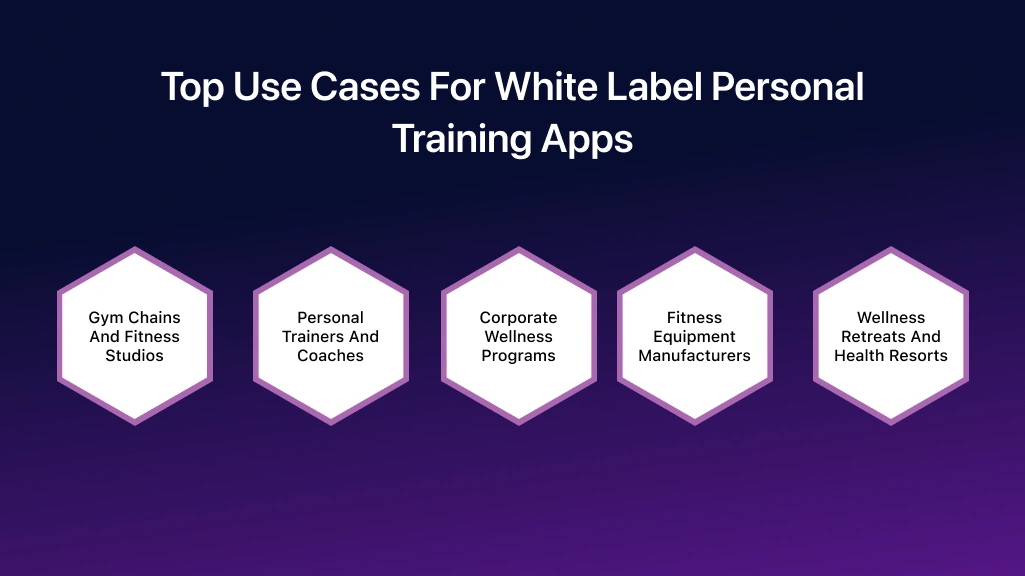
This works best when you sell coaching in a repeatable way. Same flow, same plan types, clear renewals. A white label personal training app is also useful when your team is small and you want one place for plans, payments, and progress.
1. Gym Chains And Fitness Studios
Studios usually deal with walk-ins, class packs, and trainer schedules. An app helps you keep members active between visits. You can push weekly programs, share class updates, and sell add-ons like nutrition plans. It also reduces front-desk load because clients can book and pay without calling. For multi-location gyms, role access matters, so each branch stays organised.
2. Personal Trainers And Coaches
Solo coaches often lose time in chat follow-ups. An app helps you deliver plans in a clean way and track who is actually training. You can reuse templates for new clients and run group challenges without extra tools. This is also a strong fit if you sell monthly online coaching. Renewals become smoother when payment and reminders are built in.
3. Corporate Wellness Programs
Corporate wellness needs structure. HR teams want easy onboarding and simple progress views, not complex fitness data. An app can run step challenges, habit programs, and weekly check-ins for teams. It also helps with fixed billing and time-bound programs, like 6-week wellness drives. The key is privacy and clear access rules, so only the right people see the right data.
4. Fitness Equipment Manufacturers
If you sell treadmills, bikes, or smart home gear, an app can help you keep customers engaged after purchase. You can offer guided workouts, setup tips, and training plans that match the product. It also opens a new revenue line through paid programs or subscriptions. Even without deep device linking, content and routines alone can improve product stickiness.
5. Wellness Retreats And Health Resorts
Retreats want guests to stay on track after they go back home. An app can extend the experience with follow-up plans, meal guides, and check-ins. You can sell post-retreat coaching, monthly memberships, or seasonal programs. It also helps guests feel supported, which improves reviews and repeat bookings.
Also Read : White Label Wellness App Development: Build a Scalable Wellness Platform Under Your Brand
How To Choose The Right White Label Personal Training App?
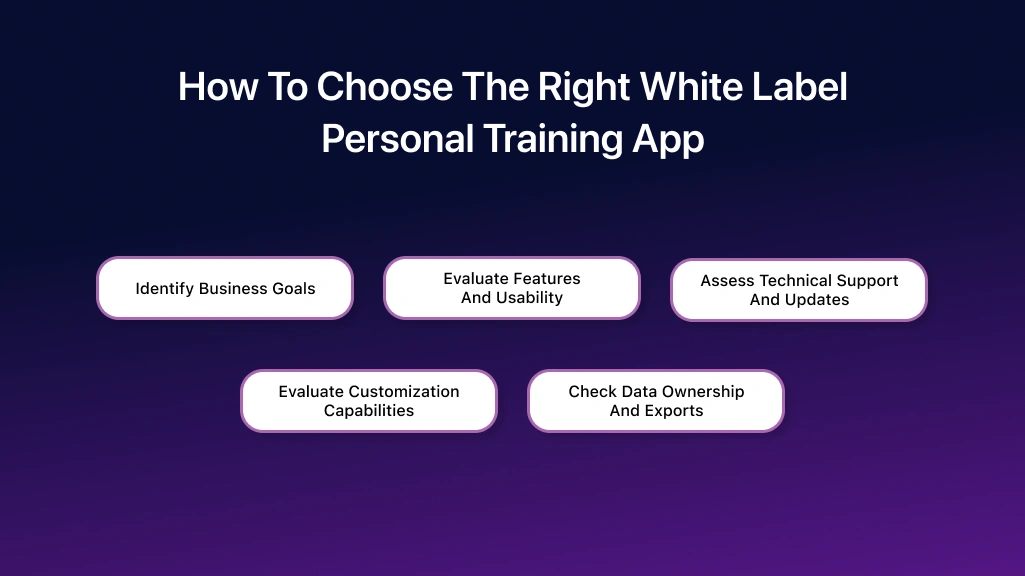
Choosing the wrong app feels fine in week one. Then the cracks show, like messy payments, limited branding, and no easy way to export client data. So choose like a startup owner, not like a feature collector. Your goal is a smooth client flow and steady renewals, not a long feature list. This is exactly why picking the right white label personal training app matters.
Here are the checks that matter most.
1. Identify Business Goals
Start with one main offer. Online coaching, group batches, in-gym training, or corporate programs. Then list the 5 actions you do every week, like onboarding, assigning plans, check-ins, renewals, and support. The app must support these actions without hacks.
2. Evaluate Features And Usability
Open the demo and test it like a client. Can you find workouts in 10 seconds. Can you log progress without confusion. Can you message the coach without digging through menus. In a white label personal training app, small friction kills consistency. Simple screens win.
3. Assess Technical Support And Updates
Ask what support looks like after launch. Is there chat support, email tickets, or a call option for urgent issues. Also ask how often updates are shipped, and what happens when iOS or Android updates break something. Get this in writing, not just in a sales call.
4. Evaluate Customization Capabilities
Branding should be more than a logo. Check if you can change app name, colours, home screen layout, plan names, onboarding questions, and coach roles. Also ask what cannot be changed. Every provider has limits, so it is better to know them early.
5. Check Data Ownership And Exports
This is a quiet but serious point. Ask who owns client data, where it is stored, and how you can export it. Also ask what happens if you stop using the service. A clean export path keeps you safe if you ever switch providers.
Also Read : Top 15 AI Nutrition Apps for Better Personal Health
Best Practices For Maximizing the Success with White Label Personal Training Apps
Launching an app is one thing. Getting people to use it every week is the real job. Most startups fail here, not in development. They launch, post one Instagram story, and hope users will “figure it out.” They won’t. You need simple habits, clear onboarding, and small checks that keep clients active.
Here are practical best practices that work well for a white label personal training app.
1. Start With One Clear Offer
Do not launch with five plans and ten price points. Pick one main program that you can sell confidently. Example, “12-week fat loss plan” or “Strength plan for beginners.” A clear offer makes marketing easier and reduces decision stress for clients. Once this offer sells, you can add more.
2. Make Onboarding Short
Keep the first steps simple. Ask only what you need, like goal, fitness level, injuries, and preferred training days. If onboarding feels long, people drop off before the first workout. Add a welcome screen that tells them what to do today, not what the app can do.
3. Use Templates, Not Manual Work
Create 5 to 10 workout templates you can reuse. Same for warm-ups, cool-downs, and nutrition tips. Then adjust for each client. This keeps coaching quality steady and saves hours every week. Your time should go into feedback and motivation, not copy-paste.
4. Track One Or Two Metrics Weekly
Too many numbers make you ignore all numbers. Track simple metrics like weekly active users, plan renewals, and workout completion rate. If you offer live sessions, track no-shows too. These numbers tell you if your service is improving or leaking clients quietly.
5. Run A Small Soft Launch
Before a full public launch, test with 10 to 20 people. Mix new clients and friendly users who will give honest feedback. Test payments, reminders, and plan updates. Fix the top three issues first. A soft launch prevents bad reviews that hurt you early.
6. Keep Support Fast And Human
Even a good app will get questions. Make it easy for users to reach you, like in-app chat or a simple support email. Reply fast, especially in the first month. Early support builds trust and reduces churn. People stay when they feel looked after.
How We Develop White Label Personal Training App?
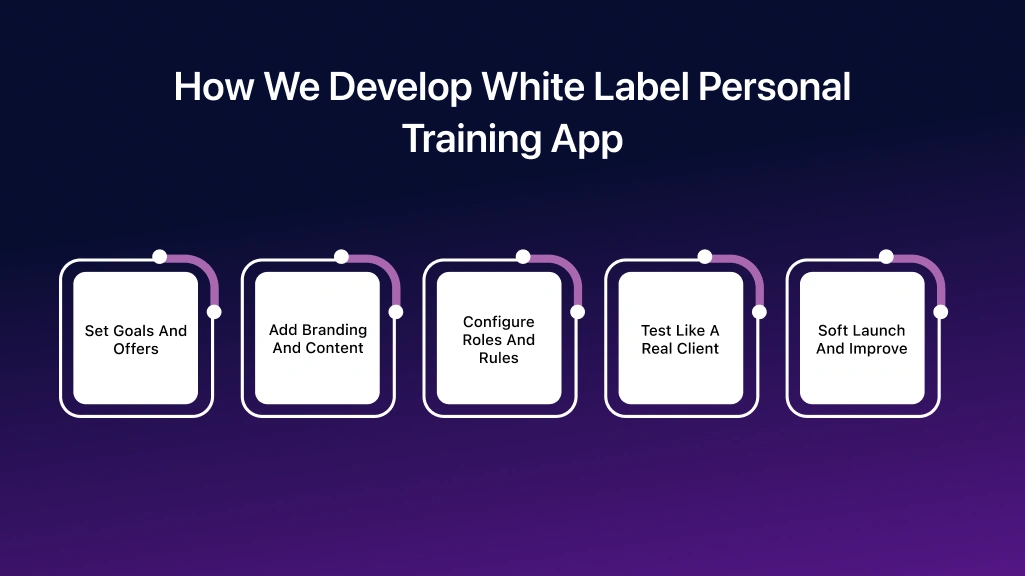
We start by understanding how you coach today. Not how a demo video looks. We map your client journey, from sign-up to renewal, and spot the messy parts, like late payments, missed check-ins, and plan confusion. Then we set up the white label personal training app around that flow, so it feels natural for you and simple for clients.
1. Set Goals And Offers
We start by fixing one clear offer. For example, 4-week fat loss, 12-week strength, or monthly online coaching. We also decide pricing, renewals, and what is included in each plan. This step stops confusion later because the app setup depends on your offer. When the offer is clear, the home screen, onboarding questions, and plan layout become easier to build.
2. Add Branding And Content
Next we set up your app name, logo, colours, and key screens. Then we load your workouts, videos, and templates, so you are not building content after launch. We keep the structure simple, like week-wise programs and clear daily tasks. In a white label personal training app, content is what clients touch every day, so we make sure it feels easy to follow from day one.
3. Configure Roles And Rules
If you have multiple trainers or staff, we set roles early. We decide who can edit plans, who can view payments, and who can manage users. This protects client data and avoids mistakes. We also set rules for groups, packages, and access, so the app stays organised as you add more clients and more trainers.
4. Test Like A Real Client
We do not only click through screens. We test real actions. We do test sign-ups, test payments, and at least one refund test. We also check reminders, plan updates, and chat flows. We test on older phones and slower networks because many users are not on the latest devices. This step catches small issues before they turn into bad reviews.
5. Soft Launch And Improve
Before a full launch, we release the app to a small set of users. This helps us spot where people get confused, like onboarding steps, plan access, or payment prompts. We fix the top issues, then open it up to the public. After launch, we track simple numbers like active users and renewals, and improve the flow in small steps.
Also Read : White Label Restaurant Ordering App
Tech Stack We Use for the Development of White Label Personal Training App
For a white label personal training app, we use tools that are stable and easy to maintain. The aim is simple. The app should load fast, take payments safely, and stay smooth after updates. We also keep future support in mind, so you are not stuck with a hard-to-fix setup later.
| Area | What It Covers | Tech Stack Options |
| Mobile App Build | iOS + Android app (cross-platform or native) | Flutter, React Native. Native: Swift (iOS), Kotlin (Android). |
| Admin Dashboard | Manage plans, users, roles, content | React. |
| Backend And APIs | App logic, auth, subscriptions, access rules | Node.js (Express, NestJS), Laravel. |
| Database And File Storage | User data, renewals, media files | PostgreSQL, MySQL. Storage: AWS S3, Google Cloud Storage. |
| Hosting And Speed | Deploy, scale, faster delivery | AWS, Google Cloud. CDN for faster media. |
| Payments And Subscriptions | Card payments, recurring billing | Stripe, or other gateways as needed. |
| Reminders And Notifications | Push, email, SMS alerts | Firebase Cloud Messaging. Email: SendGrid. SMS: Twilio. |
| Analytics And Bug Tracking | Usage tracking, crashes, errors | Google Analytics, Mixpanel. Sentry, Firebase Crashlytics. |
| Security Basics | Secure access and safe data transfer | HTTPS, secure logins, role-based access, limited staff access. |
Average Cost for Development of White Label Personal Training App
A white label personal training app is usually cheaper upfront because you pay a setup fee and a monthly platform fee, then launch fast. Many white-label tools sit around $75–$199 per month, with a small one-time setup like $75–$400, plus app store accounts like Apple’s $99 per year. Custom app development is the opposite. One time comprehensive build-out scenario, ongoing maintenance will be for app use. There are several estimates on determining average app build costs – Using coaching as an example, app build costs for medium complexity sites are between $50,000-$120,000, and fitness apps can also go higher due to the growing number of features, so you should choose an option that aligns to your runway today.
| Cost Item | White Label App | Custom App |
| One-Time Setup / Branding | $75–$400 | Included in build |
| Monthly Platform Fee | $75–$199 / month | N/A |
| App Store Accounts | Apple: $99 / year, Google Play: $25 one-time | Same fees apply |
| Build Cost (Year 1) | Usually not separate | $50,000–$120,000+ |
| Ongoing Updates / Upkeep | Often included in a subscription | $5,000–$30,000 per year (updates) |
How You Can Earn With White Label Personal Training App?
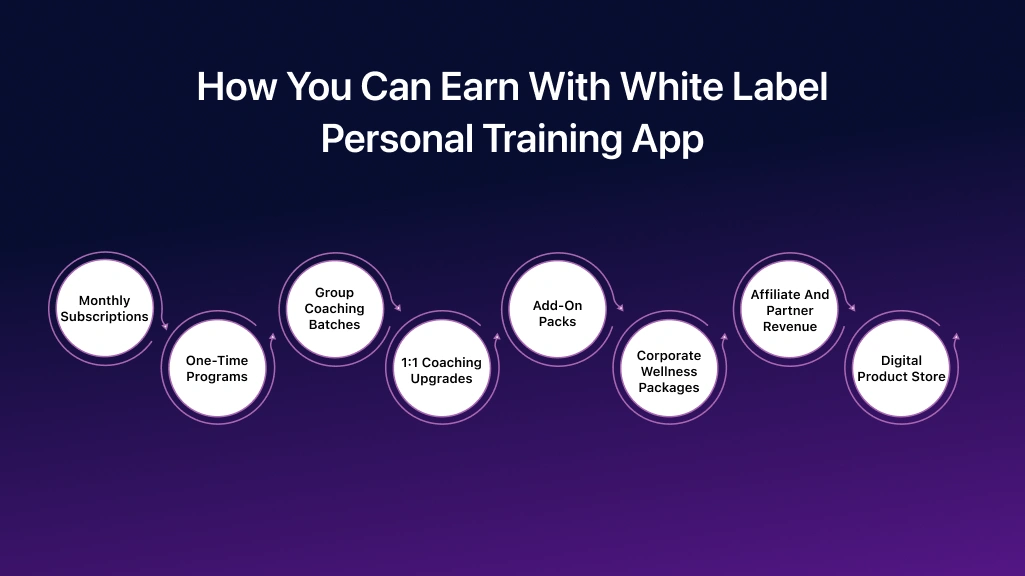
A white label personal training app can earn money in more than one way. The key is to keep pricing easy to understand. People should know what they get, what it costs, and how to upgrade. We also set it up so renewals happen on time, without you chasing payments.
1. Monthly Subscriptions
This is the most steady model. Clients pay each month for access to their workouts, check-ins, and coach support and we have established two basic plan types: Basic (self-paced) and Pro (coaching). Subscriptions help you plan cash flow and reduce income swings.
2. One-Time Programs
Some clients want a fixed goal with a finish line. Like a 21-day challenge or a 6-week strength plan. We set these as one-time purchases with clear dates and clear results. They also work well for ads because the offer is easy to explain.
3. Group Coaching Batches
Group programs help you earn more without coaching every client one by one. We set a start date, weekly plan drops, and group check-ins. Pricing is lower than 1:1, but total revenue can be higher because many people join together.
4. 1:1 Coaching Upgrades
A common pattern is simple. People start with a basic plan, then upgrade when they want personal attention. We add paid upgrades like weekly calls, form checks, custom edits, or priority support. This is often where margins improve.
5. Add-On Packs
Add-ons are small paid extras like nutrition guides, meal plans, mobility packs, or posture routines. They work because they feel optional and specific. We keep checkout quick so people do not drop off mid-payment.
6. Corporate Wellness Packages
If you sell to companies, we set pricing as per-employee per month or a fixed fee for a time-bound program. We also set up basic team views and clean billing. Corporate deals can be stable, but they need clear reporting and privacy rules.
7. And Partner Revenue
Some brands earn through partner links for gear, supplements, or wearables. We keep this light and relevant, because too many promos break trust. If it does not help the user, we do not add it.
8. Digital Product Store
We can add a simple store for digital products, like “Home Workout Starter Pack” or “Beginner Strength Guide.” This helps you earn from users who want content but not ongoing coaching.
Also Read : What is White Label Delivery Software? A Complete Guide
Future Trends In White Label Personal Training App
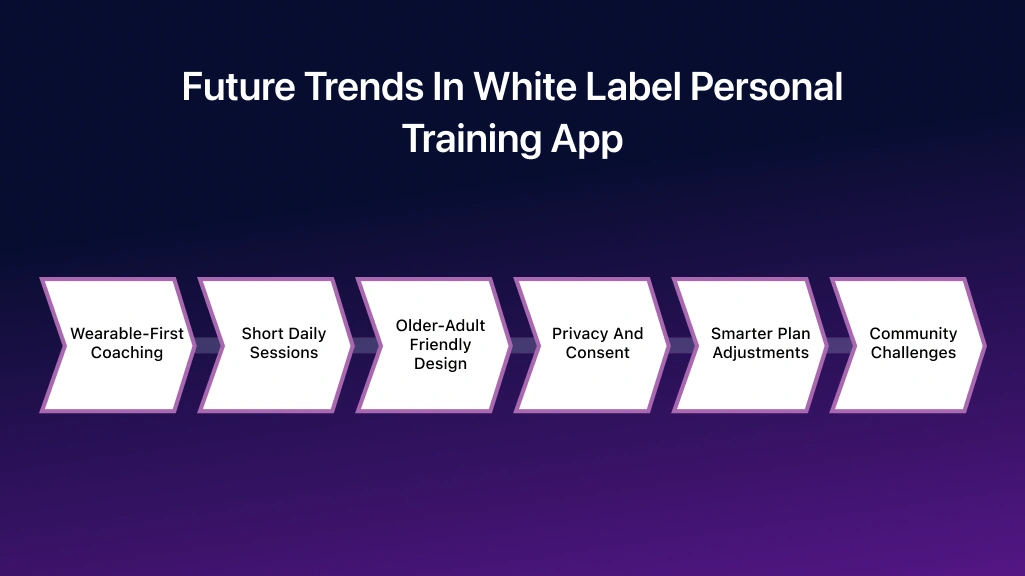
Fitness apps are getting more practical. Less noise, more daily use. ACSM’s 2026 fitness trends put wearable technology at the top, and mobile exercise apps are still in the top five. That means users will expect watch data like steps and heart rate trends, plus short workouts they can finish on a busy day. Older-adult friendly programs are also rising, so larger text and simple screens will matter more.
Privacy will get stricter too. The FTC finalized changes to the Health Breach Notification Rule in April 2024, and it clearly applies to health apps and similar tools not covered by HIPAA. At the same time, the fitness apps market is growing fast, from $12.12B in 2025 to $33.58B by 2033, per Grand View Research. This is why a white label personal training app should be built for trust, simple habits, and steady upgrades, not gimmicks.
1. Wearable-First Coaching
More users will expect their watch data to show up inside the app. Steps, heart rate trends, sleep basics, and workout minutes. Not everyone wants deep charts, but they do want simple feedback. “You walked less this week, so let’s keep cardio light.” That kind of use feels helpful. Wearable links also help coaches spot patterns without asking clients to type everything. The app should keep it clean and optional, so it does not overwhelm beginners.
2. Short Daily Sessions
People are busy and they skip long workouts first. Short sessions will keep growing because they feel doable on weekdays. Think 10 to 20 minutes, clear moves, and quick check-ins. These sessions help users build a habit, not just chase big goals. For a white label personal training app, this also improves retention. When users finish small sessions often, they stay active and renew more easily.
3. Older-Adult Friendly Design
More fitness plans are being made for older adults, and the app experience needs to match. The font size is larger, buttons are easier to press, and the progress screens are much simpler. Exercise focus should be on balance, mobility, and strength for everyday life; younger users should still see benefits in a clean and simple design. A simple interface reduces confusion for everyone, and it cuts support messages too.
4. Privacy And Consent
Fitness apps collect personal data, and users are more aware now. They want to know what is stored, why it is stored, and how to delete or export it. Consent screens will become more common, especially for data from wearables. Simple privacy settings build trust and reduce churn. It also keeps you safer when rules get tighter in different regions. A clean “data export” option is no longer a nice-to-have. It is a safety net.
5. Smarter Plan Adjustments
Apps will get better at changing plans when real life happens. Missed workouts, low streaks, or poor recovery. The best systems will not shame users. They will adapt. For example, “Busy week, let’s switch to three short sessions.” This keeps users moving instead of quitting. The key is clear wording and simple choices. No confusing graphs. Just practical changes that help users stay consistent.
6. Community Challenges
Community features will keep growing because they help motivation. Group streaks, simple challenges, buddy check-ins, and small leaderboards. It works because people like feeling part of something. For startups, this is also a strong monetisation lever. You can run monthly challenges, batch programs, and team plans. Keep it positive and optional, not noisy. A quiet community that feels safe usually performs better than a loud one.
Also Read : White Label Multi Restaurant Delivery App
White Label-Ready Personal Training Apps We Can Rebrand For You
We can rebrand ready personal training apps for you, so your white label personal training app launches under your own name without starting from scratch. We add your logo, colours, app name, and key screens, then load your plans, pricing, and onboarding questions. You get a client app, a trainer dashboard, and an admin panel, all aligned with how you coach every week. It is a faster path to a branded launch, with proper testing and app store support included.
1. EveCare
We can white label EveCare for you, so it launches with your brand as a white label personal training app style product for feminine health habits. Users can log their menstrual cycles, symptoms, moods, and daily energy levels all from one location; the app has the capability to learn from past behaviour and provide future expectations, and it gives users a simple dashboard to see their changes over time with wellness checklists they can complete at home. If desired, users can turn on life-stage support depending upon their age (puberty), pregnancy plan, or menopause. The app will be presented cleanly and without advertising, focusing solely on the user’s needs. It is not a medical tool, but it helps users stay more aware and prepared.
- Smart Cycle Predictions: Period and ovulation estimates based on personal patterns.
- Health Dashboard: Track flow, symptoms, mood, and see trends week to week.
- Wellness Checklists: Guided self-check steps and simple risk prompts to note concerns.
- Life-Stage Modules: Optional tracks for puberty, fertility planning, and menopause.
- Ad-Free Design: Private, focused screens with no distracting ads.
2. With You Connect
We can white label With You Connect for you, so it launches as your white label personal training app with your name, colours, and pricing. It works like a coaching companion that adjusts the plan as the user progresses. The routine changes based on fitness level, workout performance, and feedback, so it does not feel like a fixed one-size program. Users can swap workouts on busy days and still stay consistent. Daily sessions keep habits simple, even without equipment. The app also includes a large audio workout library across strength, HIIT, yoga, and mobility, plus a progress dashboard and wearable sync for better tracking.
- Personalised Plans: Goal-based routines that adjust as users improve.
- Smart Assistant: Swap workouts, edit schedules, and get quick wellness answers.
- Daily Sessions: Short, equipment-free routines for steady habits.
- Audio Coaching: 1,000+ guided workouts across key training styles.
- Progress Dashboard: Streaks, milestones, and lifetime stats in one view.
- Wearable Sync: Connects with Apple Watch and Garmin for real-time data.
Why Choose WhiteLabelApps for the Development of White Label Personal Training App?
A fitness app can look good and still fail. Users get stuck on day one. Payments drop. Plans feel hard to follow. WhiteLabelApps focuses on the basics that decide retention, a clean first week, smooth renewals, and simple daily use. That is how a white label personal training app becomes something clients actually open, not just download.
1. Real Coaching Flow
Your app should match how you coach in real life. Onboarding, plan delivery, check-ins, and renewals need to feel natural. The setup starts from your weekly routine, not from a generic template. This reduces daily workarounds and keeps your service consistent across clients.
2. Clean First Version
Startups do better with a small, focused launch. One clear offer, simple onboarding, easy plan access, and steady payments. The build stays lean so users do not feel lost. You can add more later, once you see what people use and what they ignore.
3. Practical Testing
Testing is not only about opening screens. It is about real actions. Sign-ups, payments, reminders, plan updates, and at least one refund test. The app is also checked on older phones and slower networks because that is what many users still use. This prevents bad reviews that come from small but painful issues.
4. Data Ownership
Client data is your business asset. So it needs clarity from day one. Client takes ownership of their data, where the data is held, and how it can be exported (if they choose) is an important point if they decide to change systems or implement new tools. Clear data rules keep your business safe as it grows.
5. Post-Launch Support
Real user feedback starts after launch, not before it. Small friction points show up, like drop-offs during onboarding or renewals. Support helps you fix these fast, then improve in steps. That keeps the app stable while your business keeps running.
Conclusion
A branded fitness app can save hours every week. It can also help clients stay consistent, because everything sits in one place. Workouts, check-ins, payments, and progress logs. No more hunting old chats or resending files.
For most startups, the first goal is simple. Launch fast, sell a clear plan, and learn what clients actually use. That is why a white label personal training app is often a safer first step than building everything from zero. It keeps costs and timelines more predictable. It also helps you test pricing, onboarding, and renewals before you invest in deeper custom work.
The smart move is to keep the first version small. One main offer. Clean onboarding. A soft launch with a small group. Then improve based on real usage, not guesses.
If you want help picking the right setup and launching a branded fitness app without tech confusion, WhiteLabelApps can guide the full rollout. From choosing the best-fit white label base to branding, testing, and launch support, the team helps startups get to market faster and stay steady after release.
FAQs
1. How long does it take to launch a white label personal training app?
Many launches can happen in a few weeks if the content is ready. Time mainly depends on branding, app store setup, and how much you customise. If your workouts, pricing, and onboarding questions are already prepared, the process moves faster.
2. Can the app look fully branded like my own product?
Yes, most providers let you change the app name, logo, colours, and key texts. Some also allow home screen layout changes and custom forms. The smart step is to ask what is editable and what is fixed, before you sign.
3. Will clients be able to pay inside the app?
In most setups, yes. You can sell plans, subscriptions, and add-ons with in-app payments. Always check which payment methods are supported in your target market and how refunds, failed payments, and renewals are handled.
4. What happens to client data if I switch providers later?
This depends on the contract. Ask who owns the data, where it is stored, and how you can export it. Also ask what format the export comes in and if there are any exit fees or notice periods.
5. Is a white label app better than a custom app for a startup?
Often yes, if speed and lower early risk matter most. A white label app helps you launch, sell, and learn faster. Custom development fits better when you need a very unique workflow and you have time and budget for a longer build.

whitelabelapp
Related Articles
Top 15 White Label Reseller Programs That Deliver Big Profits in 2026
If you have ever tried reselling services, you know the truth. The pitch is easy. Delivery is where most resellers bleed time and profit. That is why this list is not based on “popular names” or random directories. We did deep research before writing this blog. We reviewed reseller program pages, service menus, white label […]
Read More
Top 15 AI Nutrition Apps for Better Personal Health
You start tracking on Monday. By Thursday, you are tired. Breakfast is easy, lunch is outside, and dinner is late. The app asks for too many taps, so you stop logging. That is the real problem AI Nutrition Apps are trying to solve. But if you are a startup, you have a second problem. Most […]
Read More