
You want to launch a travel business and start taking bookings fast. But the moment you try to build the platform, things start getting messy. Too many modules, too many supplier links, and too many moving parts between search, pricing, payments, and admin control.
That is where white label travel portal development helps. You get a ready booking setup and launch it under your own brand, so customers and agents see your business from day one. It gives you a faster route than trying to build every screen, workflow, and integration from zero.
Building a custom portal from scratch can turn into a long and expensive project very quickly. Clutch says the usual timeline for a software development project is about 13 months, and the average project cost is about USD 132,480.29. That is one big reason many travel businesses choose a faster launch model before time and budget start slipping away.
That speed matters because online travel is still growing. With our white label app development approach, we help you skip the long custom build phase. You get the core portal structure already in place, then we shape it around your brand, booking flow, and business model. Your logo, your design, your user journey, and your pricing logic. Not a generic travel template.
This guide is shaped by practical product thinking around how travel platforms are planned, built, and launched for real business use. Soon, you start to notice a pattern. The budget is never shaped by just one thing. It shifts based on the size of the portal, the booking features you need, the supplier connections, the level of design, the number of user roles, and the support required after launch. That is where many businesses get it wrong. They focus too much on the look and feel, but miss the bigger cost drivers like integrations, testing, and long-term maintenance.
This guide explains how white label travel portals work, who they are best for, which features matter most, how pricing usually compares, and what to check before you pick the right platform.
- White label travel portal development helps travel businesses launch faster under their own brand.
- It costs less than building a custom travel platform from scratch.
- Supports B2B, B2C, or a mix of both travel selling models.
- Keeps booking, pricing, payments, and admin work in one place.
- Creates earning options through commissions, markups, service fees, add-ons, and reseller access.
- A strong portal should support business growth, supplier flexibility, and clear brand control.
- White label travel portal development gives travel agencies a ready platform they can brand and launch without building every feature from zero.
- A good white label solution usually includes a travel booking engine, supplier integrations, payment support, user management, and an admin panel.
- A B2B travel platform setup helps agents, sub-agents, and resellers manage bookings, pricing, and partner access more easily.
- A B2B travel portal is useful for businesses that want role-based pricing, account control, and better margin management.
- Travel businesses choose B2B travel portal development when they need faster market entry with lower setup pressure than custom development.
- The best white label travel website should match the business model, support supplier flexibility, and stay easy to manage after launch.
- A practical white label travel booking engine should not only look branded, but also support smooth search, checkout, and post-booking management.
What Is a White Label Travel Portal Development?
A white label travel portal enables travel businesses to set up their own branded booking platform without starting from scratch. The core system is in place. You simply mould it around your business with your brand name, logo, colours, domain, and travel rules. Most travel portals have the core tools built-in, such as booking, supplier link-ups, payment set-up, and an admin panel for managing prices, inventory, and customer bookings. This is a quicker and more sensible way for travel agencies, start-ups and resellers to enter the market while retaining control over the brand, the customer journey, and day-to-day operations.
- Builds a branded travel portal under your business name.
- Works as a ready white label solution for faster launch.
- Includes a travel booking engine for hotels, flights, cars, tours, or transfers.
- Supports both B2B travel platform and customer-facing travel models.
- Reduces development time compared to a fully custom build.
- Helps manage bookings, suppliers, payments, and users from one place.
- Gives more ownership and flexibility than a basic affiliate setup.
- Fits agencies looking for scalable B2B travel portal development options.
Also Read : White Label Education App Development: Launch Your Own eLearning Platform Fast
Why Global Demand for White Label Travel Portals Is Rising?
Travel is picking up again, and most bookings now happen online. UN Tourism said international tourist arrivals reached 1.52 billion in 2025, up 4%. Phocuswright also reported that global travel gross bookings touched $1.6 trillion in 2024 and may get close to $1.8 trillion by 2027. That is a big reason white label travel portal development is getting noticed. Travel businesses want a quicker way to launch branded booking platforms, connect with suppliers, sell in different markets, and keep better control over customer experience and revenue.
- More travelers now search, compare, and book trips online.
- Agencies want branded platforms instead of sending users to third-party sites.
- Startups want a faster launch than full custom portal development.
- B2B sellers need one place to manage agents, markups, and supplier access.
- Travel brands want better control over margins, customer data, and repeat bookings.
- Multi-product demand is rising across flights, hotels, transfers, tours, and packages.
- A strong white label solution helps businesses enter the market without building everything from zero.
Core Components Behind White Label Travel Portal Development
A strong portal does more than show travel listings. In white label travel portal development, every main part plays its own role in the booking journey. A module handles search, a module manages supplier access, and other modules are responsible for pricing, payments and admin. When all the modules work together, the portal becomes more efficient, easier to scale, and far more effective for both the business and the customer.
| Component | What It Does | Why It Matters |
| Booking Engine | Lets users search and book flights, hotels, cars, tours, or transfers. | It powers the full booking journey from search to confirmation. |
| GDS And API Integrations | Pulls live inventory, pricing, and availability from travel suppliers. | It keeps listings updated and expands product access. |
| User Interface | Shows the search, booking, and account experience users interact with. | It affects trust, ease of use, and conversion. |
| Admin Panel | Helps manage bookings, suppliers, users, markups, and reports. | It gives the business control from one place. |
| Payment Gateway | Processes online payments through secure payment methods. | It supports safe transactions and smoother checkout. |
| Markup And Pricing Rules | Applies margins, commissions, and rate changes across products or users. | It helps protect revenue and pricing control. |
| Reporting Module | Tracks bookings, sales, trends, and supplier performance. | It helps with business decisions and revenue planning. |
| User Management | Handles access for admins, agents, sub-agents, and customers. | It supports both direct and B2B travel platform models. |
How White Label Travel Portal Development Works?
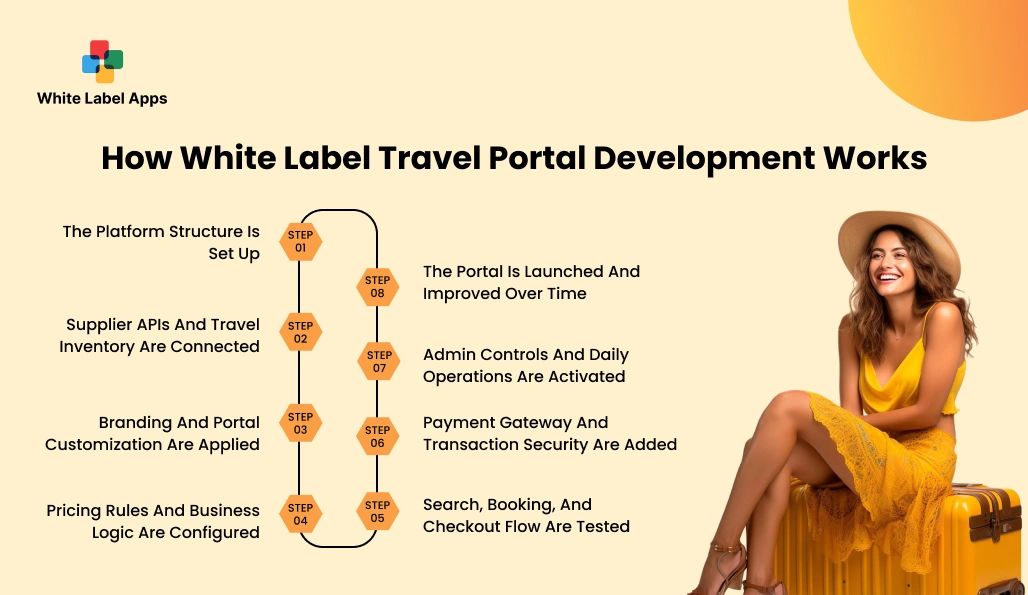
Simply put, white label travel portal development works by layering your brand over an existing ready-made booking system, supplier connectivity, and admin backend. Your portal pulls live travel inventory from APIs or GDS providers, displays it on your branded front end, and allows users to complete bookings via a secure payment flow. And on the back end, your team can manage their markups, bookings, users, and revenue from one place. That is the part that makes it useful for travel agencies, resellers, and businesses that want a faster way to launch without building from scratch.
Step 1: The Platform Structure Is Set Up.
The first step in white label travel portal development is installing your core portal framework. This typically includes the customer booking flow, the admin dashboard, the user login, and the modules for hotels, flights, cars, or tours. The aim at this stage is to build a solid working base for the business, not just make the portal look good on screen.
Step 2: Supplier APIs And Travel Inventory Are Connected.
Once you have your base system set up, you connect to the travel suppliers via APIs, GDS platforms, or third-party aggregators. This is the way your portal is getting live inventory, price data, availability, and booking data. Without this layer, your portal cannot display real products or real-time rates. This is the step that turns the platform into a live travel booking engine rather than a static travel site.
Step 3: Branding And Portal Customization Are Applied.
Once the inventory side is integrated, the portal is customised to show your business name. That includes your logo, branded colours, domain, homepage layout, banners, content, and occasionally also the booking flow. A proper white label solution should not look like a borrowed template. It should feel like your own solution from the first click to the booking confirmation.
Step 4: Pricing Rules And Business Logic Are Configured.
The next step is setting up the commercial side of the portal. This includes markups, commissions, service fees, agent rates, discounts, and payment rules. If the business runs as a B2B travel platform, different user roles may also get different pricing access. This part matters because even a good-looking portal can fail if the margin logic, user permissions, or revenue setup is weak.
Step 5: Search, Booking, And Checkout Flow Are Tested.
The entire user path must be tested before launch. That means checking how users browse, filter, select products, enter traveler information, pay and get confirmation. This step can catch broken filters, incorrect rates, checkout failures or confusing layout. In real projects, small flow problems here can hurt trust fast and reduce booking completion rates.
Step 6: Payment Gateway And Transaction Security Are Added.
A travel portal needs secure payment handling before it can go live. This step includes payment gateway integration, transaction flow verification, refunds handling, currency support, and basic protection of data. The aim is to make checkout frictionless for the user and easy to manage for the business. A timeout, failed payment or an ambiguous confirmation screen can cause friction even if the booking itself works perfectly.
Step 7: Admin Controls And Daily Operations Are Activated.
Once the portal is working from the user side, the backend needs to support real daily operations. The admin team should be able to manage bookings, update markups, handle cancellations, check reports, monitor suppliers, and control user access from one place. This is a big part of white label travel portal development because travel businesses need control, not just a branded front end.
Step 8: The Portal Is Launched And Improved Over Time.
After testing and setup are complete, the portal is launched for agents, customers, or both. But launch is not the finish line. Most travel businesses keep improving the platform by adding more suppliers, better reports, mobile features, new booking modules, or stronger automation. That is how a portal moves from a simple booking site to a scalable B2B travel portal or multi-service travel business platform.
Also Read : White Label Wellness App Development: Build a Scalable Wellness Platform Under Your Brand
Why White Label Travel Portal Development Benefits Travel Agents And Tour Operators?
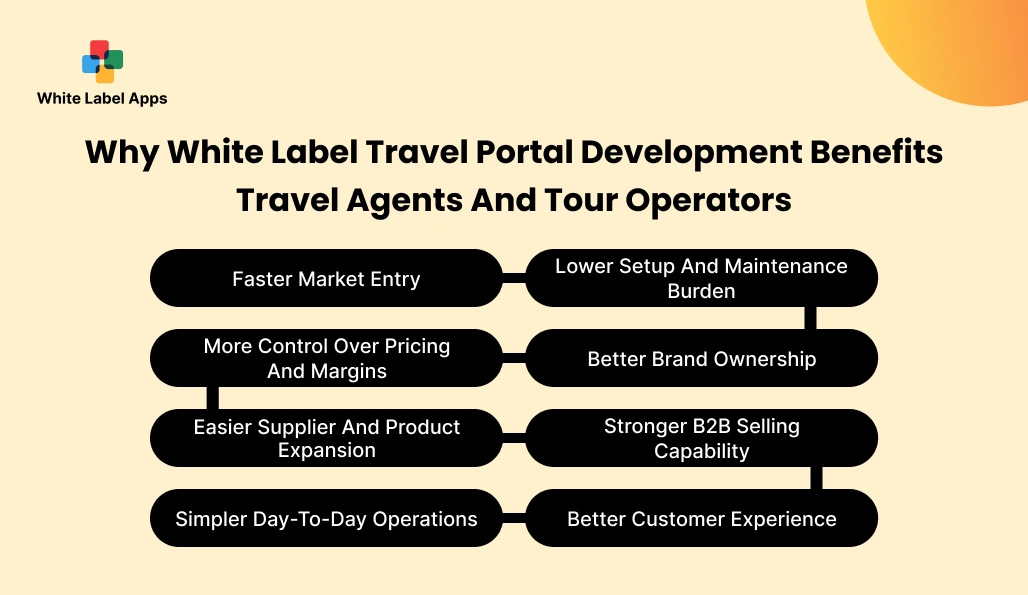
For travel agents and tour operators, speed and control matter more than having a flashy platform. A white label travel portal development enables them to launch a branded booking business quickly, without waiting for a custom build. It also helps them to manage suppliers, bookings, pricing and the entire customer journey in one place. That is a real win when daily travel work already feels hectic.
1. Faster Market Entry
Starting from scratch can take a lot of time, planning, testing, and tech work after launch. A white label solution eliminates that effort because the core booking engine is already built and ready for your customisation. That means agents and tour operators can start selling sooner, test their market faster, and avoid losing months in basic development work.
2. Lower Setup And Maintenance Burden
A ready portal usually reduces the effort needed to build core travel modules from zero. Rather than spending a lot on each search flow, supplier connection and admin feature, the business can leverage an existing platform and make it their own. The model is easier to maintain, especially when you’re a small or mid sized travel business looking to grow but don’t want a massive tech team.
3. Better Brand Ownership
When you sell only through a third-party marketplace, customers often remember the marketplace, not you. A white label portal flips that. Your logo, your domain, your design, and your booking flow stay in front of the customer from start to finish. Over time, this helps your travel brand look more established and easier to remember.
4. More Control Over Pricing And Margins
Travel agents need the freedom to manage markups, commissions, seasonal rates, and customer-specific deals. A good portal supports this with clear admin controls and pricing rules. This matters because travel profit often comes from small pricing choices, not just more bookings, and those choices should stay with you.
5. Easier Supplier And Product Expansion
A travel business might begin with hotel bookings and add flights, transfers, tours, or car rentals later. A solid white label portal makes this step-up easier because it is built to handle new integrations and extra modules. That gives agents and operators a clear way to add new revenue streams without rebuilding the entire system.
6. Stronger B2B Selling Capability
Many travel businesses do not sell only to end customers. They may also have agents, sub-agents, resellers or corp. Their portal with B2B travel portal functionalities can support role-based pricing, account management, access to bookings and reporting too. This facilitates a much easier daily collaboration than handling everything manually.
7. Simpler Day-To-Day Operations
Managing bookings via calls, emails, spreadsheets and multiple supplier logins can become a bit chaotic really fast. Store bookings, customer information, supplier access, reporting and payments all in one place. Your team can do less manual work and you can focus on selling, support and day-to-day travel functions.
8. Better Customer Experience
Travel buyers want quick search, clear prices, easy checkout, and smooth confirmations. A structured travel booking engine helps deliver that experience more consistently than patchy manual booking methods. For agents and operators, this matters because a clean booking flow can improve trust, reduce drop-offs, and make repeat bookings more likely.
Also Read : Top 10 White Label Online Ordering Platforms for Restaurants In 2026
Who Can Benefit From White Label Travel Portal Development?
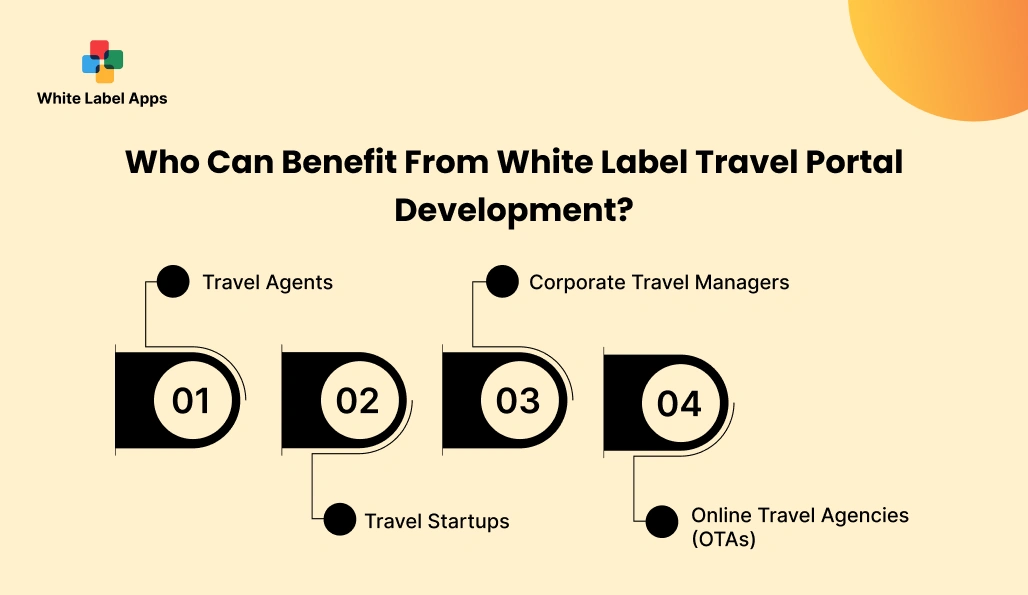
White label travel portal development is not just for the big travel brands. It can be useful for many different types of business that want to launch more quickly, better control bookings, and that prefer their own branded customer experience without building the entire platform from scratch. The real value is dependent on how that business sells travel, who they are selling to, and how much control they want over pricing, suppliers, and user access.
1. Travel Agents
Travel agents can use a white label portal to go beyond manual bookings, multiple logins to different suppliers, and endless email chains. Rather than looking up rates in one place and confirming them in another, they can search, price and book customers in one system. That makes it easier for agents to look more professional, respond faster and build better brand recall with their own portal instead of redirecting customers to third-party sites.
2. Travel Startups
Travel startups often need to get to market quickly, and custom development can take too much time and money in the early days. A ready portal is a working base that they can launch, test and iterate on over time. This makes it easier to validate the business model, get early users, and add new travel products later without the burden of full custom platform development from day one.
3. Corporate Travel Managers
Corporate travel managers don’t want a simple booking site. They want policy control, approved booking flows, reporting, invoice visibility, and easier trip management for employees and business teams. A portal designed with the right structure can meet these needs in a more organized way. It also reduces booking confusion, increases travel visibility, and controls business travel processes more tightly.
4. Online Travel Agencies (OTAs)
For OTAs a portal is a practical way of handling higher booking volume across product types like hotels, flights, transfers, and activities. It is about bringing supplier inventory, customer facing search, payment flow, and admin control into a single place. A strong B2B travel platform or mixed B2B and B2C setup can also help OTAs serve agents, sub-agents, and direct users without running separate systems for each channel.
Also Read : How Much Does a White Label Crypto Exchange Cost in 2026?
Types Of White Label Travel Portal Solutions
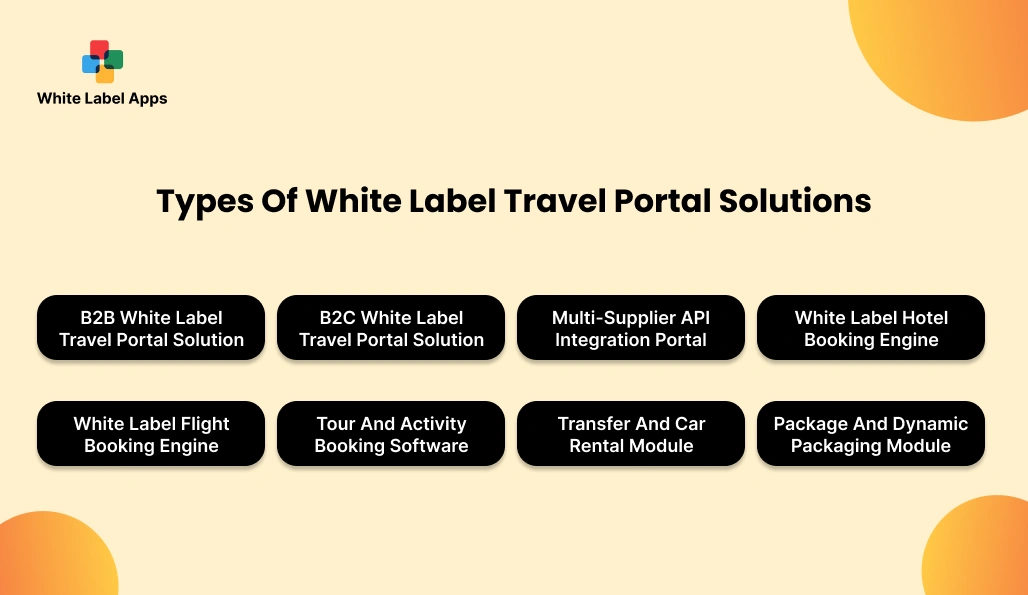
Not every travel business needs the same setup. Some sell to agents. Some sell straight to travelers. Some want only hotel bookings, while others need flights, transfers, tours, and packaged trips in one place. That is why white label travel portal development usually starts with choosing the right portal model first, not just adding random modules later.
1. B2B White Label Travel Portal Solution
A B2B portal is built for travel agents, sub-agents, resellers, and distribution partners. It gives each user the right login access, pricing rules, booking rights, and account visibility based on their role. This type of B2B travel portal works well for businesses that sell through agency networks and need better control over markups, commissions, credit limits, and partner bookings.
2. B2C White Label Travel Portal Solution
A B2C portal is meant for end customers who want to search, compare, and book travel online on their own. It is about a clean user journey, fast search, secure checkout, and simple booking experience on desktop and mobile. For brands that want a direct online sales channel, this type of white label travel website helps reduce dependence on third-party marketplaces.
3. Multi-Supplier API Integration Portal
Some travel businesses like to not depend on a sole supplier. A multi-supplier setup is one that pulls inventory from multiple sources via different APIs, aggregators or GDS sources, and then presents the best available options from each source on a single platform. This can help improve coverage, pricing flexibility, and availability, while providing the business an opportunity to compare multiple suppliers rather than being limited to a single feed.
4. White Label Hotel Booking Engine
A hotel-centric portal is one that is structured primarily around room inventory, rates, availability, filters (location, amenities, etc.), and reservation flow. This is best suited for a business that is looking to sell stays without having to add too many other travel products at the first go. A powerful white label hotel booking engine can be leveraged by agencies or travel brands looking to build a hotel-focused booking business, with a simpler rollout path.
5. White Label Flight Booking Engine
These portals require powerful search logic, filters (routes), fare visibility and real-time inventory updates. Flight booking portals are usually more complex than hotel-only systems, because flight pricing changes a lot faster, and booking conditions can vary widely across airlines. A flight-focused travel booking engine suits businesses that want air ticket sales as a core revenue stream, especially in a B2B setup.
6. Tour And Activity Booking Software
This portal supports the business requirements for selling sightseeing tours, local experiences, attraction tickets, and activity-based travel products. Ideal for operators working in the destination travel, vacation planning or experience-led packages space. It must be able to handle schedules, availability, pricing, and easy booking confirmation.
7. Transfer And Car Rental Module
A transfer and car rental module adds ground transport options to the portal. This can be airport pickup, chauffeur, intercity transfer or self drive. This helps travel businesses go beyond flight and hotel and provide a more holistic travel flow. For many portals, this module improves upsell potential because transport is often booked alongside the main trip.
8. Package And Dynamic Packaging Module
Some businesses want to sell complete travel plans instead of single services. Package module enables you to bundle hotels, flight, transfer and activities as one offer. While dynamic packaging goes further into allowing the system to create the combinations that are most suitable given the user’s search and availability. This is useful for travel brands that want higher order value and more control over bundled pricing.
Also Read : White Label Restaurant Software: Features, Integrations, And Reseller Tips
Key Features Of White Label Travel Portal Solutions
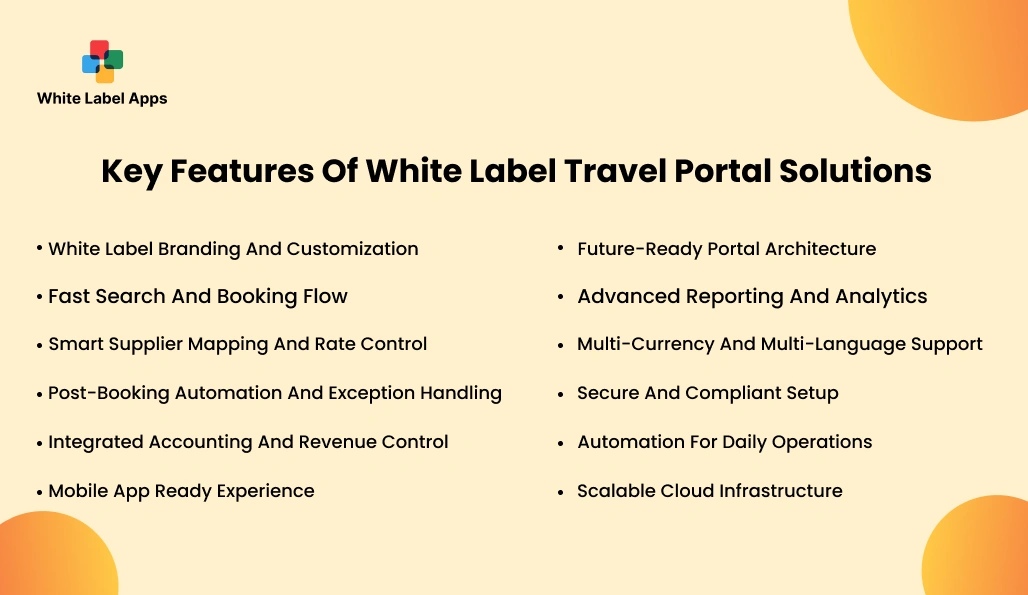
A good travel portal is not only about showing bookings on a screen. It should help the business sell better, manage suppliers more easily, control revenue, and give users a smooth booking experience. In white label travel portal development, the right feature set makes the difference between a portal that looks good and a portal that actually works well day to day.
1. White Label Branding And Customization
This feature lets the portal reflect your own business identity instead of looking like a generic reseller site. You can usually add your logo, domain, color theme, banners, content, email templates, and booking flow preferences. That matters because travel buyers trust brands they remember, and agents also want a platform that feels like their own business, not someone else’s software with a new name on top.
2. Fast Search And Booking Flow
Travellers don’t want to be on hold for slow searches, overwhelmed with filters or have to click too many times to checkout. A great portal should return results fast, allow users to compare and take them from search to confirmation without friction. And this is even more important if your portal is handling flight or hotel listings at scale, because latency impacts both trust and completion of booking.
3. Smart Supplier Mapping And Rate Control
A travel portal often pulls inventory from more than one source. Smart supplier mapping helps the system organize those feeds, show the right product, and reduce duplicate listings or confusing results. Rate control matters too, because businesses need to manage margins, compare supplier prices, and keep the most useful inventory visible instead of showing messy or inconsistent booking options.
4. Post-Booking Automation And Exception Handling
Booking is not over when the transaction is paid. A great portal should also handle confirmations, vouchers, amendments, cancellations, tracking of refunds and notifications in case of something going wrong. This feature helps travel teams spend less time fixing avoidable issues manually. It also improves the customer experience because post-booking communication stays clearer and more organized.
5. Integrated Accounting And Revenue Control
Travel businesses need more than booking visibility. They also need to track money properly. Integrated accounting and revenue controls help manage markups, commissions, taxes, invoices, payments, and partner settlements inside one system. This is a practical feature for agencies and OTAs because travel margins can get messy fast when finance tracking happens across separate tools or spreadsheets.
6. Mobile App Ready Experience
Today many users search and book on mobile not only on desktop. That’s why a portal should be built with mobile in mind. Some businesses also need support for mobile app for their customers, agents or both. This makes the white label solution more flexible, especially for brands that want stronger mobile engagement and repeat bookings.
7. Future-Ready Portal Architecture
Travel businesses don’t wait around. A portal can launch as hotels only and later on, launch flights, tours, transfers or corporate bookings. Future ready architecture means that your system doesn’t need a complete rebuild every time the business evolves. That’s important because travel growth often comes via new modules, new suppliers and new user types.
8. Advanced Reporting And Analytics
A portal should not leave the business guessing. Reporting features help track bookings, revenue, top-selling products, user activity, cancellation patterns, and supplier performance. These data give owners better control to manage pricing, inventory, promotions and channel strategy. Without reporting, even a high volume B2B travel engine can become difficult to improve because it never shows the truth.
9. Multi-Currency And Multi-Language Support
Travel businesses often sell across regions, not just in one market. Multi-currency support means that users can see and pay in the right currencies and multi-language support means that the portal is easier for different customer groups to use. This is especially important when targeting international travelers, overseas agents or multiple sales regions from a single travel booking engine.
10. Secure And Compliant Setup
Travel platforms handle personal details, payment data, and booking records, so security cannot be treated like an extra. A strong portal should support secure logins, safe payment processing, role-based access, and basic compliance practices based on the market and payment flow. This does not just protect the business. It also helps users feel safer while booking through the portal.
11. Automation For Daily Operations
Manual travel work adds up very quickly. Teams often deal with supplier checks, booking updates, pricing changes, user requests, and payment status follow-ups every day. Automation offloads that by executing repetitive tasks inside the platform. This means that businesses can work faster, drop human error and give their team more time to focus on sales, support and partner management.
12. Scalable Cloud Infrastructure
A travel portal should stay stable even when traffic grows, inventory expands, or booking volume rises during peak seasons. Scalable cloud infrastructure supports that growth by helping the platform handle more users, more searches, and more data without breaking the experience. In white label travel portal development, this is important because a portal should be built for both launch and long-term growth.
White Label Travel Portal Development Vs. Custom Travel Platform Development
Not every travel business needs a fully custom platform from day one. Some need faster launch, easier supplier setup, and lower development pressure at the start. That is where white label travel portal development usually makes more sense. It gives you an out of the box base with your branding and booking capabilities and custom development gives you depth of control, but requires more time, money and technical expertise.
| Point Of Comparison | White Label Travel Portal Development | Custom Travel Platform Development |
| Development Approach | Built on a ready platform and customized for your brand and business flow. | Built from scratch based on your exact product goals and workflows. |
| Launch Time | Faster to launch because the core system already exists. | Slower because every major module needs to be planned, designed, built, and tested. |
| Initial Cost | Usually lower at the start because you are not funding a full build from zero. | Usually higher because the product needs custom design, engineering, testing, and maintenance. |
| Branding Control | Strong branding options, but within the structure of the existing platform. | Full branding control across every part of the platform. |
| Feature Flexibility | Good for common travel business needs like bookings, pricing, and supplier management. | Better for businesses with unusual workflows, advanced rules, or product ideas that need custom logic. |
| Maintenance Burden | Lower because much of the core system is already managed or structured. | Higher because the business owns more technical complexity over time. |
| Scalability Path | Works well for many growing agencies, OTAs, and travel resellers. | Better for businesses that expect deep expansion, complex integrations, or unique long-term needs. |
| Best Fit | Travel agencies, startups, resellers, and businesses that want faster market entry. | Large travel brands, high-growth firms, or businesses with highly specific platform goals. |
Top Examples Of White Label Travel Portals
If you are researching white label travel portal development, these are some of the best-known names to study. They do not all work in the exact same way, but each one shows a different model of branded travel selling, supplier access, and booking support.
1. Expedia Group
Expedia Group is one of the strongest examples for businesses that want a branded, end-to-end travel booking experience backed by large travel supply. Its White Label Travel Platform is positioned as a full-service solution, not just a basic inventory feed.
Key Features
- Branded template site with your own logo and brand colors.
- End-to-end shopping, booking, and servicing experience.
- Access to large global inventory, including properties, airlines, and activities.
- Loyalty program support, including earn and redeem options.
- Single sign-on support for a smoother user journey.
- Full-funnel marketing and traffic growth support.
- Analytics tools to support smarter business decisions.
2. Trawex
Trawex is a practical example for agencies and travel businesses that want a broader booking setup across B2B and B2C models. Its official pages focus on live booking, admin control, markup flexibility, and payment support.
Key Features
- Real-time flight and hotel booking through GDS-integrated travel portal setup.
- Security-focused portal with direct GDS data visibility.
- User-friendly admin panel that does not require special training.
- Markup and convenience fee controls for admins and agents.
- Discount management for different agents.
- Promo code management from the admin side.
- Payment gateway integration for online transactions.
- Live chat support for feedback and queries.
3. Traveltek
Traveltek is a strong example for travel agents and OTAs that want a branded portal with broad travel inventory and supplier reach. Its white-label setup is built around rebranding, ready APIs, online booking convenience, and strong supplier access.
Key Features
- Bespoke branded booking platform for travel agencies.
- Pre-built portal with integrated travel provider APIs.
- Supports flights, hotels, transfers, packages, cruises, and rental cars.
- Custom rebrand setup using your domain, homepage theme, logo, and payment gateway details.
- Online financial transaction handling and business reports.
- Third-party API integration with real-time inventory, rates, and availability.
- Access to 300+ suppliers.
- Support for Sabre, Travelport, and Amadeus connections.
4. Amadeus
Amadeus is a little different from the others. It is not presented as a broad, standard white-label portal in the same way Expedia Group or Trawex are. But its Amadeus Hey! Mobile product is still a useful example in white label travel portal development, especially for agencies that want a branded mobile travel experience after booking.
Key Features
- Custom-branded mobile app for travel agencies.
- Real-time trip updates, itinerary access, and personalized recommendations.
- Organized mobile itinerary with flights, hotels, rental cars, and more in one timeline.
- Booking import and sync from Amadeus, plus support for other providers.
- Offline access to travel details.
- Push, SMS, and email notifications for delays, gate changes, check-in reminders, and weather updates.
- Cross-sell options for transfers, activities, restaurants, and lounges.
- Multi-language support and quarterly product updates handled by the Amadeus team.
Also Read : White-Label vs Custom-Built Food Delivery Apps: Which Is Best for Startups?
Core Technical Setup For White Label Travel Portal Development
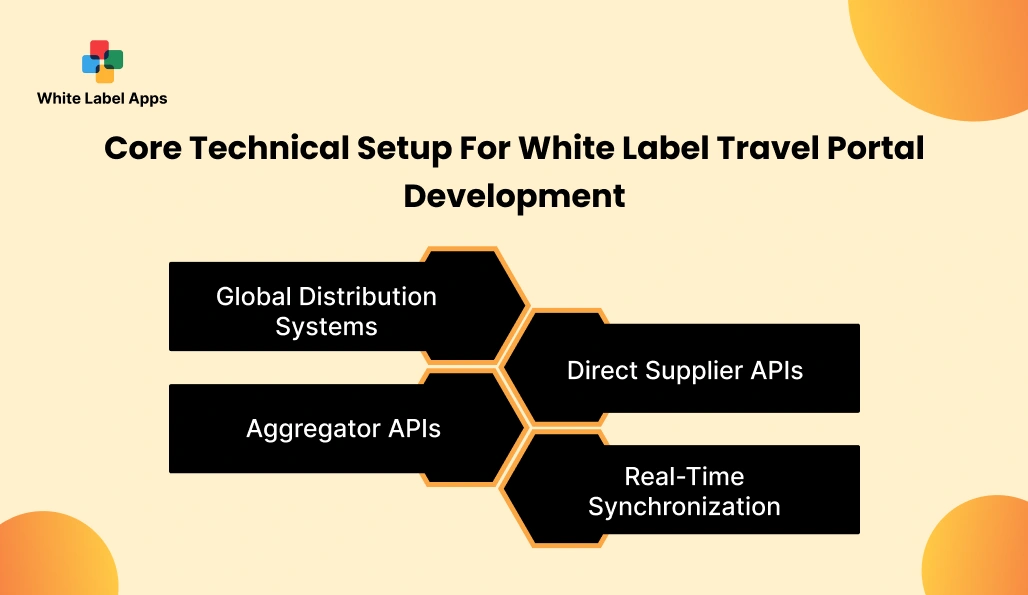
The technical side of white label travel portal development decides whether the platform feels smooth or frustrating. A branded front end is just the tip of the iceberg. All the real action takes place in the back end where the portal connects to travel inventory, pulls live prices, checks availability, books and keeps everything in sync. No matter how great the portal looks, without that foundation, it can die in the first search, checkout or post-booking change.
1. Global Distribution Systems
Global Distribution Systems help travel portals connect with large travel inventories through one structured network. These are often used for flights and other travel content that requires live pricing, seat or room availability and booking capabilities. In plain English, they allow the portal to scale into travel content instead of relying on manual supplier updates or isolated systems.
2. Direct Supplier APIs
Direct supplier APIs connect the portal straight to hotel providers, transfer companies, activity sellers, car rental services, or other travel suppliers. This setup can improve inventory depth and give the business better control over product coverage. It is also useful when the portal wants to focus on specific travel categories instead of depending only on broad distribution networks.
3. Aggregator APIs
Aggregator APIs act as a middle layer between the portal and multiple travel suppliers. Instead of building many separate integrations, the business connects through one aggregated source and pulls a wider set of travel products from there. This can reduce technical effort, speed up setup, and make supplier expansion easier later.
4. Real-Time Synchronization
Travel data changes quickly. Prices move, rooms sell out, flights change, and booking status can update in minutes. That is why real-time synchronization matters in white label travel portal development. The portal needs to keep the search results, availability, booking and post-booking changes in sync so your users don’t see stale rates or incorrect inventory.
Tech Stack We Use For White Label Travel Portal Development
A practical white label travel portal development stack should help the platform do three things well. It should be quick to load, handle live booking data and remain simple to scale as the products, users and supplier connections grow. In most cases, the architecture will include a front-end layer for the user experience, a back-end for booking logic and integrations, a database for core business data, a caching layer for speed, a payment layer for checkout, and a deployment layer for stability.
| Layer | Suggested Technology / Language | What It Handles |
| Front-End | HTML, CSS, JavaScript, TypeScript, React, Next.js | Search pages, listing pages, booking flow, login, dashboard screens, and portal UI. |
| Back-End | JavaScript, TypeScript, Node.js | Booking logic, supplier API calls, user actions, admin controls, and pricing rules. |
| Database | SQL, PostgreSQL | Stores users, bookings, payments, invoices, markups, and reports. |
| Cache And Sessions | Redis | Speeds up repeated searches, handles short-term data, and supports faster session management. |
| Payment Layer | Payment Gateway APIs | Connects checkout, payment confirmation, and booking completion. |
| Deployment | Docker | Helps package, deploy, and run the portal more consistently across environments. |
Average Cost Of White Label Travel Portal Development
The biggest cost difference comes from what you are building and how much you are building from zero. In white label travel portal development the core system is already developed, so the cost is typically allocated to rebranding, supplier onboarding, feature tweaking, payment integration and launch support. In custom development the business pays for product planning, UI design, backend architecture, booking logic, testing, integrations and ongoing maintenance from scratch. That is why white label is the practical option for businesses that want to launch quickly with lower spend, while custom builds are for those that want more control over features and can afford to spend more in the long term.
| Cost Area | White Label Travel Portal Development | Custom Development |
| Starting Budget | USD 5,000 to USD 10,000 for a basic setup. | USD 25,000+ for a custom platform, with complex builds going much higher. |
| Mid-Range Budget | USD 10,000 to USD 30,000 when you add stronger branding, more integrations, and business rules. | USD 50,000 to USD 150,000+ for a more serious travel platform with custom workflows. |
| Add-On Modules | Usually USD 3,000 to USD 5,000 per extra module, such as car rental, cruise, or bus booking. | Often higher because each extra module needs custom design, backend logic, testing, and integration work. |
How You Can Earn Money From A White Label Travel Portal?
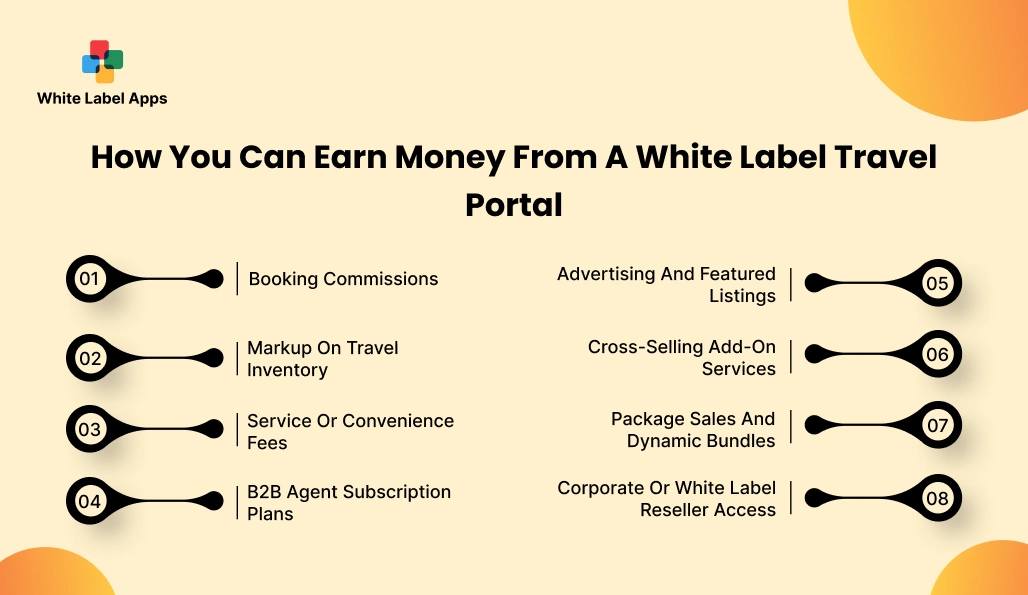
A travel portal should not only help people book trips. It should also help the business earn from different parts of the booking journey. That is one reason many companies choose white label travel portal development. It gives them more control over pricing, supplier markups, partner access, and add-on sales. Instead of depending on one income stream, the portal can earn from multiple services inside one booking flow.
1. Booking Commissions
The most popular revenue model is portal commission on every hotel, flight, transfer, tour or rental booking placed through the portal. The size of the commission depends on the contract with the supplier, and the type and value of the product. For many travel businesses, this becomes the base income stream that grows as booking volume increases.
2. Markup On Travel Inventory
The business can also choose to add a markup on the supplier rates before displaying the price to customers or agents. This provides more direct control over margins, especially for B2B sales. Although a small markup per booking may look like a small thing on the surface, when multiplied by the volume of transactions a portal can have, it can become a significant revenue stream.
3. Service Or Convenience Fees
Some portals charge a fixed service fee or convenience fee during checkout. It can help offset payment processing, support or platform costs, and works best when the fee is fully disclosed and not left out of the final price. In practice, it’s a simple way to increase the margin without renegotiating supplier contracts.
4. B2B Agent Subscription Plans
If the portal is also used by other travel businesses as a B2B travel solution, the portal can offer agent or sub-agent access for a monthly or yearly fee or a tiering of the subscription based on users, types of products, or volume of bookings. This can help shift the business model to have a more stable recurring revenue, and less volatility from the seasonal booking cycle.
5. Advertising And Featured Listings
Some portals generate revenue by offering hotels, tour operators, or destination partners paid visibility on the portal. This can be in the form of promoted listings, featured placement, homepage banner, or a placement in a campaign for a special offer. The portal needs to have an established audience and supplier network, as the visibility has value only when users are actively making travel plans.
6. Cross-Selling Add-On Services
A portal can earn more by selling related services during or after the main booking. This may include travel insurance, airport transfers, visa support, activities, lounge access, or rental cars. These add-ons increase order value without needing a new customer each time. In many cases, this is where a portal improves margins beyond the main hotel or flight booking.
7. Package Sales And Dynamic Bundles
Instead of selling one product at a time, the portal can combine hotels, flights, activities, and transfers into travel packages. These bundled offers often give the business more room to set pricing and improve margins. They also make the portal more useful to travelers who want a complete trip plan instead of booking each part separately.
8. Corporate Or White Label Reseller Access
Some businesses make money by offering portal access to other agencies, membership businesses or reseller partners via a branded or semi-branded model. The platform turns into a product rather than a channel and makes money not only from travelers but also from businesses that sell through it.
Also Read : What is White Label App Builder: What They Are & How To Use Them
How To Choose The Best White Label Travel Portal?
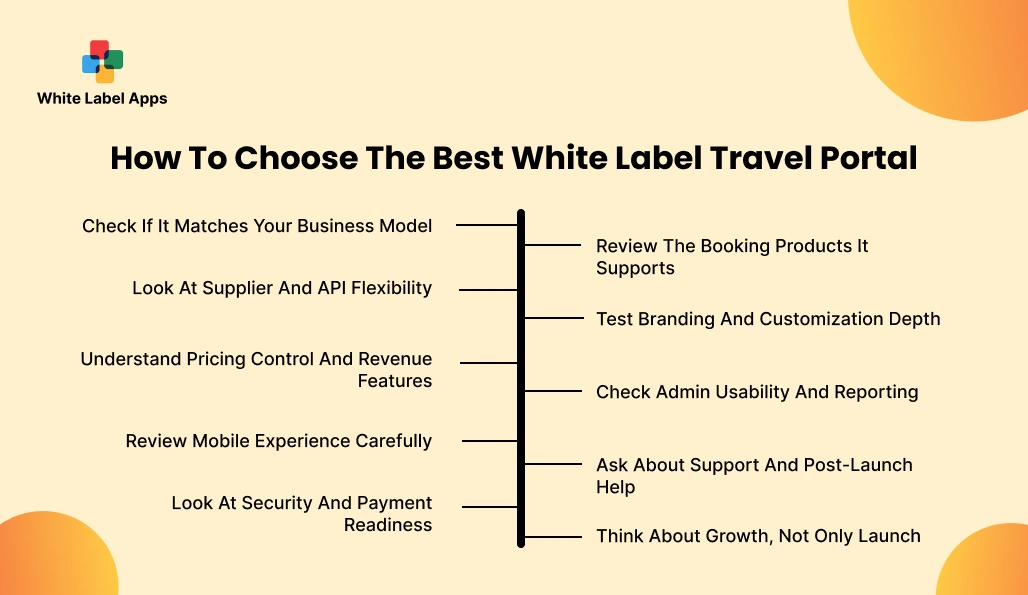
Picking the right portal is not necessarily about the biggest name; it is about the right product for your business model. A demo may look great but if the platform cannot support your products, your pricing rules, your supplier mix or your user flow, it will bring problems later on. That is why white label travel portal development should be evaluated like a business system, not just a website purchase.
1. Check If It Matches Your Business Model
Start with the basic question. Are you selling to agents, direct customers, corporate buyers, or all three. A portal built for B2C may not work well for a B2B setup with agent logins, markups, and credit control. The right fit depends on how you plan to sell travel every day.
2. Review The Booking Products It Supports
Some portals are stronger in hotels. Others are better at flights, transfers, tours, car rentals or dynamic packages. Before you decide, make sure the platform supports the products you’re going to sell right now and in the future.
3. Look At Supplier And API Flexibility
A portal should not trap you with weak inventory options. Check that it supports supplier APIs, aggregator feeds or GDS connections in a practical way. A better supply coverage often translates into better prices, better availability and fewer limits as your travel business expands.
4. Test Branding And Customization Depth
A portal should feel like your business, not like a generic template with your logo on top. Verify what you can really customize, like domain, homepage layout, colors, banners, content blocks, search flow, and email templates. Good branding control gives you stronger recall and a more credible customer experience.
5. Understand Pricing Control And Revenue Features
Do not stop at the demo screen. Ask about how the system handles markups, commissions, convenience fees, discounts, promo codes, or role based pricing. A portal can look pretty and still be a weak link in margin control. This is a real problem from the moment bookings start coming in.
6. Check Admin Usability And Reporting
Your team will be spending a lot of time in the backend, so your admin panel should be clean and simple. Verify booking management, cancellation handling, user roles, supplier settings, and reports. If your daily workflow is too much work, your portal will slow down your team instead of making them more efficient.
7. Review Mobile Experience Carefully
Many travel users search and book on phones, not only on desktops. So test the mobile flow with care. Check search speed, filters, traveler forms, payment steps, and confirmation screens. A weak mobile experience can quietly hurt conversion even when the desktop version looks fine.
8. Ask About Support And Post-Launch Help
Travel portals need updates, fixes, and integration support over time. Ask what happens after launch. Will you get technical help, onboarding support, bug fixes, or upgrade options. A portal is easier to trust when support is clear before the sale, not vague until something breaks.
9. Look At Security And Payment Readiness
The platform will be handling all of your traveler’s data, booking information and online payments, so the fundamentals must be strong. Verify login security, role based access, payment gateway options, and how booking confirmations or refunds are handled. Not the most fun, but it’s important.
10. Think About Growth, Not Only Launch
A portal may work fine for launch and still become limiting after six months. Check whether it can support more users, more suppliers, more products, and more markets over time. The best choice is not only the portal that helps you go live fast. It is the one that still makes sense when your business gets bigger.
How We Approach White Label Travel Portal Development?
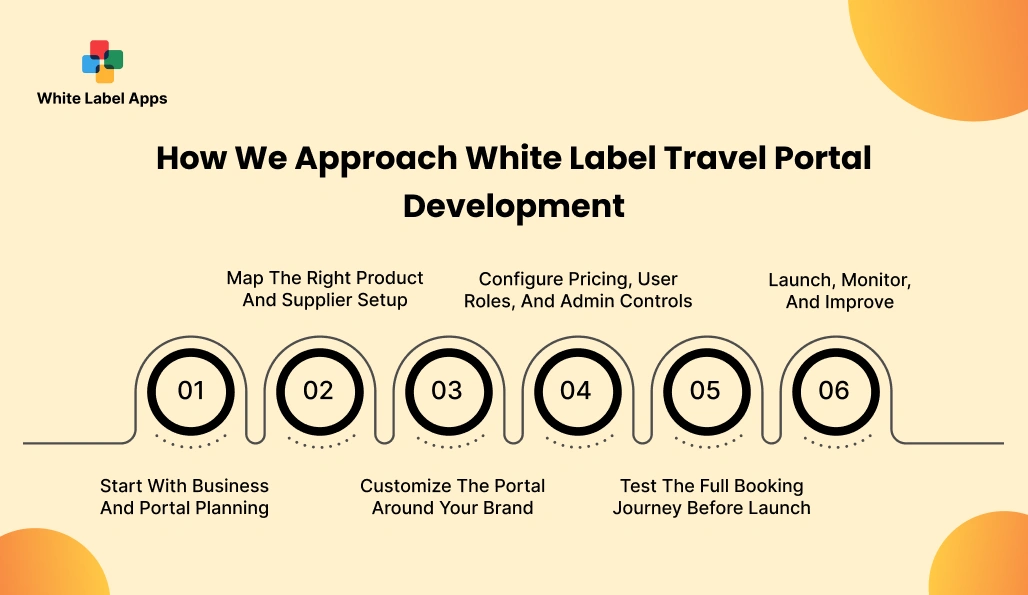
This part is different from how the portal works on the backend. Here, the focus is on how we handle the project from planning to launch. A good white label travel portal development process should keep the build clear, reduce rework, and make sure the portal fits the way your travel business actually sells. That means we do not start with design screens first. We start with your business model, products, suppliers, and revenue plan.
1. Start With Business And Portal Planning
We first understand who the portal is for and how you plan to sell. Some businesses want a B2B model for agents and sub-agents. Some want a direct customer portal. Some need both. At this stage, we define the booking products, user roles, pricing structure, supplier needs, and core features, so the portal is shaped around the business, not the other way around.
2. Map The Right Product And Supplier Setup
Once the business model is clear, we map the modules and integration needs. This includes deciding whether the portal needs hotels, flights, transfers, tours, car rentals, or package booking support. We also plan the supplier connection layer, because inventory depth and booking reliability depend heavily on how the portal is connected behind the scenes.
3. Customize The Portal Around Your Brand
After the base structure is ready, we shape the portal around your brand identity. All of that, from logo placement, domain set up, design direction, first screen, search flow, content blocks and user screens. All of that is to make the portal feel like you and your business from the first click, not like a generic template travel with cosmetic edits.
4. Configure Pricing, User Roles, And Admin Controls
A travel portal needs more than front-end design. It also needs working business logic. We configure markups, commissions, convenience fees, discounts, user permissions, booking access and admin controls based on your sales model. Why this matters is a portal can look great and not work well if the pricing flow or backend control is lacking.
5. Test The Full Booking Journey Before Launch
Before the portal goes live, we test the full journey carefully. That includes search flow, filters, availability checks, traveler forms, checkout, booking confirmation, admin actions, and basic exception scenarios. In travel, even small issues can create booking friction fast. That is why proper testing matters before traffic starts coming in.
6. Launch, Monitor, And Improve
Launch is not the end of the job. Once the portal goes live, the next phase of the job begins, watching it perform and making improvements that matter. That could be adding more suppliers, improving reports, making booking flow smoother, adjusting pricing logic and logic or adding new modules. A good white label travel portal development process should support growth after launch, not stop at deployment.
Also Read : Why Becoming a White Label Restaurant Ordering Software Reseller Makes Sense
Future Trends In White Label Travel Technology
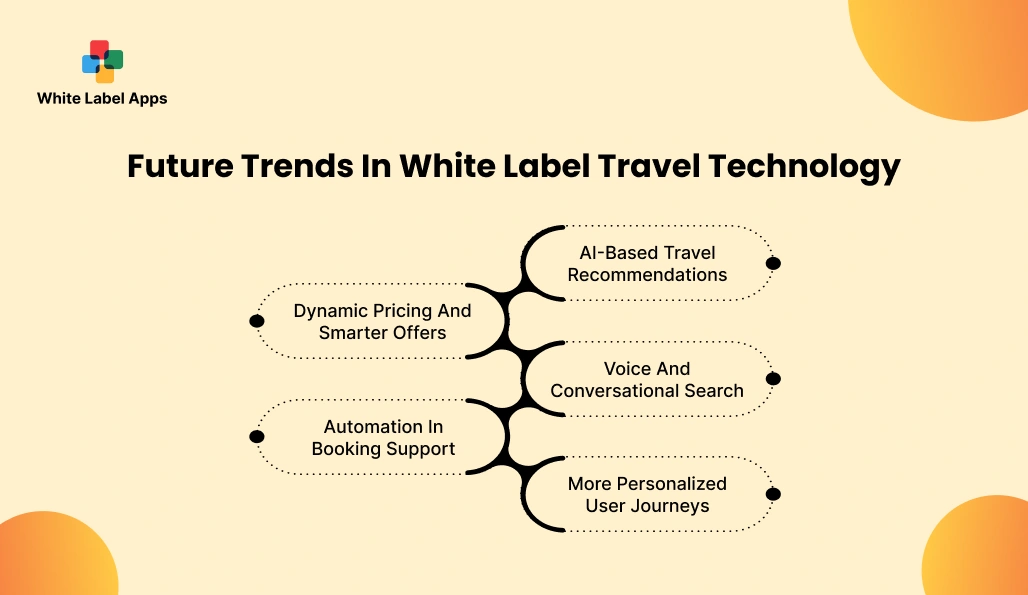
Travel platforms are changing fast. Users now expect quicker search, more relevant results, smoother booking journeys, and less manual effort. That matters for white label travel portal development because a portal now needs to do more than show listings. It needs to help users decide faster and book with less friction.
1. AI-Based Travel Recommendations
Travel portals are heading toward smarter, more relevant stays, routes, add-ons and packages, based on user behavior, trip type, travel history and booking preferences. Instead of giving up all options to all users, your system can surface stays, routes, add-ons and packages that match the user better. This makes the booking experience feel more useful and can also improve conversions.
2. Dynamic Pricing And Smarter Offers
Pricing is becoming more flexible and more context-driven. Portals are starting to use demand signals, customer behavior, booking patterns, and bundled offers to show better pricing options. For travel businesses, this can help protect margins, improve upsell opportunities, and create offers that feel more relevant to different customer groups.
3. Voice And Conversational Search
Search is becoming more natural. Many users now prefer to type or speak the way they normally ask questions, instead of using stiff search terms. This means future travel portals may need to support conversational search, voice input, and simpler discovery flows, especially for users booking on mobile devices.
4. Automation In Booking Support
Travel technology is also moving toward stronger automation after the booking is made. This includes confirmation updates, reminder messages, cancellation handling, refund tracking, and support alerts. For portal owners, this can reduce manual work and make the user experience feel more reliable when plans change.
5. More Personalized User Journeys
Future portals will likely become more personalized across the full journey, not only at search. That includes saved preferences, tailored offers, relevant add-ons, location-based suggestions, and clearer account experiences. This kind of personalization can help travel businesses improve repeat usage and keep the portal more useful over time.
White Label Ready Travel Portal Solutions We Can Rebrand For You
1. Evox
Evox is a travel portal built to make daily and long-distance travel easier from one place. Users can book local rides, rent vehicles, and manage longer journeys without jumping between different apps or websites. The platform is designed to keep travel planning simple, whether someone needs a quick city ride or tickets for flights, buses, ferries, or trains. It gives businesses a practical way to offer multiple travel services through one connected portal.
Core Features
- Ride Booking for quick local travel.
- Vehicle Rental for flexible short-term or long-term use.
- Flight Ticketing for long-distance air travel.
- Bus Ticketing for intercity and regional trips.
- Ferry Ticketing for water-based travel routes.
- Train Ticketing for convenient rail travel.
2. Ylore
Ylore is a travel portal built for people who want to explore on their own terms. It helps users discover self-guided tours, nearby points of interest, and ready-made itineraries without depending on group tours or fixed schedules. The platform makes travel planning easier with multimedia tour content, custom itinerary tools, offline access, and location-based storytelling that unlocks as users move through a destination. It also gives creators a simple way to build and share their own tours with friends, followers, or the wider community.
Core Features
- Self-Guided Tours for flexible travel at your own pace.
- Multimedia Tour Content with video, photos, text, and audio support.
- Geo-Fenced Tour Unlocks that reveal stories as users reach each location.
- Points of Interest Discovery for local insights and nearby highlights.
- Custom Itinerary Planning to organize tours and places in one trip plan.
- AI-Powered Audio with text-to-speech in different voice and language options.
- Translation Support for easier travel across different regions.
- Offline Mode so users can download tours before they go.
- Dynamic Navigation with route support for walking, biking, or driving.
- Tour And POI Creation tools for users, creators, and influencers.
- Private And Public Sharing options for tours and travel recommendations.
- Travel Hub And Safety Content with useful destination and preparedness information.
Also Read : White Label App Marketplace: How Businesses Launch Apps Faster Without Building From Scratch
Why Travel Agencies Choose Us For White Label Travel Portal Development?
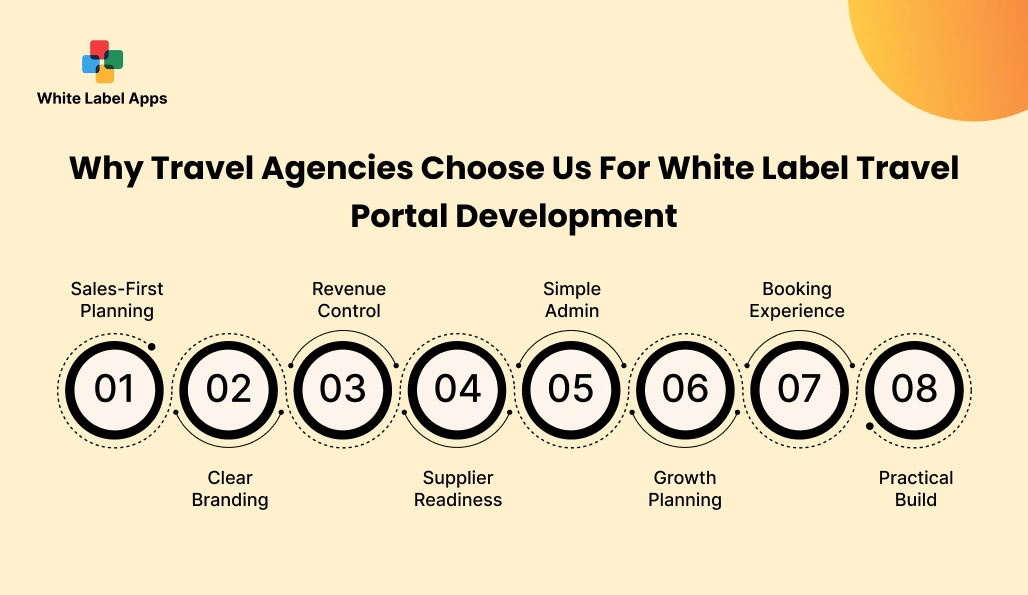
Travel agencies usually do not need more software noise. They need a portal that helps them sell, manage bookings, control margins, and grow without adding more daily confusion. That is where our approach stays practical. In white label travel portal development, the focus stays on the parts that affect real business use, not just the look of the platform.
1. Sales-First Planning
The first step is understanding whether the portal is meant for direct customers, agents, sub-agents, or a mixed setup. That helps shape user roles, pricing logic, booking access, and admin flow in a way that matches how the business actually works.
2. Clear Branding
A portal should feel like your travel business, not like a reused template with a new logo. The branded experience should stay consistent across the homepage, search flow, booking journey, and account areas.
3. Revenue Control
Travel businesses need more than bookings. They need margin visibility too. Markups, commissions, convenience fees, discounts, and partner pricing should be set up in a way that supports daily commercial control.
4. Supplier Readiness
A portal is only as strong as the booking setup behind it. Early planning for supplier connections, pricing updates, and booking consistency helps the platform stay more useful and easier to manage later.
5. Simple Admin
The backend should help the team move faster, not create extra clicks. Booking review, pricing control, user access, and reporting should feel easy enough to manage every day.
6. Growth Planning
Many travel businesses start with one service, then expand into more products, more suppliers, or more markets. The portal should be planned in a way that supports that growth without forcing a full rebuild too early.
7. Booking Experience
Search, filters, traveler details, payment, confirmation, and post-booking actions all shape user trust. Even small friction points in this journey can affect bookings and repeat use.
8. Practical Build
The goal is not to overcomplicate the platform. It is to create something branded, manageable, and commercially useful in real business conditions.
Conclusion
A travel business does not always need to start with a full custom build. In many cases, white label travel portal development is the more practical path because it helps you launch faster, control your branding, manage bookings more easily, and enter the market with lower upfront pressure. It gives you a working base, but still leaves room to shape the platform around your products, pricing model, and user flow.
The real value comes when the portal is built around business use, not just visual design. It should support live inventory, smooth booking, clear admin control, flexible pricing, and room to grow as your travel business expands. When those parts are planned properly, a white label portal becomes more than a booking site. It becomes a stronger sales and operations system for long-term travel growth.
If you want a partner that understands both the business side and the platform side, WhiteLabelApps can help. We build travel portals that are easier to brand, easier to manage, and easier to scale as your booking business grows. Whether you need a B2B setup, a customer-facing portal, or a mixed model, our team focuses on building a solution that supports real travel operations, not just a good-looking launch.
Frequently Asked Questions
1. What Is White Label Travel Portal Development?
White label travel portal development is the process of developing a branded travel booking portal on top of a pre-existing system rather than building everything from scratch. Your business has its own logo and design and a domain, booking flow and admin access, but the underlying travel technology is already there.
2. What Is The Cost Of White Label Travel Portal Development?
Costs vary depending on the number of booking modules, level of supplier integration, level of customisation, admin features and support. In most cases, white label development will be cheaper than custom development as there is already a base platform to build upon, but the final cost will depend on how much you want to customise.
3. Who Can Use A White Label Travel Portal?
It can be a good fit for travel agents, start-ups, OTAs, tour operators, corporate travel sellers and reseller networks. The ideal configuration will depend on your customers, whether you are targeting direct customers, B2B agents, or both.
4. What Is The Difference Between API-Only Access And A White Label Travel Portal?
API-only access gives you access to the raw travel inventory, but you still need to build the front end, booking flow, admin system and business logic on top of that. A white label portal gives you a pre-existing platform with some of that work already in place, so you tend to launch quicker.
5. Can A White Label Travel Portal Support Both B2B And B2C Models?
Yes, many portals can support both models if the platform is planned that way from the start. This usually means separate user roles, pricing rules, login access, booking permissions, and admin controls for agents and end customers.

whitelabelapp
Related Articles
White Label Personal Training App Development: Launch Your Branded Fitness App Faster
Your day is full of small fitness tasks. A client asks for the plan again. Another forgets to pay. Someone says the video link is not opening. It all happens on WhatsApp, notes, and screenshots, and it gets messy fast. A white label personal training app helps you put workouts, check-ins, payments, and progress in […]
Read More
Top 15 White Label Reseller Programs That Deliver Big Profits in 2026
If you have ever tried reselling services, you know the truth. The pitch is easy. Delivery is where most resellers bleed time and profit. That is why this list is not based on “popular names” or random directories. We did deep research before writing this blog. We reviewed reseller program pages, service menus, white label […]
Read More